

Medical Rubber and Balloon Product Market Size, Share, Growth, Report 2026 to 2035
 Status Published
 Category Healthcare


Content
Medical Rubber and Balloon Product Market Size and Growth 2026 to 2035
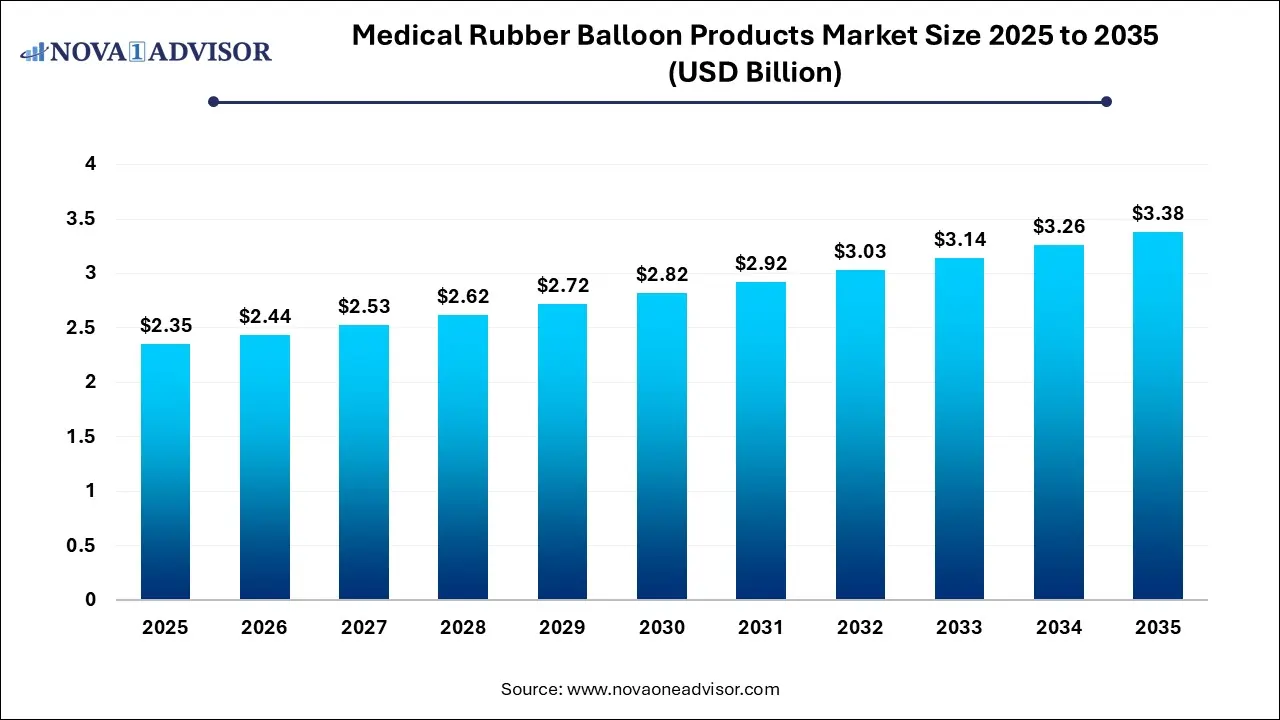
The global medical rubber and balloon product market size was estimated at USD 2.35 billion in 2025 and is projected to hit around USD 3.38 billion by 2035, growing at a CAGR of 3.7% during the forecast period from 2026 to 2035.
Market Overview
The medical rubber and balloon product market forms an essential component of the broader medical devices industry. Medical rubber products are widely utilized across hospitals, diagnostic laboratories, surgical centers, and home healthcare settings because of their flexibility, durability, sealing capabilities, and biocompatibility. Balloon products, particularly medical-grade balloons and catheters, are increasingly important in minimally invasive procedures including angioplasty, gastrointestinal dilation, urinary drainage, and embolization therapies.
The market includes a diverse range of products such as natural rubber latex gloves, medical balloons, catheters, condoms, drainage tubes, sealing products, and other rubber-based medical accessories. These products are used in diagnostics, therapeutics, industrial medical manufacturing, and specialized healthcare applications. Demand continues to grow due to the rising prevalence of cardiovascular disorders, diabetes, urological diseases, and chronic respiratory conditions that require catheterization and minimally invasive intervention procedures.
The expansion of global healthcare infrastructure is significantly contributing to the adoption of medical rubber and balloon products. Hospitals are increasing investments in advanced surgical equipment and disposable medical consumables to improve infection prevention and patient outcomes. Medical balloons are particularly critical in interventional cardiology, where balloon angioplasty procedures have become standard treatment for coronary artery disease. For example, drug-coated balloons and specialty angioplasty balloons are increasingly replacing conventional open surgeries in several healthcare systems.
Another important growth factor is the increasing aging population. Elderly patients are more susceptible to chronic illnesses requiring long-term catheterization, therapeutic drainage, and cardiovascular interventions. Foley catheters, balloon catheters, and drainage systems therefore continue to witness rising demand globally. Furthermore, increasing healthcare awareness and access to reproductive healthcare products are supporting demand for medical-grade condoms and related rubber products.
Medical rubber products also play an important role in laboratory diagnostics and pharmaceutical manufacturing. Rubber stoppers, tubing systems, and sealing products are widely used in drug packaging and sterile medical environments. The growth of biopharmaceutical manufacturing and vaccine production has further accelerated demand for high-quality medical elastomers and rubber components.
However, the market is also facing challenges related to latex allergies, environmental sustainability, and strict regulatory standards. Manufacturers are increasingly focusing on synthetic latex alternatives, biodegradable materials, and advanced polymer technologies to address these concerns. The transition toward sustainable healthcare consumables is expected to create long-term transformation across the industry.
Overall, the medical rubber and balloon product market is expected to experience stable and long-term growth due to expanding therapeutic applications, technological innovation, and rising healthcare investments worldwide.
Market Outlook
- Market Growth Overview: The global medical rubber and balloon product market is expected to grow significantly between 2025 and 2035, driven by the rise in minimally invasive procedures, aging global population, and increasing healthcare expenditure.
- Sustainability Trends: Sustainability trends involve eco-friendly materials, circular economy practices, and energy-efficient manufacturing.
- Major Investors: Major investors in the market include Boston Scientific, Medtronic, Abbott Laboratories, B. Braun Melsungen AG, and Teleflex Incorporated.
How is AI Transforming the Medical Rubber and Balloon Product Market
Artificial intelligence is gradually transforming the medical rubber and balloon product market by improving manufacturing efficiency, product precision, predictive quality management, and patient-specific treatment planning. AI-driven systems are increasingly integrated into production facilities to optimize manufacturing consistency and reduce defects in balloon catheters and rubber-based medical devices.
One of the most significant applications of AI is predictive quality control. Medical balloons and catheters require extremely high dimensional accuracy because even minor manufacturing inconsistencies can impact patient safety. AI-powered machine vision systems can identify microscopic defects, irregular wall thickness, pinholes, or surface abnormalities during production. This significantly reduces product recalls and improves compliance with stringent medical regulations.
AI is also enhancing supply chain and inventory management for medical consumables. Hospitals and manufacturers use machine learning algorithms to forecast demand for catheters, surgical balloons, and disposable rubber products. Predictive analytics helps manufacturers maintain optimized inventory levels and avoid shortages during healthcare emergencies.
In interventional medicine, AI-assisted imaging and robotic navigation systems are improving the effectiveness of balloon-based procedures. During angioplasty, AI-integrated imaging systems can help physicians determine optimal balloon sizing, placement, and inflation pressure. This improves procedural accuracy and reduces complications. AI-guided catheter navigation is also increasingly explored in neurovascular and cardiovascular procedures.
Manufacturers are further utilizing AI for predictive maintenance of manufacturing equipment. Production downtime can significantly affect medical device supply chains. AI systems can analyze equipment performance data and predict maintenance needs before failures occur, thereby improving operational efficiency.
Another emerging trend is personalized medical balloon design. AI algorithms can analyze patient anatomy using imaging data and assist in designing patient-specific balloon catheters or therapeutic devices. This can improve treatment outcomes in complex cardiovascular or gastrointestinal interventions.
Furthermore, AI supports research and development by accelerating material innovation. Advanced simulations powered by AI help researchers identify biocompatible rubber compounds with improved elasticity, durability, and chemical resistance. These innovations are particularly important in developing hypoallergenic and sustainable medical rubber alternatives.
Overall, AI is becoming a strategic tool that enhances manufacturing precision, procedural outcomes, supply chain efficiency, and product innovation within the medical rubber and balloon product market.
Medical Rubber and Balloon Product Market Report Scope
| Report Coverage | Details |
| Market Size in 2026 | USD 2.44 Billion |
| Market Size by 2035 | USD 3.38 Billion |
| Growth Rate From 2026 to 2035 | CAGR of 3.7% |
| Base Year | 2025 |
| Forecast Period | 2026 to 2035 |
| Segments Covered | By Type,By Application, By Region |
| Market Analysis (Terms Used) | Value (USD Million/Billion) or (Volume/Units) |
| Regional Scope | North America; Europe; Asia Pacific; Central and South America; the Middle East and Africa |
| Key Companies Profiled | Abbott Laboratories (U.S.), Adventa Berhad (Malaysia), AngioDynamics, Inc. (U.S.), Ansell Healthcare (Australia), Arrow International (New Zealand), Astra Tech, Inc. (U.S.), B. Braun Melsungen AG (Germany), Cardinal Health, Inc. (U.S.), Hartalega Holdings Berhad (Malaysia), Church & Dwight Co, Inc. (U.S.), Latexx Partners Berhad (Malaysia), Reckitt Benckiser Group (U.K), and others. |
Segmental Insights
By Type
How did the natural rubber latex segment dominate the Global Medical Rubber and Balloon Product market?
The natural rubber latex segment is driven by its exceptional elasticity and high tactile sensitivity, making it indispensable for precision surgeries and high-pressure balloon inflation. The natural composition provides an eco-friendly, biodegradable profile that perfectly aligns with modern corporate sustainability initiatives and green manufacturing shifts.
How did the catheters segment expect to hold the fastest-growing Global Medical Rubber and Balloon Product market in the coming years?
The catheters segment is driven by the shift toward minimally invasive cardiovascular and urological procedures, which heavily favour high-precision dual and twin-balloon designs. To maximize patient comfort, manufacturers are aggressively replacing legacy plastics with highly biocompatible, thermosensitive materials like polyurethane and high-performance latex or silicone to drastically reduce friction.
By Application
How did the diagnostics segment dominate the Global Medical Rubber and Balloon Product market?
The diagnostics segment is driven by the high-volume consumables, where diagnostic tools, examination gloves, and single-use tubing require continuous replacement to generate a highly predictable, recurring revenue system. The rapid expansion of in-vitro diagnostics and point-of-care testing kits relies heavily on these advanced polymer components to ensure high-precision fluid transport and accurate sample collection across diverse clinical environments.
How did the therapeutics segment expect to hold the fastest-growing Global Medical Rubber and Balloon Product market in the coming years?
The therapeutics segment is driven by leading original equipment manufacturers that are securing a strong market edge by executing strategic collaborations with contract manufacturers to design and scale these complex combination drug-delivery systems cost-effectively. To maximize patient outcomes, manufacturers are aggressively transitioning away from legacy materials and toward eco-friendly silicones and high-performance polymers that offer superior elasticity and mechanical compliance.
By Regional
How did the North America region account for the largest share in the Global Medical Rubber and Balloon Product market?
North America is driven by the high prevalence of cardiovascular and peripheral arterial diseases within an aging population, driving massive regional demand for precision catheter and angioplasty balloons. The advanced clinical infrastructure, offering extensive access to state-of-the-art ambulatory facilities and specialized diagnostic centres, ensures steady product consumption.
U.S. Global Medical Rubber and Balloon Product Market Trends
The U.S. shift toward minimally invasive surgeries is driving high-volume demand for advanced neurovascular, cardiovascular, and urological catheters. The transition away from traditional materials toward high-biocompatibility silicone and polyurethane, alongside a pronounced cardiology shift toward specialized drug-coated balloons that eliminate permanent metal implants.
How did the Asia-Pacific region become the fastest-growing Global Medical Rubber and Balloon Product Market during the forecast period?
Asia Pacific’s rapid construction of modern healthcare facilities and a massive, aging demographic across nations, such as China and Japan, are battling chronic cardiovascular diseases. The strong regional shift toward minimally invasive techniques is creating an immense, high-volume demand for specialized rubber balloon catheters and polymer consumables.
China Global Medical Rubber and Balloon Product Market Trends
China’s strong upward valuation is heavily accelerated by a major clinical shift toward minimally invasive procedures across cardiology, gastroenterology, and urology, which significantly increases the volume usage of specialized rubber catheters. The high-performance material innovations with scalable manufacturing workflows will remain the primary driver for boosting procedural success and securing long-term market dominance.
Key Players in the Global Medical Rubber and Balloon Product Market
- Abbott Laboratories
Abbott is a major market leader in cardiovascular technology, producing highly engineered balloon catheters and stents used in coronary and peripheral interventions. Their continuous innovation in minimally invasive medical devices significantly enhances patient outcomes and accelerates recovery times.
- Adventa Berhad
Adventa supplies essential medical rubber products, serving as a prominent manufacturer and distributor of high-quality surgical and examination gloves. Through its subsidiaries, the company provides critical hospital disposables to global healthcare institutions, ensuring infection control and safety for medical personnel.
- AngioDynamics, Inc.
AngioDynamics contributes advanced medical devices, specializing in minimally invasive technologies for vascular access and oncology. Their comprehensive portfolio of specialized catheters and fluid management devices elevates the standard of care in diagnostic and therapeutic procedures worldwide.
Segments Covered in the Report
This report forecasts revenue growth at country levels and provides an analysis of the latest industry trends in each of the sub-segments from 2021 to 2035. For this study, Nova one advisor, Inc. has medical rubber and balloon product market.
By Type
- Natural Rubber Latex
- Catheters
- Balloons
- Condoms
- Others
By Application
- Diagnostics
- Therapeutics
- Industrial
- Others
By Region
- North America
- Europe
- Asia Pacific
- Latin America
- Middle East and Africa (MEA)
FAQ's

Proceed to Buy
Instant PDF delivery on confirmation

Medical Rubber and Balloon Product Market Size to Hit USD 3.38 Billion by 2035
 Request Customization
 Download Sample

Get a Sample of this Report
Medical Rubber and Balloon Product Market