

Particle Counter Market (By Type; By End User; By Application) - Global Industry Analysis, Share, Growth, Regional Outlook And Forecasts, 2026-2035
 Status Published
 Category Healthcare


Content
Particle Counter Market Size, Growth and Trends 2026 to 2035
The global particle counter market size was estimated at USD 684.70 million in 2025 and is expected to reach USD 1,696.85 million by 2035, growing at a CAGR of 9.5% from 2025 to 2035.
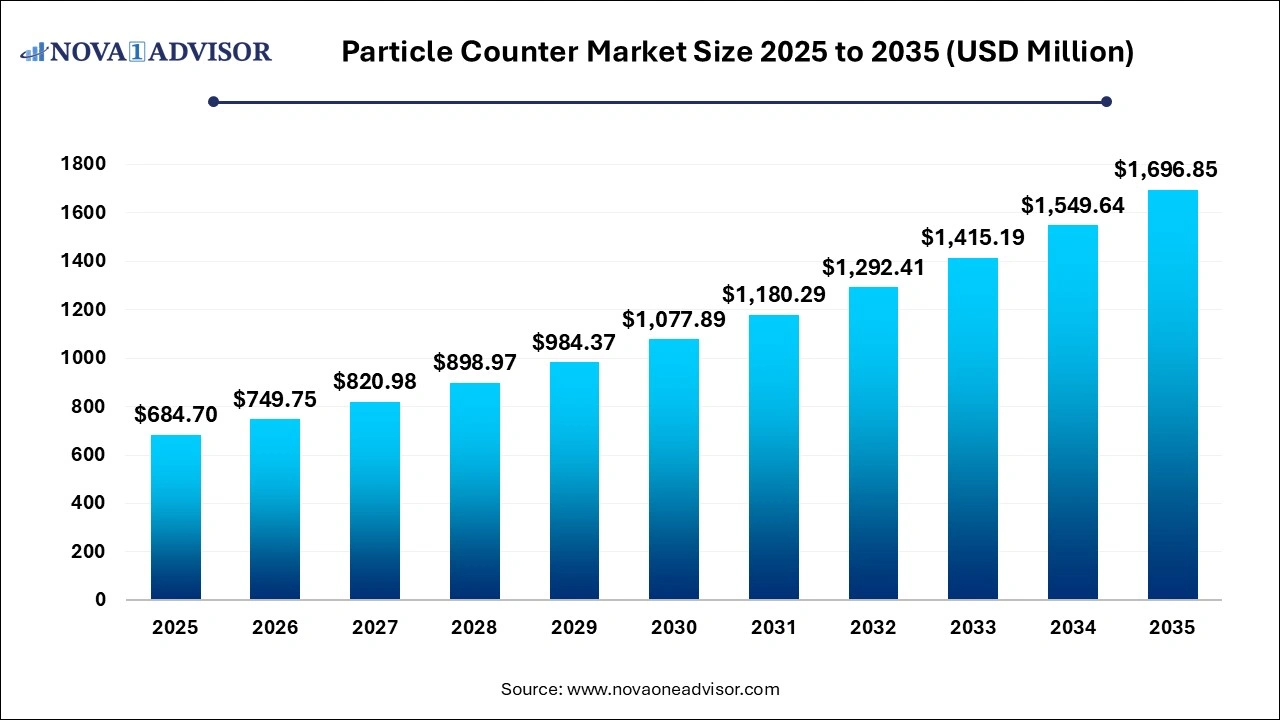
Particle Counter Market Outlook
- Market Growth Overview: The particle counter market is expected to grow significantly between 2026 and 2035, driven by the growing pharmaceutical and biotech sectors, increased demand for cleanroom spaces in pharmaceutical healthcare, high-tech electronic manufacturing drive demand, and advancement in automated monitoring.
- Sustainability Trends: Sustainability trends involve real-time monitoring and IoT integration, energy-efficient and compact devices, and green cleanroom technology.
- Major Investors: Major investors in the market include Beckman Coulter (Danaher Corporation), TSI Inc., Spectris Plc, Rion Co., Ltd., and Lighthouse Worldwide Solutions.
COVID-19 Impact Assessment on Market Landscape
The report comprises the scrutiny of COVID-19 lock-down impact on the income of market leaders, disrupters and followers. Since lock down was instigated differently in diverse regions and nations, influence of same is also dissimilar across various industry verticals. The research report offers present short-term and long-term influence on the market to assist market participants across value chain makers to formulate the framework for short term and long-lasting tactics for recovery and by region.
Particle Counter market report empower readers with all-inclusive market intelligence and offers a granular outline of the market they are operational in. Further this research study delivers exceptional combination of tangible perceptions and qualitative scrutiny to aid companies accomplishes sustainable growth. This report employs industry-leading research practices and tools to assemble all-inclusive market studies, intermingled with pertinent data. Additionally, this report also emphases on the competitive examination of crucial players by analyzing their product portfolio, pricing, gross margins, financial position, growth approaches, and regional occurrence.
Particle Counter Market Report Scope
| Report Coverage | Details |
| Market Size in 2025 | USD 749.75 Million |
| Market Size by 2036 | USD 1,696.85 Million |
| Growth Rate From 2026 to 2035 | CAGR of 9.5% |
| Base Year | 2025 |
| Forecast Period | 2026 to 2035 |
| Segments Covered | By Type, By End User, By Application |
| Market Analysis (Terms Used) | Value (USD Million/Billion) or (Volume/Units) |
| Regional Scope | North America; Europe; Asia Pacific; Central and South America; the Middle East and Africa |
| Key Companies Profiled | Particle Measuring Systems, Beckman Coulter, Rion Co., Ltd, Lighthouse Worldwide Solutions |
Particle Counter Market Regional Insights
By Type Insights
How did the airborne particle counters segment dominate the Particle Counter market?
The airborne particle counters segment is driven by its critical role in maintaining a sterile environment for the pharmaceutical and semiconductor industries. Strict compliance with global standards, such as ISO 16644 and GMP, necessitates the use of these calibrated sensors to prevent catastrophic financial losses from microscopic contamination. The technological advancement in handheld and portable devices provides real-time data and automated alerts. The high demand for cleanroom monitoring and indoor air quality tracking ensures this segment remains the primary revenue driver.
How did the liquid particle counters segment expect to hold the fastest-growing Particle Counter market in the coming years?
The liquid particle counters segment is driven by the semiconductor industry’s need for high-purity chemicals and the pharmaceutical sector's strict safety standards for injectable drugs. Technological innovations in automated, real-time detection are replacing manual testing, significantly improving monitoring efficiency. The rapid industrialization and cleanroom investment in the Asia-Pacific region are accelerating the global adoption of these specialized devices.
By Application Insights
How did the cleanroom monitoring segment account for the largest share in the Particle Counter market?
The cleanroom monitoring segment is driven by the absolute necessity of meeting stringent ISO 14644 and GMP standards in aseptic zones. High-growth sections, such as semiconductors and pharmaceuticals, rely on these systems for real-time contamination control to mitigate the risk of high-value product failures. The rise of IoT-enabled and automated counters that allow for continuous, connected surveillance of ultra-pure environments. The integration of these devices into smart manufacturing workflows ensures they remain the primary revenue driver for the global contamination control industry.
How did the drinking water contamination monitoring segment expect to hold the fastest-growing Particle Counter market in the coming years?
The drinking water contamination monitoring segment is driven by the increasing regulatory pressure from bodies, such as the EPA. Water treatment facilities are rapidly adopting online and inline counters to provide real-time verification of membrane filtration and reverse osmosis efficiency. The integration of these devices' maintenance ensures constant safety against microorganisms and debris. The rising public health concerns over water pollution are driving massive global investment in these automated, high-precision monitoring solutions.
By End User Insights
How did the life science and medical device industry segment account for the notable share in the Particle Counter market?
The life science and medical devices industry segment is driven by the strategic integration of these tools into aseptic production lines ensures this segment remains the primary revenue driver for global contamination control. The rise in biotechnology research and complex drug formulations has further increased the demand for advanced, portable counting solutions for on-site validation.
How did the semiconductor industry segment expect to hold the fastest-growing Particle Counter market in the coming years?
The semiconductor industry segment is driven by the AI infrastructure boom, which has triggered massive investment in advanced cleanrooms and constant contamination control. The demand for liquid particle counters in ultrapure water systems is also surging to reduce defects in high-performance computing components. The supportive manufacturing laws in Asia and the move toward automated, real-time IoT monitoring are cementing the semiconductor sector's rapid expansion.
Key Players in the Particle Counter Market
- Particle Measuring Systems: As the leading innovator, they invented laser particle counting technology and offer comprehensive contamination monitoring solutions for air and liquids, boasting over 60 patents. They dominate the market by providing advanced data analysis for yield protection in strict regulatory industries.
- Beckman Coulter: They contribute significantly through their specialized expertise in utilizing the Coulter Principle (impedance measurements) for high-precision particle counting and sizing. Their instruments are crucial for both liquid-based contamination control and scientific research, ensuring robust cellular and particle analysis.
- Rion Co., Ltd.: As the first to develop airborne particle counters in Japan, they provide highly reliable particle measurement instruments for the pharmaceutical and semiconductor industries.
- Lighthouse Worldwide Solutions: They are a premier manufacturer of real-time air and liquid contamination monitoring systems, specializing in ultra-low level detection for nanotechnology and high-end semiconductors.
Unravelling the Critical Segments
This research report offers market revenue, sales volume, production assessment and prognoses by classifying it on the basis of various aspects including product type, application/end-user, and region. Further, this research study investigates market size, production, consumption and its development trends at global, regional, and country level for period 2017 to 2027 and covers subsequent region in its scope:
By Type
- Airborne Particle Counters
- Portable
- Remote
- Handheld
- Condensation/Ultrafine
- Liquid Particle Counters
- Online/Inline
- Offline
By Application
- Cleanroom Monitoring
- Drinking Water Contamination Monitoring
- Aerosol Monitoring and Research
- Indoor Air Quality Monitoring
- Contamination Monitoring of Liquids
- Chemical Contamination Monitoring
- Other Applications
By End User
- Life Sciences & Medical Device Industry
- Semiconductor Industry
- Automotive Industry
- Aerospace Industry
- Food & Beverage Industry
- Other End Users
By Region
- North America
- U.S.
- Canada
- Europe
- Germany
- France
- United Kingdom
- Rest of Europe
- Asia Pacific
- China
- Japan
- India
- Southeast Asia
- Rest of Asia Pacific
- Latin America
- Brazil
- Rest of Latin America
- Middle East & Africa (MEA)
- GCC
- North Africa
- South Africa
- Rest of Middle East & Africa

Proceed to Buy
Instant PDF delivery on confirmation

Particle Counter Market Size to Worth Around USD 1,696.85 Mn by 2035
 Request Customization
 Download Sample

Get a Sample of this Report
Particle Counter Market