

Particle Size Analysis Market (By Technology; By End-User: By By Dispersion Type) - Global Industry Analysis, Share, Growth, Regional Outlook And Forecasts, 2026-2035
 Status Published
 Category Healthcare


Content
Particle Size Analysis Market Size, Growth and Trends 2026 to 2035
The global particle size analysis market size was valued at USD 501.13 million in 2026 and is expected to exceed around USD 897.44 million by 2035, with a CAGR of 6% from 2026 to 2035.
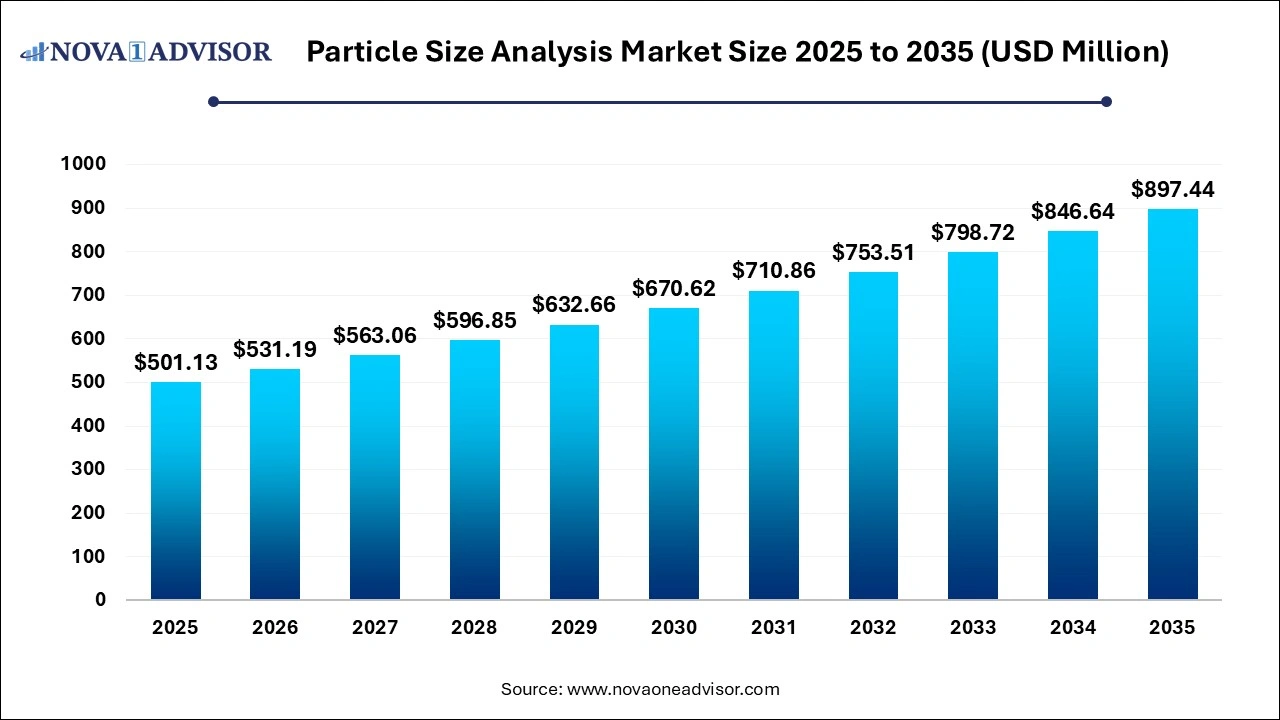
Particle Size Analysis Market Outlook
- Market Growth Overview: The particle size analysis market is expected to grow significantly between 2026 and 2035, driven by the growing nanotechnology research, stringent regulatory standards, advancement in technology, and growth in pharmaceutical and biotech firms.
- Sustainability Trends: Sustainability trends involve eco-friendly and energy-efficient analyzers, reduced solvent consumption, and on-line-real-time analysis.
- Major Investors: Major investors in the market include Malvern Panalytical (Spectris), HORIBA, Anton Paar, Beckman Coulter (Danaher), and Micromeritics.
Particle Size Analysis Market Report Scope
| Report Coverage | Details |
| Market Size in 2026 | USD 531.19 Million |
| Market Size by 2035 | USD 897.44 Million |
| Growth Rate From 2026 to 2035 | CAGR of 6% |
| Base Year | 2025 |
| Forecast Period | 2026 to 2035 |
| Market Analysis (Terms Used) | Value (USD Million/Billion) or (Volume/Units) |
| Segments Covered | By Technology, By Dispersion Type, By End Use |
| Regional Scope | North America; Europe; Asia Pacific; Central and South America; the Middle East and Africa |
| Key Companies Profiled | Malvern Panalytical, HORIBA, Beckman Coulter, MICROTRAC MRB, Izon Science |
Particle Size Analysis Market Segmental Insights
By Technology Insights
How did the laser diffraction segment dominate the Particle Size Analysis market?
The laser diffraction segment is driven by exceptional versatility and speed, enabling rapid measurement across a wide range from nanometres to millimetres. Its standard, validated by ISO 13320, makes it the preferred choice for meeting strict pharmaceutical regulatory requirements. Continuous technological advancement, such as automated costs and integrated data software, has significantly reduced operational costs and training barriers. Its broad application across food safety, mining, and material research ensures its continued leadership in particle size analysis.
How did the nanoparticle tracking analysis segment expect to hold the fastest-growing Particle Size Analysis market in the coming years?
The nanoparticle tracking analysis segment is driven by tracking individual particles, offering deeper insights into polydisperse samples than traditional methods. Its adoption has surged with the biopharmaceutical boom, where it is critical for characterizing mRNA vaccines, viral vectors, and protein aggregates. NTA has become essential in EV battery R&D for ensuring the uniformity of next-generation sulphide electrolytes. As regulatory bodies like the FDA and EMA increasingly mandate high-precision data for nanotechnology, NTA is solidifying its role as the gold standard for sub-micron characterization.
By Dispersion Type Insights
How did the wet dispersion segment account for the largest share in the Particle Size Analysis Market?
The wet dispersion segment is driven by the superior precision and ability to effectively de-agglomerate fine particles for stable, repeatable results. It is the preferred method for the pharmaceutical and food industries, where analysing emulsions and suspensions requires maintaining strict sample integrity. The surge in nanotechnology research has further cemented its role, as liquid-based carriers are essential for characterizing advanced nanoparticles.
How did the dry dispersion segment expect to hold the fastest-growing Particle Size Analysis market in the coming years?
The dry dispersion segment is driven by it maintains sample integrity by testing powders in their natural states without altering their physical properties. Its high-speed measurement capabilities make it ideal for high-throughput production environments in the mining, cement, and cosmetic industries. The increasingly favoured method for evaluating powder flowability and blending characteristics, which are critical for pharmaceutical manufacturing efficiency.
By End Use Industry Insights
How did the life healthcare segment account for the notable share in the Particle Size Analysis market?
The life science and medical devices industry segment is driven by the rise of specialized drug delivery systems, such as lipid nanoparticles and aerosols, which require exacting sub-micro measurements. The industry’s heavy investment in research and development and generic bioequivalence testing ensures its position as the largest revenue-generating end-user. Stringent FDA mandates for batch-to-batch consistency and stability force manufacturers to adopt high-precision analytical techniques like laser diffraction.
How did the chemicals and petroleum segment expect to hold the fastest-growing Particle Size Analysis market in the coming years?
The chemicals and petroleum segment is driven by the rapid expansion of nanotechnology in advanced catalysts and polymers. High-precision tools like NTA have become essential for optimizing petrochemical yields, such as reducing cobalt catalyst sizes to improve hydrocarbon production. Precise particle characterization also enables superior process optimization, directly enhancing flowability and reducing production costs through better quality control.
Key Players in the Particle Size Analysis Market
- Malvern Panalytical: As a market leader, Malvern Panalytical drives the industry with laser diffraction (Mastersizer series) and dynamic light scattering (Zetasizer) technologies, providing comprehensive particle characterization from sub-nanometer to millimeter sizes.
- HORIBA: HORIBA provides highly accurate particle characterization tools using laser diffraction, DLS, and image analysis, covering a vast range from below 1 nanometer to 30 millimeters.
- Beckman Coulter: Beckman Coulter pioneered the Coulter Principle (electrical resistance technology), which provides high-resolution particle counting and sizing that is independent of particle characteristics like refractive index.
- MICROTRAC MRB: Microtrac MRB, part of Verder Scientific, offers a unique combination of laser diffraction and dynamic image analysis (CAMSIZER series) to simultaneously measure particle size and shape.
- Izon Science: Izon Science specializes in nanopore-based technology, specifically through their TRPS (Tunable Resistive Pulse Sensing) instruments, to precisely measure the size, concentration, and charge of individual nanoparticles.
Unravelling the Critical Segments
This research report offers market revenue, sales volume, production assessment and prognoses by classifying it on the basis of various aspects including product type, application/end-user, and region. Further, this research study investigates market size, production, consumption and its development trends at global, regional, and country level for period 2017 to 2027 and covers subsequent region in its scope:
By Technology
- Laser Diffraction
- Dynamic Light Scattering
- Imaging
- Dynamic Imaging
- Static Imaging
- Atomic Spectroscopy
- Coulter Principle
- Nanoparticle Tracking Analysis (NTA)
- Other Technologies
By Dispersion Type
- Wet Dispersion
- Dry Dispersion
- Spray Dispersion
By End-use Industry
- Healthcare Industry
- Pharmaceutical & Biotechnology Companies
- Public & Private Institutions
- Academic Institutions
- Chemicals & Petroleum Industry
- Mining, Minerals, & Cement Industry
- Food & Beverage Industry
- Other Industries
By Region
- North America
- U.S.
- Canada
- Europe
- Germany
- France
- United Kingdom
- Rest of Europe
- Asia Pacific
- China
- Japan
- India
- Southeast Asia
- Rest of Asia Pacific
- Latin America
- Brazil
- Rest of Latin America
- Middle East & Africa (MEA)
- GCC
- North Africa
- South Africa
- Rest of Middle East & Africa

Proceed to Buy
Instant PDF delivery on confirmation

Particle Size Analysis Market Size to Worth Around USD 897.44 Bn by 2035
 Request Customization
 Download Sample

Get a Sample of this Report
Particle Size Analysis Market