

Transcatheter Embolization and Occlusion Devices Market Size, Share, Forecast Report, 2026-2035
 Status Published
 Category Healthcare


Content
Transcatheter Embolization and Occlusion Devices Market Size, Growth and Trends 2026 to 2035
The global transcatheter embolization and occlusion devices market size was estimated at USD 6.33 billion in 2025 and is expected to reach USD 12.14 billion by 2035, growing at a CAGR of 7.5% from 2025 to 2035.
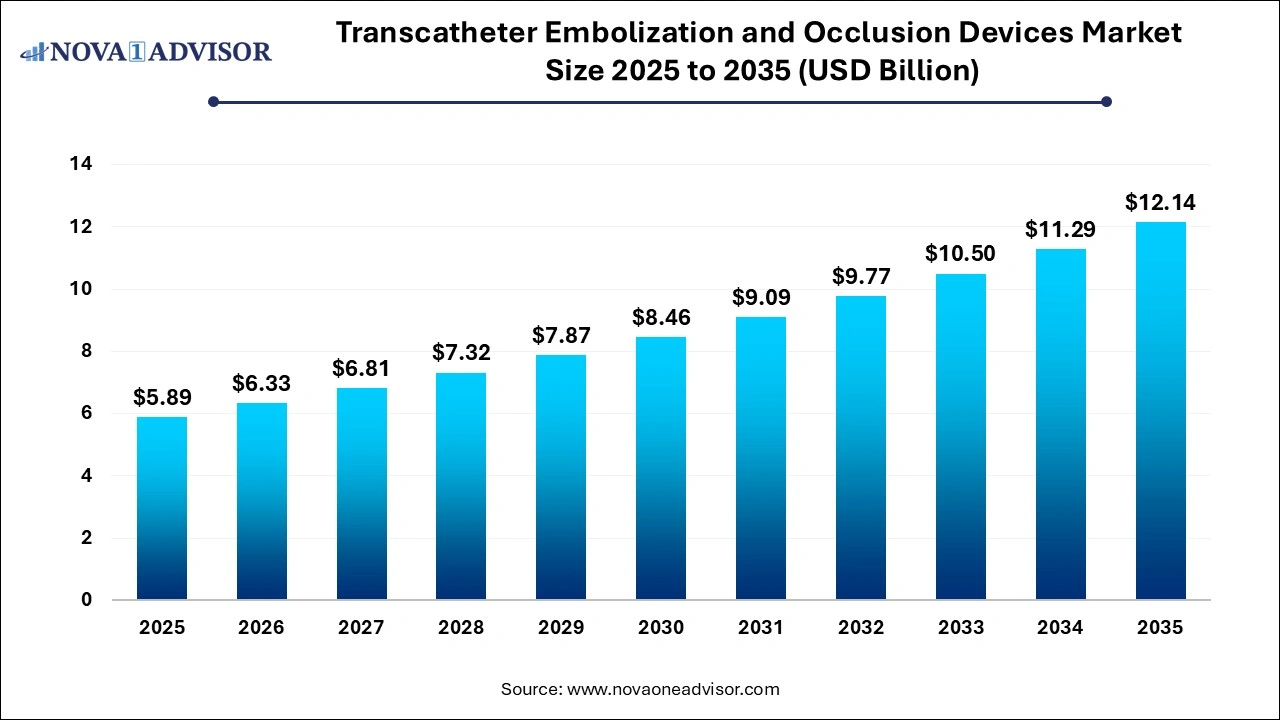
Transcatheter Embolization and Occlusion Devices Market Outlook
- Market Growth Overview: The transcatheter embolization and occlusion devices market is expected to grow significantly between 2026 and 2035, driven by the rising prevalence of chronic diseases, the shift toward minimally invasive procedures, and increasing use in emergencies.
- Sustainability Trends: Sustainability trends involve eco-responsible design, biodegradable and biocompatible materials, and improved manufacturing and safety.
- Major Investors: Major investors in the market include Boston Scientific Corporation, Medtronic, Stryker Corporation, Abbott Laboratories, and Terumo Corporation.
Transcatheter Embolization and Occlusion Devices Market Report Scope
| Report Coverage | Details |
| Market Size in 2026 | USD 6.33 Billion |
| Market Size by 2035 | USD 12.14 Billion |
| Growth Rate From 2026 to 2035 | CAGR of 7.5% |
| Base Year | 2025 |
| Forecast Period | 2026 to 2035 |
| Segments Covered | By Product, By Application, By End-user |
| Market Analysis (Terms Used) | Value (USD Million/Billion) or (Volume/Units) |
| Regional Scope | North America; Europe; Asia Pacific; Central and South America; the Middle East and Africa |
| Key Companies Profiled | BTG plc, Boston Scientific Corporation, Penumbra, Inc, Cook Medical |
Transcatheter Embolization and Occlusion Devices Market Segmental Insights
By Product Insights
How did the Non-coil Devices Segment Dominate the Transcatheter Embolization and Occlusion Devices Market?
The Non-coil devices segment is driven by the critical role in interventional oncology, particularly for TACE procedures, which ensures high demand as cancer cases rise globally. The continuous technological innovations from industry leaders are enhancing clinical outcomes and procedural safety. These advancements are driving non-coil devices to outpace traditional coils as the fastest-growing segment in the industry.
How did the Liquid Embolic Segment Expect to Hold the Fastest-Growing Transcatheter Embolization and Occlusion Devices Market in the Coming Years?
The liquid embolic segment is driven by the superior efficacy of liquid embolic agents in treating complex neurovascular conditions and hypervascular tumors, which is establishing them as a market leader. This dominance is reinforced by technological innovations in radiopaque and non-adhesive polymers that ensure safer, more controlled vascular occlusion. The global shift toward minimally invasive outpatient procedures in an aging population is significantly accelerating adoption.
By Application Insights
How did the Oncology Segment Account for the Largest Share in the Transcatheter Embolization and Occlusion Devices Market?
The oncology segment is driven by the rising global cancer burden, and the high efficacy of targeted therapies like TACE is establishing oncology as the dominant application for embolization devices. The shift toward minimally invasive interventional radiology further drives this growth by offering lower complication rates and faster recovery times than traditional surgery. Additionally, the development of specialized materials like drug-eluting beads ensures more precise tumor targeting and improved patient outcomes.
By End-user Insights
How did the Hospitals Segment Account for the Largest Share in the Transcatheter Embolization and Occlusion Devices Market?
The hospitals segment is driven by its unique capacity for high-risk, complex interventions like TACE and neurovascular surgeries. Their specialized infrastructure, including hybrid operating rooms and intensive care, remains essential for managing the rising volume of chronic vascular and oncological cases. Furthermore, as primary adopters of advanced technologies like drug-eluting beads, hospitals attract the specialized staff necessary for sophisticated device deployment.
How did the Ambulatory Surgical Centers Segment Expect to Hold the Fastest-Growing Transcatheter Embolization and Occlusion Devices Market in the Coming Years?
The ambulatory surgical center segment is driven by their superior cost-efficiency and the growing preference for minimally invasive outpatient care. This transition is further enabled by technological leaps in miniaturized delivery systems and AI-assisted imaging, which allow complex interventions to be performed safely outside traditional hospitals. The rise of specialized clinics tailored to neurovascular and oncology services is rapidly expanding patient access.
Key Players in the Transcatheter Embolization and Occlusion Devices Market
- BTG plc: BTG revolutionized the oncology segment by introducing innovative drug-eluting beads, such as DC Bead™, for targeted chemoembolization to treat liver cancer.
- Boston Scientific Corporation: Boston Scientific contributes to the market with a comprehensive portfolio, including the EMBOLD Fibered Detachable Coil and Interlock™ Fibered IDC™ Occlusion System for peripheral vascular embolization.
- Medtronic plc: Medtronic maintains a strong market position with the Amplatzer™ Vascular Plug portfolio, which offers controlled, precise occlusion for peripheral and neurovascular conditions.
- Penumbra, Inc.: Penumbra contributes with a distinct embolization platform, featuring the Ruby® Coil and POD® (Penumbra Occlusion Device), designed for high-density packing in peripheral aneurysms and malformations.
- Cook Medical: Cook Medical offers a wide array of embolization solutions, including various coils and plugs specifically designed for vascular embolization in interventional radiology.
Transcatheter Embolization and Occlusion Devices Market into Segments and Sub-Segments in Bullet points:
By Product
- Coil Devices
- Non-coil Devices
- Vascular Plugs
- Occlusion Devices
- Liquid Embolic Agents
- Radiopaque Polymers
- Non-adhesive Polymers
- Others
- Embolic Microspheres
- Drug-Eluting Beads
By Application
- Oncology
- TACE (Transarterial Chemoembolization)
- Tumor Embolization
- Cardiovascular
- Peripheral Vascular Occlusion
- Neurovascular Procedures
- Others
- Arteriovenous Malformation (AVM) Treatment
- Gastrointestinal Bleeding Management
By End-User
- Hospitals
- General Hospitals
- Specialty Hospitals
- Ambulatory Surgical Centers (ASCs)
- Oncology-focused Centers
- Neurovascular-focused Centers
- Others
- Diagnostic & Interventional Clinics
By Region
- North America
- Europe
- Asia Pacific
- Central and South America
- Middle East & Africa

Proceed to Buy
Instant PDF delivery on confirmation

Transcatheter Embolization and Occlusion Devices Market Size to Worth Around U...
 Request Customization
 Download Sample

Get a Sample of this Report
Transcatheter Embolization and Occlusion Devices Market