

U.S. Cath Labs Market Size, Share & Trends Analysis Report By Component (Services, Equipment), By Facility Type (Independent Labs, Hospital-based Labs)- Industry Analysis, Size, Share, Growth, Trends, and Forecast 2026-2035
 Status Published
 Category Healthcare


Content
U.S. Cath Labs Market Size, Growth, Trends 2026 to 2035
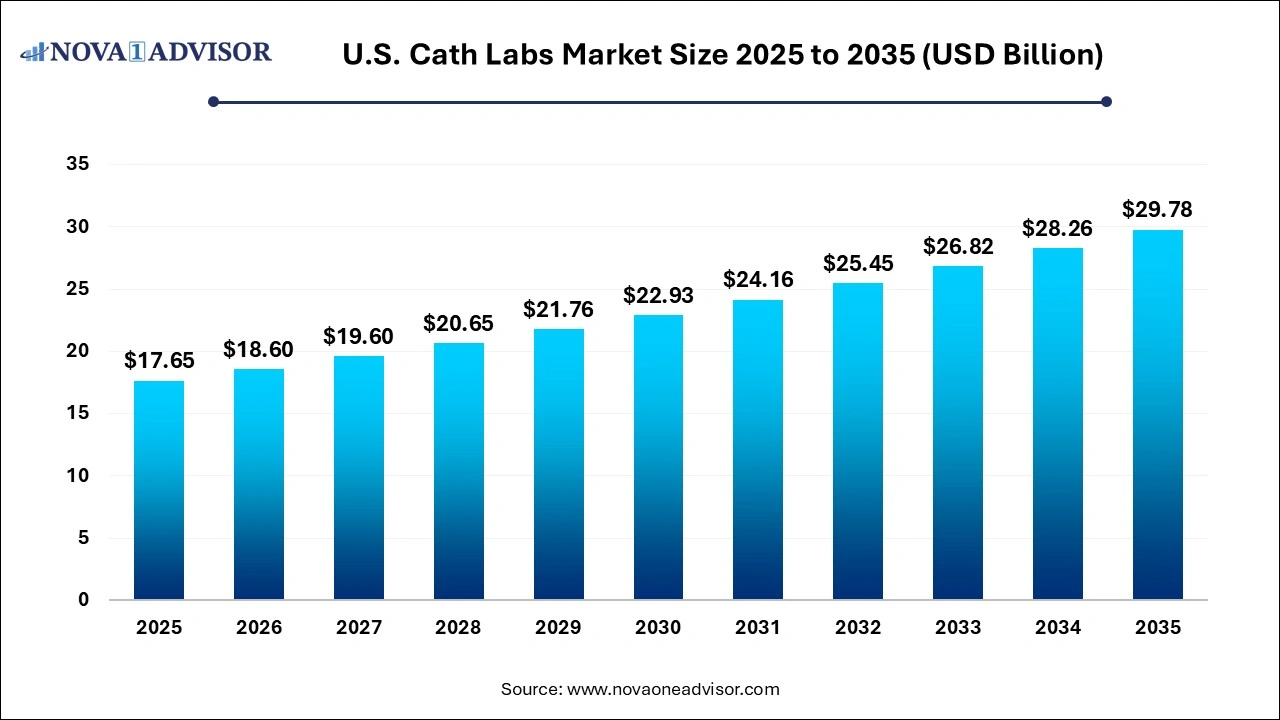
The U.S. cath labs market size valued at USD 17.65 billion in 2025 and is projected to hit USD 29.78 billion by 2035, growing at a CAGR of 5.37% from 2026 to 2035. The U.S. cath labs market is driven by the expansion of minimally invasive procedures, favorable CMS reimbursement and site-of-service shift, and rising geriatric demographics.
Key Takeaways:
- By component, the equipment segment held a dominant position in the market with a share of 40.00% in 2025.
- By component, the medical devices segment is the fastest growing between 2026 and 2035.
- By facility type, the hospital-based labs segment held a dominant position in the market with a share of 70.00% in 2025.
- By facility type, the independent labs segment is the fastest growing between 2026 and 2035.
U.S. Cath Labs Market Overview
The U.S. catheterization laboratories (Cath Labs) market is a dynamic and integral segment of the country’s cardiovascular care landscape. Cath Labs serve as specialized hospital rooms equipped with diagnostic imaging equipment used to visualize the arteries and chambers of the heart, and treat any stenosis or abnormality found. These facilities are crucial for conducting both diagnostic and therapeutic procedures, especially for patients suffering from coronary artery disease, heart failure, and structural heart disorders. The U.S. healthcare system, known for its rapid adoption of advanced medical technologies, has played a pivotal role in driving the sophistication and expansion of Cath Labs nationwide.
As heart disease remains the leading cause of death in the United States, the demand for advanced cardiovascular interventions continues to grow. Consequently, the number of cardiac catheterization procedures, including angioplasty, stent placements, and electrophysiological studies, is increasing across the country. Furthermore, innovations in imaging technologies, minimally invasive surgeries, and integration of artificial intelligence (AI) in diagnostics have enhanced the precision and safety of procedures performed in Cath Labs. The U.S. Cath Labs market is further propelled by government initiatives, private investments, and the continuous development of infrastructure in both independent and hospital-based settings.
With increasing emphasis on early detection of cardiovascular conditions, diagnostic services in Cath Labs have also seen a significant uptick. The rise in outpatient procedures and the growing preference for minimally invasive techniques are reshaping how Cath Labs operate, focusing on reducing hospital stays and improving patient outcomes. At the same time, healthcare providers are investing heavily in upgrading equipment and expanding services to meet the surge in demand and regulatory requirements.
U.S. Cath Labs Market Trends
- Structural Pivot to Ambulatory Surgical Centers (ASCs)
The recent favorable Medicare coverage, more catheterization and ablation procedures are moving out of traditional hospitals and into outpatient settings. This decentralization lowers healthcare costs and allows for quicker recovery times, resulting in a surge of ASC-focused cardiovascular investments.
- Capital Investment in Hybrid Cath Labs
Healthcare facilities are heavily transitioning to hybrid cath labs that seamlessly merge advanced imaging systems with surgical theaters. This allows multidisciplinary teams to perform complex, combined procedures (such as cardiology and neurology interventions) in a single room without moving the patient.
- Increased Preference For Radial Access and Same-Day Discharge
Interventional cardiologists are steadily shifting toward transradial (wrist) access rather than transfemoral (groin) access for coronary interventions. This technique significantly reduces bleeding complications and vascular issues, making same-day discharge programs viable and highly popular.
Key AI Integration in the U.S. Cath Labs Market
AI and ML are enhancing procedural precision and diagnostic accuracy during complex cardiac interventions. By automating real-time image analysis, AI algorithms assist cardiologists in precisely locating blockages, optimizing stent placement, and reducing radiation exposure. Additionally, predictive analytics streamline workflows and support real-time decision-making, ultimately improving patient outcomes. As facilities increasingly adopt these advanced software solutions, AI integration is becoming an economic necessity to maintain market competitiveness and meet rigorous payer quality standards.
Report Scope of The U.S. Cath Labs Market
| Report Coverage | Details |
| Market Size in 2026 | USD 18.60 Billion |
| Market Size by 2035 | USD 29.78 Billion |
| Growth Rate From 2026 to 2035 | CAGR of 5.37% |
| Base Year | 2025 |
| Forecast Period | 2026-2035 |
| Segments Covered | Component, Facility Type |
| Market Analysis (Terms Used) | Value (USD Million/Billion) or (Volume/Units) |
| Regional Scope | U.S. |
| Key Companies Profiled | Koninklijke Philips N.V.; Shimadzu Corporation; GE Healthcare; Johnson & Johnson; B. Braun Melsungen AG; Siemens Healthineers; Medtronic; Cardinal Health, Inc.; Boston Scientific Corporation; Abbott Laboratories |
Market Dynamics
Driver
Rising Prevalence of Heart Disease
The millions of Americans suffering from conditions, such as coronary artery disease and heart attacks, there is an increased demand for rapid, accurate diagnostics and interventions. The aging population and lifestyle-related risks further exacerbate this burden, accelerating the need for timely procedures like stent placements and angiographies. The hospitals and specialized centers are heavily investing in modern, minimally invasive cath lab solutions to meet this clinical demand and improve patient survival rates.
Restrain
High Capital and Installation Costs
The market growth is hindered by imposing heavy financial burdens on healthcare facilities, setting up a single modern system often requires million-dollar investments, including specialized room construction, lead shielding, and advanced imaging hardware. Consequently, smaller hospitals and rural clinics are often priced out of these expansions, leaving them unable to offer localized cardiovascular interventions.
Opportunity
Growth of Outpatient and Ambulatory Settings
The reducing healthcare costs and allowing for faster same-day discharges. Favorable Medicare reimbursement updates for ambulatory surgery centers and outpatient-based labs encourage private investments and geographic expansion. Hospitals systems are increasingly outsourcing routine, low-acuity procedures to these freestanding centers. This decentralization increases overall procedure accessibility.
Segment Insights
By Components Insights
Why Did the Equipment Segment Hold a 40.00% Share for the U.S. Cath Labs Market?
The equipment segment held a dominant position in the market with a share of 40.00% in 2025. Owing to its essential role in establishing and upgrading cath lab capabilities, coupled with high acquisition costs and continuous technology replacement cycles. These less invasive treatments require specialized equipment that can ensure high success rates while enabling faster patient recovery.
The medical devices segment held a 35.00% share of the market in 2025, with rising procedure volumes, increasing adoption of minimally invasive interventions, and ongoing innovation in device technologies. The ballooning geriatric demographic and prevalence of conditions, such as obesity, coronary artery diseases, and heart failure, ensure high patient throughput.
The services segment held a 25.00% share of the market in 2025, with the high prevalence of cardiovascular diseases and a clinical shift toward minimally invasive, high-throughput procedures. Major healthcare networks are expanding decentralized, freestanding ambulatory surgical centers to meet demand for cost-effective, same-day discharge services.
By Facility Time Insights
Why Did the hospital-based labs Segment Hold a 70.00% Share for the U.S. Cath Labs Market?
The hospital-based labs segment held a dominant position in the market with a share of 70.00% in 2025. Owing to its advanced infrastructure, ability to manage complex cases, and strong patient inflow supported by established healthcare networks. The growing trend toward hospital consolidation and the establishment of dedicated, specialized heart centers has solidified the dominance of these institutional facilities.
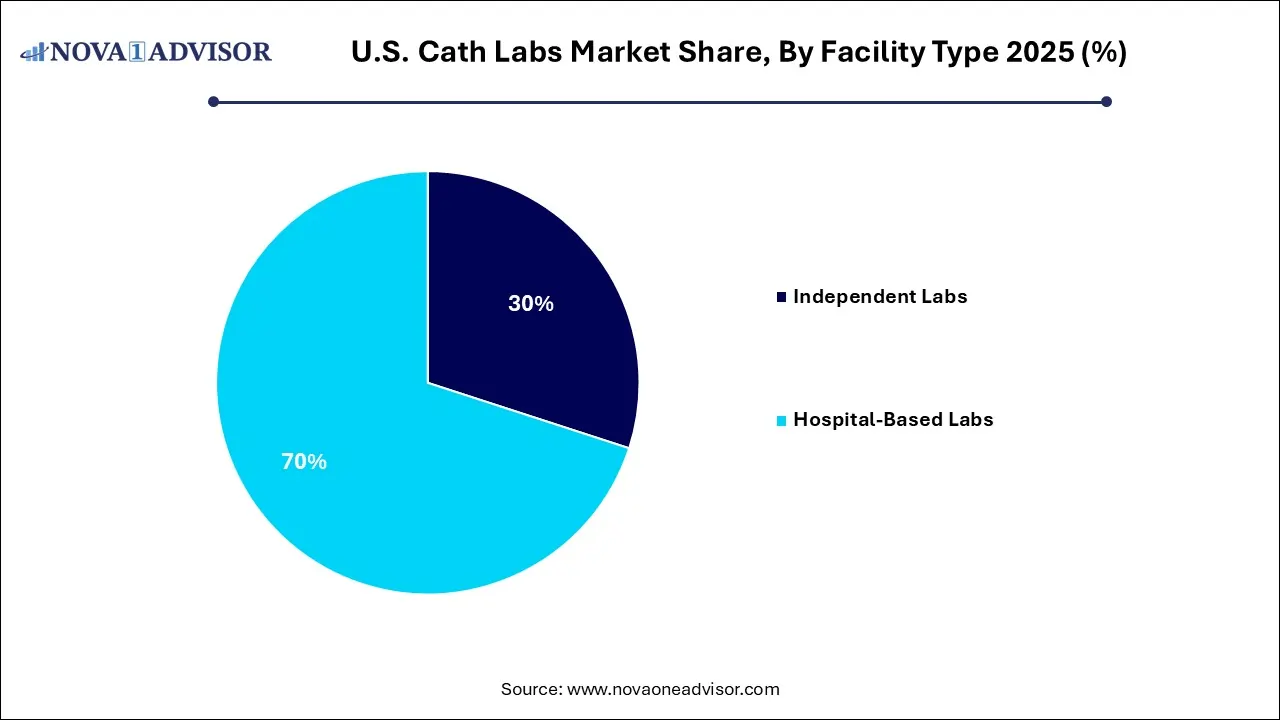
The independent labs segment held a 30.00% share of the market in 2025, with significantly lower overhead and procedural costs compared to corporate hospital units. These specialized facilities optimize operational efficiency through streamlined diagnostic workflows, greater scheduling convenience, and faster patient turnaround times. The miniaturization and declining cost of advanced imaging systems empower independent operators to deploy sophisticated, cutting-edge cardiology tools.
Country-Level Insights United States
Within the United States, the Cath Labs market exhibits significant activity across both metropolitan hubs and suburban areas. Large states such as California, Texas, and Florida have seen major investments in cardiac care infrastructure, with numerous hospitals expanding their Cath Lab capabilities. Cities like Houston, Los Angeles, and New York are leading the way in adopting robotic-assisted and AI-integrated Cath Lab technologies. Academic institutions and research hospitals in these cities are also conducting groundbreaking trials in interventional cardiology.
In contrast, rural regions face challenges related to access and affordability. Although government grants and telemedicine initiatives are helping bridge the gap, more investment is needed to ensure uniform access to Cath Lab services. Efforts are underway to introduce mobile Cath Labs and expand the reach of outpatient centers in less urbanized regions. Furthermore, initiatives by the Centers for Medicare & Medicaid Services (CMS) to reimburse outpatient procedures are fueling the growth of non-hospital Cath Labs, particularly in mid-sized cities across the Midwest and Southeast.
Some of the prominent players in the U.S. cath labs market include:
- Koninklijke Philips N.V.
- Shimadzu Corporation
- GE Healthcare
- Johnson & Johnson
- B. Braun Melsungen AG
- Siemens Healthineers
- Medtronic
- Cardinal Health, Inc.
- Boston Scientific Corporation
- Abbott Laboratories
Recent Developments
- In October 2025, Royal Philips introduced an industry-first integration of its Advanced Visualization Workspace with the Azurion image-guided therapy platform at TCT 2025, enabling automated synchronization of pre-operative CT data with C-arm movement. This "Follow C-arm" technology aims to advance CT-guided percutaneous coronary intervention (PCI) by providing real-time 3D anatomical insights and reducing manual interaction during procedures.
- In April 2026, Boston Scientific Corporation officially launched its innovative Kinetix™ Guidewire for use in percutaneous coronary intervention (PCI) procedures. Designed to assist physicians in navigating difficult anatomies to deliver drug-eluting stents and other therapeutic devices, the new "workhorse" wire marks a major technological advancement in interventional cardiology.
Segments Covered in the Report
This report forecasts revenue growth at country levels and provides an analysis of the latest industry trends in each of the sub-segments from 2021 to 2035. For this study, Nova one advisor, Inc. has segmented the U.S. cath labs market
By Component
- Services
-
- Therapeutic
-
-
- Angioplasty
- Stent Placement
- Rotational Atherectomy
- Thrombectomy
- Cardioversion
- Transcatheter Aortic Valve Replacement (TAVR)
- Others
-
-
- Diagnostic
-
-
- Angiography
- Coronary Intravascular Ultrasound
- Cardiac Catheterization
- ECG/EKG
- Fractional Flow Reserve (FFR)
- Others
-
- Equipment
By Facility Type
- Independent Labs
- Hospital-based Labs
FAQ's

Proceed to Buy
Instant PDF delivery on confirmation

 Request Customization
 Download Sample

Get a Sample of this Report
U.S. Cath Labs Market