

U.S. Exoskeleton Market Size, Share, and Trends 2026 to 2035
 Status Published
 Category Healthcare


Content
U.S. Exoskeleton Market Size and Growth 2026 to 2035
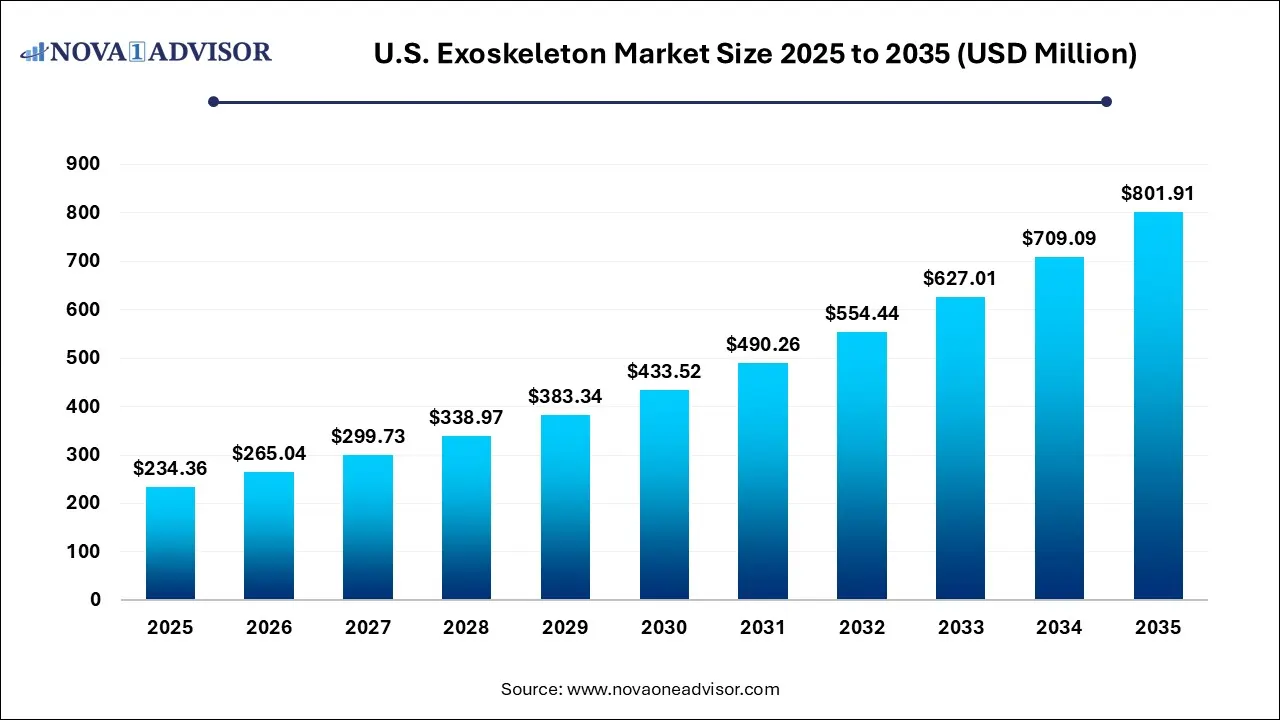
The U.S. exoskeleton market size was estimated at USD 234.36 million in 2025 and is projected to increase from USD 265.04 million in 2026 to approximately USD 801.91 million by 2035, growing at a CAGR of 13.09% from 2026 to 2035. The U.S. exoskeleton market is driven by the growing need for mobility solutions for individuals with stroke, spinal cord injuries, and neurological conditions, which has made medical exoskeletons crucial. Innovation in artificial intelligence, sensors, and advanced lightweight materials, such as carbon fiber, has improved comfort, responsiveness, and battery life, making the technology more effective, and has led to the rise in incidence of chronic diseases.
Key Takeaways
- By mobility, the mobile segment held a dominant position in the market with a share of 70% in 2025.
- By mobility, the fixed/stationary segment is the fastest growing between 2026 and 2035.
- By technology, the powered segment held a dominant position in the market with a share of 75% in 2025.
- By technology, the non-powered segment is the fastest growing between 2026 and 2035.
- By extremity, the upper body segment accounted for a considerable revenue share of 50% in the market in 2025.
- By end use, the healthcare segment accounted for a considerable revenue share of 50% in the market in 2025.
Innovation Driving Transformation in the U.S. Exoskeleton Market
A U.S. exoskeleton is a wearable electromechanical or passive mechanical system that interacts with the body to assist with lifting, walking, and rehabilitation in the industrial, healthcare, and defense sectors. Key benefits include significant reductions in occupational musculoskeletal injuries, increased productivity, and enhanced rehabilitation outcomes, such as enabling individuals with spinal cord injuries to stand and walk. The market growth is driven by a rapidly aging population, rising work-related injury costs, and the integration of AI-driven, lightweight materials that enhance usability.
U.S. Exoskeleton Market Trends
- Scaling Soft Exosuit Solutions for Occupational Risk Mitigation
In the healthcare sector, there is a surge in demand for lightweight, soft exosuits in the construction, automotive, and logistics sectors to reduce worker fatigue and injuries. These wearable robots help with heavy lifting and repetitive tasks, boosting productivity while adhering to safety standards.
- Dominance of Powered and Hybrid Technology
It enhanced capabilities in supporting heavy tasks. Additionally, hybrid architecture that combines powered motors with passive support is gaining momentum as the fastest-growing, offering the best balance of battery life and support.
- Rise of Subscription and Rent-to-Own Models
To overcome high upfront costs, manufacturers are shifting to subscription-based, rentals, or exoskeleton-as-a-service models. This trend enables smaller industrial firms and rehabilitation clinics to adopt the technology without massive capital outlays, ensuring continued, recurring revenue for manufacturers.
Key AI Integration in the U.S. Exoskeleton Market
AI and ML are transforming the U.S. exoskeleton industry from passive mechanical devices into intelligent, adaptive mobility solutions, driving market expansion. By analyzing real-time sensor data from EMG, gyroscopes, and pressure sensors. ML algorithms predict user intent and fatigue, allowing devices to adjust support dynamically and reduce injury risk. In healthcare, AI-powered exoskeletons enable personalized rehabilitation, with ML algorithms optimizing giant patterns and tracking progress to speed up recovery. In an industrial setting, AI enables preventative injury platforms that assess posture and load in real time, with the U.S. market experiencing high adoption in manufacturing, logistics, and construction.
U.S. Exoskeleton Market Report Scope
| Report Coverage | Details |
| Market Size in 2026 | USD 265.04 Million |
| Market Size by 2035 | USD 801.91 Million |
| Growth Rate From 2026 to 2035 | CAGR of 13.09% |
| Base Year | 2025 |
| Forecast Period | 2026 to 2035 |
| Segments Covered | Mobility, Technology, Extremity, End-use, Region |
| Market Analysis (Terms Used) | Value (USD Million/Billion) or (Volume/Units) |
| Country scope | U.S. |
| Key Companies Profiled | Ekso Bionics; Lockheed Martin Corporation; Suit X; Rex Bionics Plc.; ReWalk Robotics; DIH Medical; German Bionic; Sarcos Technology and Robotics Corporation; Parker Hannifin Corporation; Bionik Laboratories. |
Market Dynamics
Driver
Rising Geriatric Population and Stroke Incidence
The expanding geriatric population and increasing stroke incidence, which combined, necessitate advanced mobility rehabilitation solutions. As the elderly population grows, there is a high prevalence of age-related mobility impairments and lower-limb disabilities, boosting demand for assistive wearable robotics that aid in walking and standing. The rising incidence of stroke, a leading cause of disability in the U.S., creates a critical need for rehabilitation devices that offer repetitive, targeted therapy to help patients regain mobility.
Restraint
Limited Reimbursement Pathways
The market growth is hindered by many private insurers, and Medicare still classifies these advanced technologies as investigational or experimental. hospitals and rehab centers struggle to justify the high capital investment without guaranteed coverage, delaying adoption. This lack of financial coverage forces patients to self-fund, severely limiting the growth of the personal and home-care segments.
Opportunity
Expansion in Military Applications
The addressing the critical need for increased soldier endurance, load-carrying capacity, and injury prevention in demanding combat scenarios. Heavy investment by the U.S. Department of Defense in research and development directly accelerates the adoption of both passive and powered systems by elite forces and logistics teams. These military-funded projects, such as the ONYX lower-body system and the Guardian XO, foster technological advancements in AI-driven control and power efficiency, which in turn fuel innovation for civilian applications.
Segment Insights
By Mobility Insights
Why Did the Mobile Segment Hold a 70% Share for the U.S. Exoskeleton Market?
The mobile segment held a dominant position in the market with a share of 70% in 2025, owing to strong demand in rehabilitation, workplace assistance, and real-world usability. Continuous improvement in battery life, lightweight materials, and AI-driven movement adoption has made mobile devices more functional and user-friendly.
The Fixed/Stationary segment held a 30% share of the market in 2025, due to the limited flexibility and use-case confinement restrict broader adoption compared to mobile systems. The increasing incidence of spinal cord injuries and neurological disorders necessitates a stable, long-term rehabilitation solution.
By Technology Insights
Why Did the Powered Segment Lead the U.S. Exoskeleton Market?
The powered segment registered its dominance over the market with a share of 75% in 2025, owing to the superior performance, automation, and increasing integration of robotics drive widespread adoption. Growing use of these tools in industries to prevent worker injury, while the military utilizes them to augment soldier load-carrying capacity.
The non-powered segment held the 25% share of the market in 2025, due to lower functionality and limited assistive capability compared to powered systems reduce demand. The increasing adoption is driven by the launch of lightweight, comfortable designs specifically engineered for back and shoulder protection in warehousing and logistics.
By Extremity Insights
Why Did the Upper Body Segment Lead the U.S. Exoskeleton Market?
The upper body segment registered its dominance over the market with a share of 50% in 2025, owing to the high usage in industrial ergonomics and injury prevention, rapid advancement in wearable robotics. These devices significantly reduce fatigue, work-related musculoskeletal disorders, and injuries, driving adoption in labor-intensive sectors.
The lower body segment held the 25% share of the market in 2025, with a surge in lower limb mobility impairments, particularly among the elderly and those with paraplegia, has created high demand for supportive weight-bearing mobility solutions. It is essential for assisting patients with neurological disorders to stand, walk, and perform rehabilitation, making them popular in hospitals and clinics.
The full body segment held 25% share of the market in 2025, due to the broader functionality that exists, but complexity and cost slow large-scale adoption. They are used in rehabilitation for patients needing comprehensive assistance to recover from severe mobility impairments. Increasing investment in AI integration, advanced actuator systems, and sensor networks enables full-body suits to deliver superior functionality.
By End Use Insights
Why Did the Healthcare Segment Lead the U.S. Exoskeleton Market?
The healthcare segment registered its dominance over the market with a share of 50% in 2025, owing to the established clinical applications and rising cases of mobility disorders, sustaining strong demand. Next-generation, AI-driven, and wearable robotic systems offer superior, personalized rehabilitation that is more effective than traditional therapy. Growing geriatric population, reimbursement, and regulatory approvals.
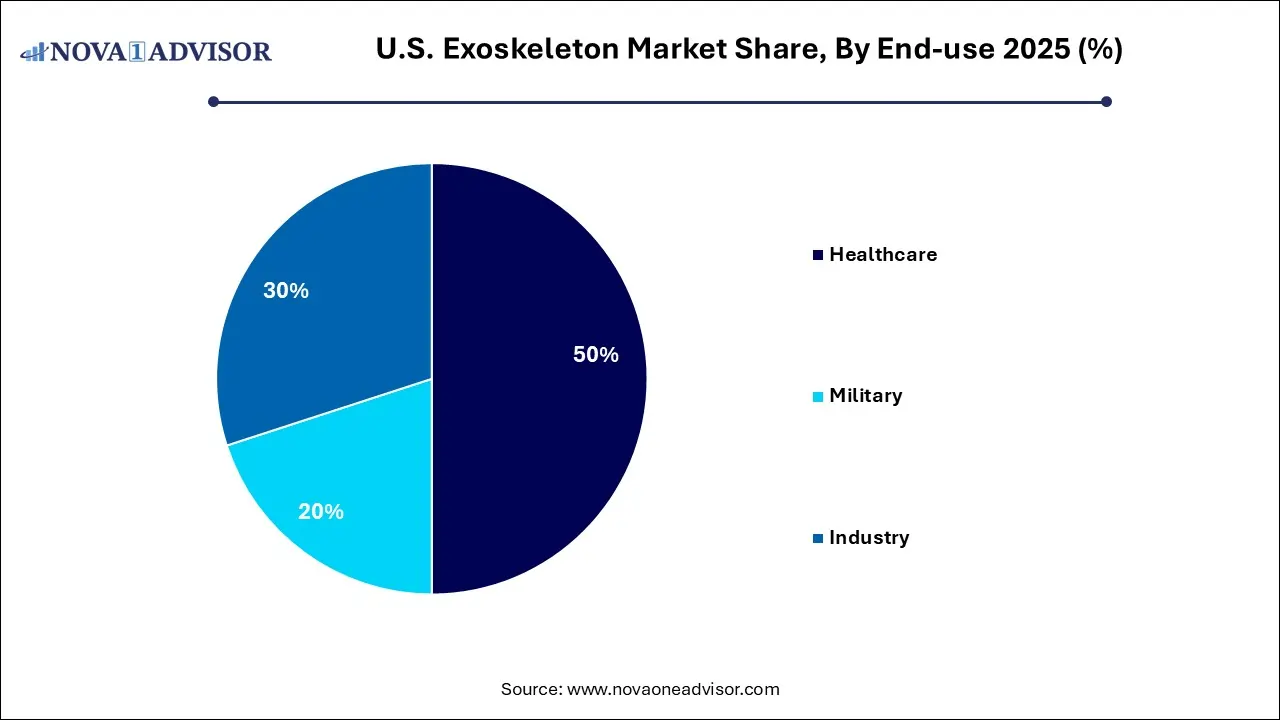
The military segment held the 20% share of the market in 2025, with a major focus on logistical support to mitigate musculoskeletal injuries among troops handling heavy supplies and equipment. Dominance of lower-body exoskeletons, enhancing soldier performance in combat and logistics, with specialized suits allowing soldiers to carry heavier equipment over long distances while reducing physical burden and injuries.
The industry segment held 30% share of the market in 2025, due to the increasing focus on worker safety and productivity, which is accelerating adoption across industries. The industry is implementing powered, mobile exoskeletons to reduce musculoskeletal disorders in workers, preventing injuries caused by heavy lifting and repetitive tasks. Integration of AI and lightweight, advanced materials allows for more effective, comfortable, and versatile powered solutions.
Recent Developments
- In April 2026, Skyjack introduced the SJ5545 E, an electric drive slab scissor lift offering a 51-foot working height and 770-pound capacity, marking the highest reach in its electric lineup. The model features E-Drive technology with a 25% gradeability, a 3-foot roll-out extension deck, and is available now in North American and European markets.
- In April 2025, Lifeward launched the ReWalk 7 Personal Exoskeleton in the U.S., offering enhanced, cloud-connected mobility for individuals with spinal cord injuries following March 2025 FDA clearance. The seventh-generation device features customizable walking speeds, crutch-integrated controls, and improved navigation for stairs and curbs, with Medicare reimbursement pathways now in place.
- In January 2026, Dephy officially launched the Sidekick at CES 2026, a $4,500, 3.1-lb bionic ankle assist designed for everyday mobility, providing motorized push-off assist to offload over 100 pounds of joint pressure. The system, which features adaptive, AI-driven control and a 3–5-mile battery range, is positioned as an e-bike for walking and began shipping.
U.S. Exoskeleton Market Companies
- Ekso Bionics
- Suit X
- Lockheed Martin Corporation
- Rex Bionics Plc.
- DIH Medical
- ReWalk Robotics
- German Bionic
- Parker Hannifin Corporation
- Sarcos Technology and Robotics Corporation
- Bionik Laboratories
Segments Covered in the Report
This report forecasts revenue growth at country levels and provides an analysis of the latest industry trends in each of the sub-segments from 2021 to 2035. For this study, Nova one advisor, Inc. has segmented the U.S. exoskeleton market.
By Mobility
- Mobile
- Fixed/Stationary
By Technology
- Powered
- Non-powered
By Extremity
- Upper Body
- Lower Body
- Full Body
By End-use
- Healthcare
- Military
- Industry
FAQ's

Proceed to Buy
Instant PDF delivery on confirmation

U.S. Exoskeleton Market Size to Hit USD 801.91 Million by 2035
 Request Customization
 Download Sample

Get a Sample of this Report
U.S. Exoskeleton Market