

U.S. Senior Living Market Size, Share & Trends Analysis Report By Facility (Skilled Nursing Facility, Assisted Living Facility, Active Adult (55+) Communities/Independent Living, Memory Care)- Industry Analysis, Size, Share, Growth, Trends, and Forecast 2026-2035
 Status Published
 Category Healthcare


Content
U.S. Senior Living Market Size and Growth
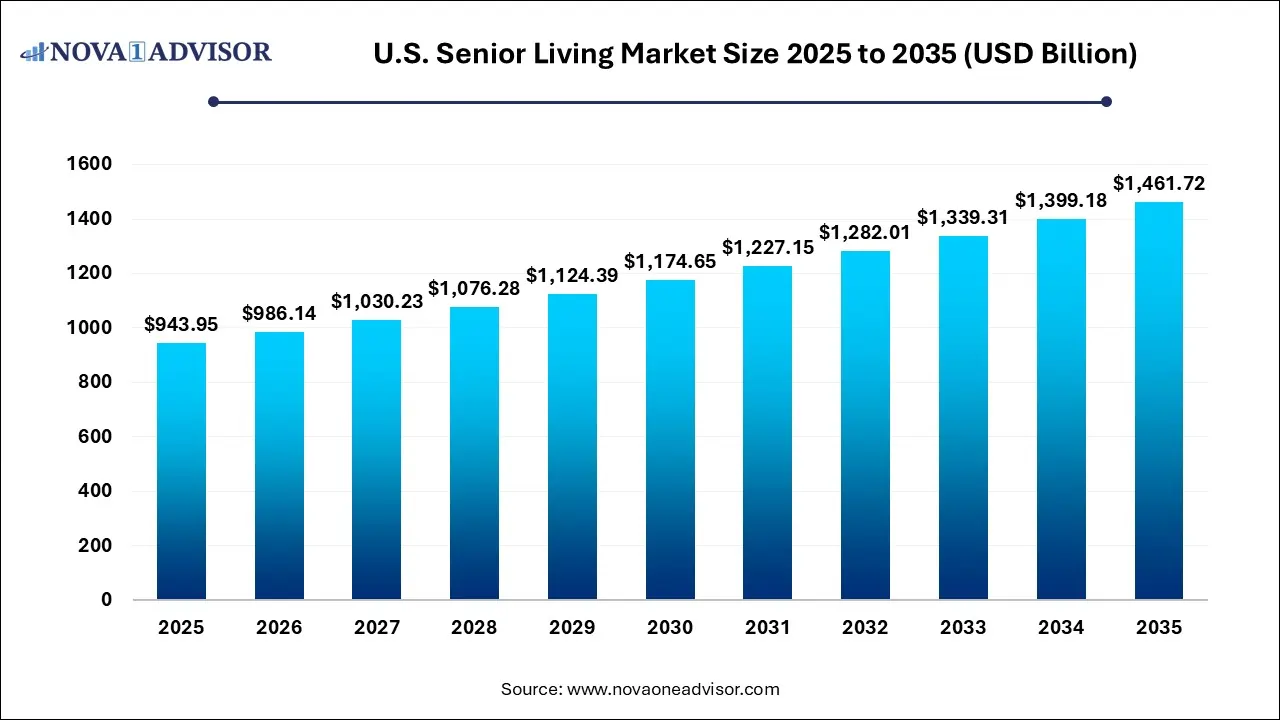
The U.S. senior living market size was estimated at USD 943.95 billion in 2025 and is projected to increase from USD 986.14 billion in 2026 to approximately USD 1,461.72 billion by 2035, growing at a CAGR of 4.47% from 2026 to 2035. The U.S. senior living market is driven by the increasing prevalence of chronic illnesses necessitating specialized care, particularly in memory care sectors, the adoption of AI, smart home technology, and remote health monitoring to enhance safety and efficiency, and the evaluation of consumer preferences.
U.S. Senior Living Market Key Takeaways:
- By facility share, the active adults 55+ community segment held a dominant position in the market with a share of 45% in 2025.
- By facility share, the assisted living residences segment is the fastest growing between 2026 and 2035.
- By region, the southeast region accounted for a considerable revenue share of 28% in the market in 2025.
- By region, the West region is the fastest growing during 2026 and 2035.
Innovation Driving Transformation in the U.S. Senior Living Market
U.S. senior living comprises a diverse range of residential models, including independent living, assisted living, and memory care. The market primarily serves baby boomers seeking maintenance-free, secure, and socially engaging lifestyles. The major benefits include improved health outcomes due to consistent access to care, reduced isolation, and peace of mind for families, along with added convenience, such as wellness programs and transportation. Market growth is driven by the silver tsunami of the aging baby boomer generation, increased adoption of technology for safety, and rising demand for active-adult communities. The shift toward integrated healthcare services within senior housing, helping senior housing, helping seniors age in place while reducing emergency room visits.
U.S. Senior Living Market Trends
- Deployment of Predictive AI and Health Informatics
Senior communities are shifting from passive monitoring to AI-driven predictive health models that analyze vital signs, fall detection, and behavior patterns to prevent emergencies before they occur. This trend includes the adoption of smart medication management systems and voice assistants to create seamless, data-enabled living environments.
- Expansion of the Active Adult Rental Asset Class
Active adult rentals are growing rapidly as a lifestyle choice, serving as a bridge between traditional apartment living and higher-acuity assisted living. These developments focus on community-oriented lifestyles, low-maintenance living, and shared amenities, designed to appeal to active seniors who want a social environment without immediate on-site healthcare.
- Strategic Adoption for the Solo Ager Demographic
Providers are adjusting their services to accommodate the rising demographic of solo agers, seniors without children or spouses who require customized support. This trend places a greater emphasis on professional care navigation, comprehensive trend places a greater emphasis on professional care navigation, comprehensive financial planning assistance, and fostering social connections to combat isolation.
Key AI Integration in the U.S. Senior Living Market
AI and ML are transforming the U.S. senior living industry by shifting care from reactive to proactive, utilizing predictive analytics to anticipate health issues, such as falls or chronic condition changes, before they become emergencies. These technologies enhance resident safety through non-intrusive monitoring, such as AI-powered cameras, smart sensors, and wearables that analyze behavior patterns while protecting privacy. AI streamlines workflows, optimizes staffing levels, and reduces the administrative burden of caregivers, helping to manage high turnover and labor shortages. AI enhances the resident experience through voice-activated assistants, personalized engagement activities, and companionship robots that combat loneliness.
Report Scope of U.S. Senior Living Market
| Report Coverage | Details |
| Market Size in 2026 | USD 986.14 Billion |
| Market Size by 2035 | USD 1,461.72 Billion |
| Growth Rate From 2026 to 2035 | CAGR of 4.47% |
| Base Year | 2025 |
| Forecast Period | 2026-2035 |
| Segments Covered | Facility |
| Market Analysis (Terms Used) | Value (US$ Million/Billion) or (Volume/Units) |
| Key Companies Profiled | Genesis Healthcare; Brookdale Senior Living Solutions; Lincare, Inc.; The Ensign Group, Inc; Extendicare; Sunrise Senior Living, LLC; Life Senior Living Facilities; Golden Living Centers; LifeCare Centers of America Corporate; Peninsula behavioral health; Sava Senior Care Administrative Services LLC; Kindred Healthcare, LLC; Capital Senior Living; Merrill Gardens; Integral Senior Living (ISL); Belmont Village, L.P.; The Villages; Pultegroup, Inc.; Latitude Margaritaville; Hot Springs Village; Rossmoor Walnut Creek; Robson Ranch; Sun Lakes; Green Valley; Life Care Services; Five Star Senior Living; Atria Senior Living; Erickson Living; Kensington Park Senior Living; Masonicare; ProMedica Health System, Inc.; Azura Memory Care; Affinity Living Group |
Market Dynamics
Driver
Aging Demographic and Chronic Health Conditions
The baby boomer generation's retirement is the primary driver of the market, creating an unprecedented, sustained demand for housing options. As this demographic lives longer, the high prevalence of age-related chronic conditions, such as Alzheimer’s, dementia, and Parkinson’s, intensifies the need for specialized assisted living and memory care services, which are growing faster than independent living segments. The rising need for 24/7 care and medication management is increasingly difficult for families to provide at home.
Restraint
Affordability Challenges
The market growth is hindered by creating a widening gap between rising service costs and the fixed incomes of the aging population. High entry fees and monthly rental costs often exceed the financial resources of seniors, forcing many to delay their move into specialized communities or opt to age in place, which stunts operators' demand. The high interest rates and inflation increase operational costs for developers, including property taxes and labor, reducing the feasibility of new, middle-market projects and causing a scarcity of affordable options.
Opportunity
Multigenerational Communities
The addressing the demand for connection, social interaction, and caregiving support, rather than promoting isolation. By incorporating public-facing spaces like daycare centers, playgrounds, and shared community centers, senior developments allow older adults to remain active participants in society while fostering bonds across generations. These intergenerational settings, which often include university-linked or mixed-use designs, increase the appeal of senior living by mitigating loneliness and offering emotional and cognitive benefits for residents.
U.S. Senior Living Market By Facility Insights
Why Did the Active Adults 55+ Community Segment Hold a 45% Share for the U.S. Senior Living Market?
The active adults 55+ community segment held a dominant position in the market with a share of 45% in 2025, owing to the increasing number of seniors seeking active, independent lifestyles with a focus on wellness and leisure. The high-demand investment promoted significant investment in specialized, age-restricted housing designed for this demographic, leading to strong market growth.
The assisted living residences segment held a 20% share of the market in 2025. Due to the growing demand for seniors who need assistance but want to live independently. Older adults are increasingly moving away from institutional settings, toward residential-style environments that offer social engagement, safety, and community settings. Increasing investment from private equity and real estate investment trusts, and cost efficiency and flexibility.
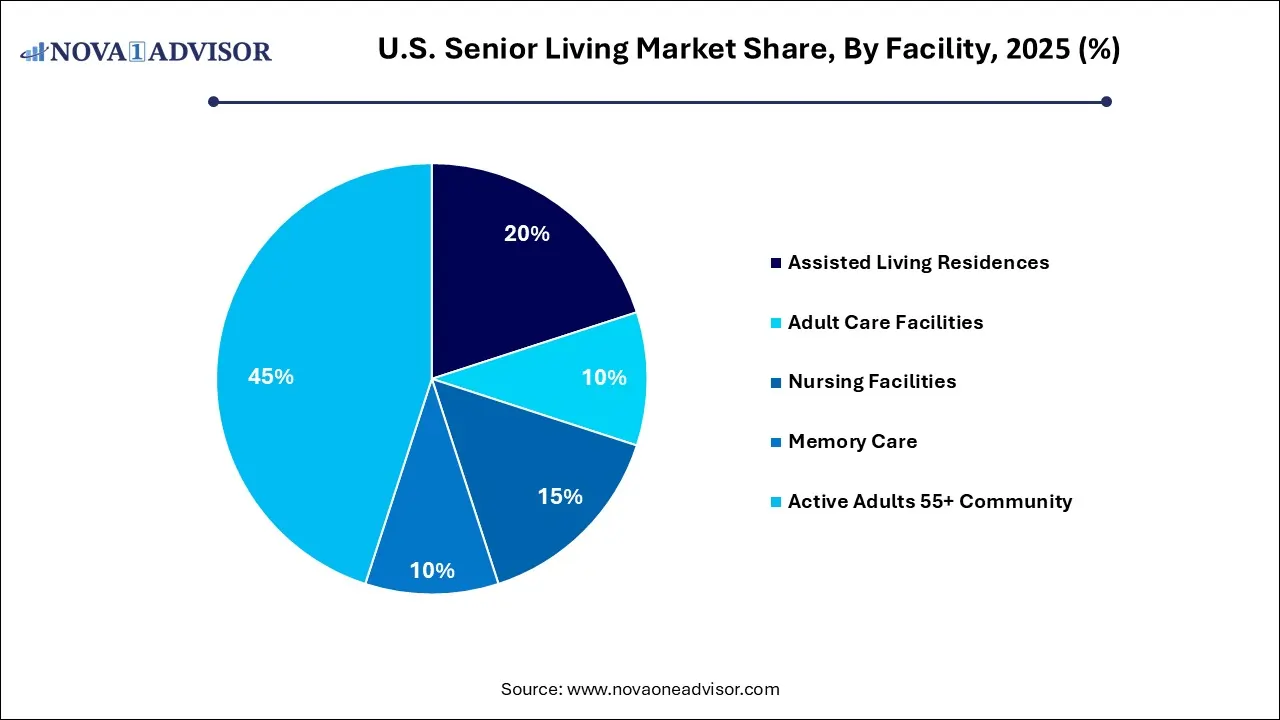
The nursing facilities segment holds a 15% share of the market in 2025, with the increasing demand due to the aging population and more complex healthcare needs, particularly among those who require extensive medical care. High demand for post-acute care, continued expansion of Medicare and Medicaid coverage for long-term care services, support the financial stability and high utilization.
The adult care facilities segment held a 10% share of the market in 2025, due to more seniors opting for independent living or nursing care services rather than general adult care. Government efforts and consumer preference have shifted care away from nursing homes toward community-based, non-institutionalized settings, boosting the popularity of assisted living. The expansion of advanced care services and high fragmentation and availability.
The memory care segment held 10% share of the market in 2025, because of the specific nature of care required; however, it’s growing as awareness of dementia-related needs increases. It provides tailored services, including 24/7 supervision, secure environments, and structured cognitive activities, addressing the acute safety and care needs of seniors with dementia. Increased investment in technology and facilities and impact on family caregivers.
U.S. Senior Living Market By Regional Insights
Why Did the Southeast Region Lead the U.S. Senior Living Market?
The southeast region registered its dominance over the market with a share of 28% in 2025, owing to its attractiveness to retirees seeking affordable living with a warm climate and abundant senior services. A favorable climate and numerous recreational amenities make the Southeast a preferred retirement destination. The booming in adult communities and significant developments are accelerating the region’s market share.
The west region held the 22% share of the market in 2025, due to its significant but not the largest share, due to competitive markets and high living costs driving some seniors to other regions. The strong investment in senior living infrastructure including luxurious and technologically advanced facilities. The shift toward assisted living and high demand for specialized services are prevalent in the region.
The southwest region held a 16% share of the market in 2025 because of its attractiveness to retirees seeking affordable living with a warm climate and abundant senior services. The heavily invested in healthcare infrastructure, ensuring access to quality medical care and specialized services, such as memory care and assisted living, which are in high demand. The expansion of an active adult community and an investment-friendly environment.
The Midwest region held a 18% share of the market in 2025, with the aging population, but slightly less attractive than the Southeast and West due to colder climates and fewer retirement-centric amenities. Growing focuses on independent living to support aging in place. Many older homes are being replaced or renovated, prompting retirees to choose, communities that prioritize independence over clinical care.
The Northeast segment held a 16% share of market in 2025, with the higher living costs and less senior-specific infrastructure compared to the Southeast. The high consume preference shift toward premium, technology-enabled, and eco-friendly senior living solutions.
Some of the prominent players in the U.S. senior living market include:
- Genesis Healthcare
- Brookdale Senior Living Solutions
- Lincare, Inc.
- The Ensign Group, Inc
- Extendicare
- Sunrise Senior Living, LLC
- Life Senior Living Facilities
- Golden Living Centers
- LifeCare Centers of America Corporate
- Peninsula behavioral health
- Sava Senior Care Administrative Services LLC
- Kindred Healthcare, LLC
- Atria Senior Living, Inc.
- Five Star Senior Living
- Capital Senior Living
- Merrill Gardens
- Integral Senior Living (ISL)
- Belmont Village, L.P.
- The Villages
- Pultegroup, Inc.
- Latitude Margaritaville
- Hot Springs Village
- Rossmoor Walnut Creek
- Robson Ranch
- Sun Lakes
- Green Valley
- Life Care Services
- Erickson Living
- Kensington Park Senior Living
- Masonicare
- ProMedica Health System, Inc.
- Azura Memory Care
- Affinity Living Group
U.S. Senior Living Market Recent Developments
- In March 2026, The North Star Group has introduced the Serenity Village Development Model, a new approach designed for public housing authorities (PHAs) that utilizes Mortgage Revenue Bonds to create affordable and workforce housing while retaining ownership and control. This model leverages structured finance, SIP construction, and integrated community features to offer sustainable housing, aiming to reduce long-term maintenance risks and reliance on traditional LIHTC funding.
- In April 2026, Teva Pharmaceuticals launched Home Ground™ Schizophrenia Community, an online resource hub designed to support individuals with schizophrenia and their care partners through peer-driven insights, tools for symptom management, and strategies to reduce isolation. Developed in collaboration with the mental health community, the platform provides free access to resources focused on emotional wellness, independent living, and physical health, alongside virtual and in-person events.
- In December 2024, Morgan Stanley Real Estate Investing (MSREI) partnered with Brightview Senior Living to acquire a portfolio of eight premium senior housing communities from Harrison Street, totaling 1,186 units across the Baltimore, Philadelphia, Providence, and Boston areas. Brightview will continue to operate the communities, which were acquired to address the increasing demand for quality senior living driven by the aging baby boomer demographic.
Segments Covered in the Report
This report forecasts revenue growth at country levels and provides an analysis of the latest industry trends in each of the sub-segments from 2021 to 2035. For this study, Nova one advisor, Inc. has segmented the U.S. senior living market
By Facility
- Skilled Nursing Facility
- Assisted Living Facility
- Active Adult (55+) Communities/Independent Living
- Memory Care
By Regional
- Southeast
- West
- Midwest
- Northeast
- Southwest
FAQ's

Proceed to Buy
Instant PDF delivery on confirmation

 Request Customization
 Download Sample

Get a Sample of this Report
U.S. Senior Living Market