

Viral Vectors And Plasmid DNA Manufacturing Market (By Vector Type; By Application; By End Use; By Disease; By Product Type; By Region) - Global Industry Analysis, Share, Growth, Regional Outlook and Forecasts, 2026-2035
 Status Published
 Category Healthcare


Content
Viral Vectors And Plasmid DNA Manufacturing Market Size, Share and Trends Analysis 2026 to 2035
The global viral vectors and plasmid DNA manufacturing market size was exhibited at USD 7.71 billion in 2025 and is projected to hit around USD 46.81 billion by 2035, growing at a CAGR of 19.76% during the forecast period 2026 to 2035. The North America dominated the global market with a share of 49.79% in 2025.
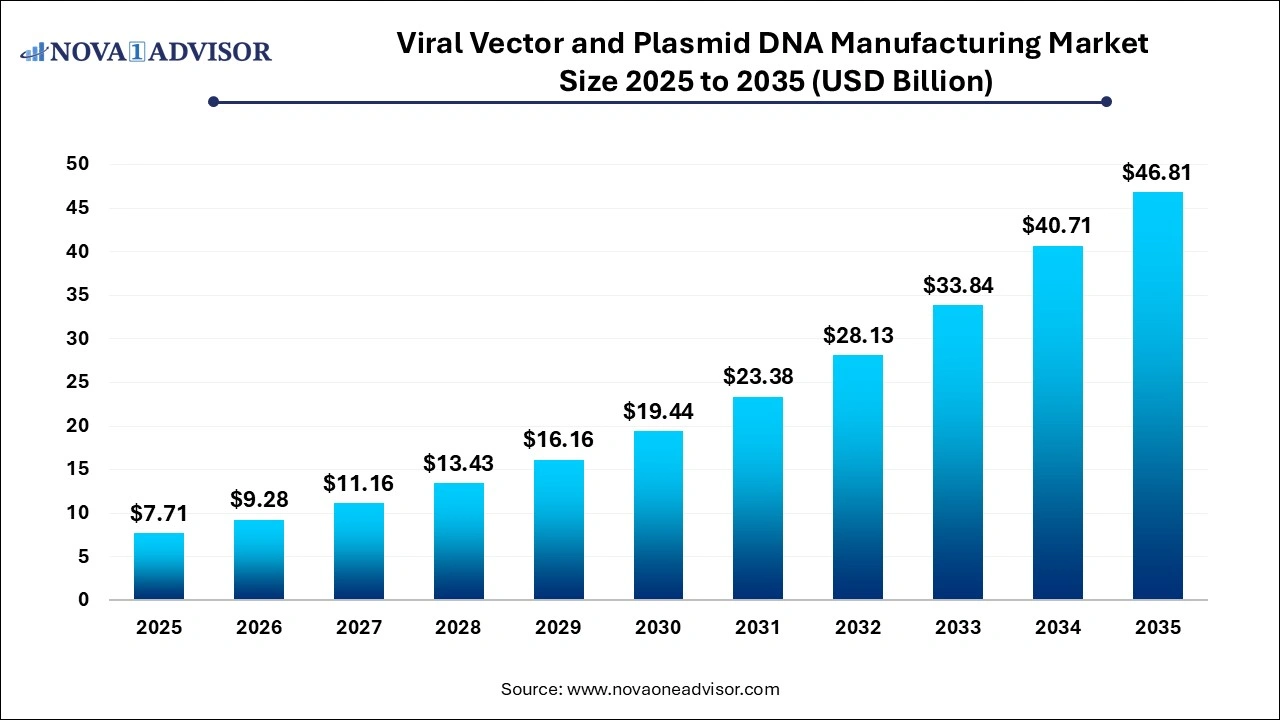
Key Pointers:
- The Adeno-associated virus (AAV) segment held the highest market share of 19.26% in 2025.
- The downstream processing segment held the highest market share of 54.31% in 2025.
- The vaccinology segment held the highest market share of 25.29% in 2025.
- The research institutes segment held the highest market share of 57.42% in 2025.
- The cancer segment held the highest market share of 38.32% in 2025.
- North America dominated the global market with a share of 49.79% in 2025.
Viral Vectors And Plasmid DNA Manufacturing Market Report Scope
Viral vectors are tools for delivering genetic material into cells. Viruses have developed specific systems for transporting their DNA inside the cells they infect. Furthermore, retrovirus, adenovirus, lentivirus, herpes simplex virus, and others are among the viral vectors which can be employed to transfer genetic material into the genetic composition of cells.
The viral vectors and plasmid DNA manufacturing market saw a lucrative opportunity due to the COVID-19 pandemic. Furthermore, the market players are shifting their business focus toward the development of viral vectors for the SARS-CoV-2 vaccine. Viral vectors are commonly employed tools used in the discovery and development of vaccines against SARS-CoV-2. The ongoing COVID-19 pandemic has encouraged investment in this space in search of a vaccine as viral vector-based vaccines can be manufactured and designed relatively quickly with the use of the same building blocks. For instance, Companies such as Johnson and Johnson/Janssen (J&J); AstraZeneca/University of Oxford; Gamaleya Research Institute; and CanSino Biologics have developed viral vector-based vaccines.
The market for viral vectors and plasmid DNA manufacturing is growing due to the increasing prevalence of target ailments and diseases and the efficacy of viral vectors in gene therapy delivery. This increase is aided by continued research into viral vector-based cell and gene therapies, as well as financing for gene therapy advancement. In addition, an increase in the number of gene therapy-based discovery programs initiated by biotechnology and pharmaceutical companies is expected to drive the demand for scalable production of gene therapy vectors.
A rising number of patients opting for gene therapy is driving the global market. Due to a surge in gene therapy development, demand for plasmid DNA is skyrocketing. Thus, Adeno-associated virus (AAV), lentivirus, and other viral vector systems require pDNA (Plasmid DNA) to be manufactured. In addition, several genetic illnesses and infectious diseases are on the rise in different areas of the globe. For instance, as per UNAIDS data, 38.0 million people across the globe were living with HIV in 2019, and 1.7 million people were newly infected with the virus.
Additionally, rising demand for synthetic genes and untapped expanding market potential are projected to open up new chances for market players in the future. However, the risk of insertional mutagenesis and the high cost of gene treatments stymie market expansion. Furthermore, technical innovations that address the constraints posed by traditional vector production processes create an attractive potential for industry manufacturers.
Market Outlook
- Market Growth Overview: The viral vectors and plasmid DNA manufacturing market is expected to grow significantly between 2025 and 2035, driven by the surging demand for cell and gene therapies, technological advancements in manufacturing, and vaccine development and novel applications.
- Sustainability Trends: Sustainability trends involve single-use technologies, decentralized manufacturing, and synthetic DNA alternatives.
- Major Investors: Major investors in the market include Lonza, Thermo Fisher Scientific, Catalent, Merck KGaA, and Charles River Laboratories.
Viral Vectors And Plasmid DNA Manufacturing Market Report Scope
| Report Coverage | Details |
| Market Size in 2026 | USD 9.28 Billion |
| Market Size by 2035 | USD 46.81 Billion |
| Growth Rate From 2026 to 2035 | CAGR of 19.76% |
| Base Year | 2025 |
| Forecast Period | 2026 to 2035 |
| Segments Covered | Vector Type, Workflow, Application, End-use, Disease, Product Type, Region |
| Market Analysis (Terms Used) | Value (USD Million/Billion) or (Volume/Units) |
| Regional Scope | North America; Europe; Asia Pacific; Central and South America; the Middle East and Africa |
| Key Companies Profiled | Merck KGaA; Lonza; FUJIFILM Diosynth Biotechnologies; Thermo Fisher Scientific; Cobra Biologics; Catalent Inc.; Wuxi Biologics; Takara Bio Inc.; Waisman Biomanufacturing; Genezen laboratories; Batavia Biosciences; Miltenyi Biotec GmbH; SIRION Biotech GmbH; Virovek Incorporation; BioNTech IMFS GmbH; Audentes Therapeutics; BioMarin Pharmaceutical; RegenxBio, Inc. |
Segmental Insights
By Vector Type
How did the adeno-associated virus segment dominate the Viral Vectors And Plasmid DNA Manufacturing market?
The adeno-associated virus segment is driven by its exceptional transduction efficiency, which allows it to successfully deliver therapeutic genetic material to both dividing and non-dividing cells, making it uniquely capable of targeting complex, non-replicating tissues, such as the central nervous system and the eyes. Backed by these biological advantages, AAVs now anchor a robust clinical pipeline addressing rare hereditary disorders, genetic diseases, and a variety of cancers.
How did the lentivirus segment expected to hold the fastest-growing Viral Vectors And Plasmid DNA Manufacturing market in the coming years?
The lentivirus segment is driven by its unique ability to transduce both dividing and non-dividing cells, ensuring highly stable, long-term genetic expansion. This capability has fueled skyrocketing adoption across oncology and hematology, solidifying lentivirus as the dominant platform for CAR-T cell manufacturing and complex genetic disorder research.
By Workflow
How did the downstream processing segment dominate the Viral Vectors And Plasmid DNA Manufacturing market?
The downstream processing segment is driven by the critical regulatory and financial backbone of viral vector and plasmid manufacturing, demanding strict compliance to eliminate host-cell proteins and process contaminants to ensure patient safety. Because conventional laboratory extraction methodologies remain an intricate operational bottleneck, maximizing yield and purity during these directly determines clinical validation and final product efficacy.
How did the upstream processing segment expected to hold the fastest-growing Viral Vectors and Plasmid DNA Manufacturing market in the coming years?
The upstream processing segment is driven by the transition from early clinical trials to commercialization; companies must scale up from restrictive small-batch methods to larger, industrialized bioreactor operations to satisfy global patient demand. Maximizing yield at this initial stage effectively reduces downstream purification burdens, lowering the overall cost of goods and preventing critical supply chain bottlenecks.
By Application
How did the vaccinology segment dominate the Viral Vectors and Plasmid DNA Manufacturing market?
The vaccinology segment is driven by the rapid public-private partnerships that have infused billions of dollars into vaccine research and development pipelines targeting complex respiratory and latent viruses. The strategic scope of viral vectors is expanding aggressively into oncology, where they are engineered to deliver anti-cancer genes and trigger strong, long-lasting immune responses against malignant tumours.
How did the cell therapy segment expected to hold the fastest-growing Viral Vectors and Plasmid DNA Manufacturing market in the coming years?
The cell therapy segment is driven by the surge in clinical trials for oncology treatments and rare genetic disorders, which has created an urgent, large-scale demand for a consistent supply of premium plasmid and viral vectors. As personalized immunotherapies offer fewer side effects and long-lasting patient responses, the industry has shifted entirely toward advanced biological platforms.
By End-use
How did the research institutes segment dominate the Viral Vectors and Plasmid DNA Manufacturing market?
The research institutes segment is driven by substantial financial backing and public grants; these entities possess the resources required to continuously fund large-scale clinical trials and exploratory pipelines targeting rare genetic diseases and oncology. With substantial financial backing and public grants, these entities possess the resources required to continuously fund large-scale clinical trials and exploratory pipelines targeting rare genetic diseases and oncology.
How did the pharmaceutical and biotechnology companies segment expected to hold the fastest-growing Viral Vectors and Plasmid DNA Manufacturing market in the coming years?
The pharmaceutical and biotechnology companies segment is driven by the relentless rise of advanced therapies for targeted oncology and inherited genetic disorders, which has placed viral vectors and plasmid DNA at the center of modern pharmaceutical manufacturing. To accelerate drug discovery pipelines, biotechnology and pharmaceutical firms are scaling up internal production capabilities while aggressively outsourcing large-scale manufacturing to specialized CDMOs.
By Disease
How did the cancer segment dominate the Viral Vectors and Plasmid DNA Manufacturing market?
The cancer segment is driven by the fact that the vectors are uniquely engineered to encode immunomodulatory or suicide genes directly into tumour sites, effectively making cancer cells vulnerable to immune destruction. With the high volume of clinical trials and regulatory approvals targeting both blood and solid tumors, the demand for scalable, high-quality vector manufacturing has become a critical pillar of modern oncology.
How did the genetic disorders segment expected to hold the fastest-growing Viral Vectors and Plasmid DNA Manufacturing market in the coming years?
The genetic disorders segment is driven by advancements in precision medicine that enable these molecular tools to deliver better, long-term therapeutic efficiency tailored to a patient's exact genetic profile. By addressing the root cause of inherited diseases rather than just managing symptoms, these advanced biomanufacturing platforms offer a definitive, life-changing approach to treating previously incurable genetic disorders.
By Regional
How did the North America region account for the largest share in the Viral Vectors and Plasmid DNA Manufacturing market?
North America is driven by its robust clinical pipeline, hosting an exceptionally high volume of active trials for advanced genetic medicines and mRNA vaccines. This research momentum is accelerated by a powerful biopharmaceutical ecosystem, where major multinational firms seamlessly drive therapeutic discoveries from early laboratory testing into high-volume commercial markets.
U.S. Viral Vectors and Plasmid DNA Manufacturing Market Trends
The U.S. is navigating severe capacity crunches by pursuing high-volume facility expansions and triggering an outsourcing boom to specialized CDMOs capable of managing complex GMP requirements. To optimize these supply chains, manufacturers are aggressively shifting to scalable suspension cell culture systems while investing in non-viral vector technologies to reduce immunogenicity and lower production costs.
How did the Asia-Pacific region become the fastest-growing Viral Vectors and Plasmid DNA Manufacturing Market during the forecast period?
Asia Pacific’s expansion of cell and gene therapy-clinical funding and increased healthcare expenditures are successfully establishing localized biomanufacturing clusters to modernize infrastructure and streamline regulatory frameworks. With the rising regional disease burden and an expanding geriatric population, this optimized infrastructure is uniquely positioned to satisfy the surging demand for life-saving adeno-associated virus and lentiviral-based therapies.
China Viral Vectors and Plasmid DNA Manufacturing Market Trends
China’s dominance of adeno-associated virus and lentivirus vectors for long-term oncology therapies, alongside a surging clinical pipeline demand for foundational GMP-grade plasmid DNA. To support this intensive research and advanced CRISPR gene-editing applications, government-backed initiatives are heavily funding local bioprocessing and manufacturing infrastructure.
How did Europe Hold A Notable Share in the Viral Vectors and Plasmid DNA Manufacturing Market?
Europe’s surge in clinical trials and commercial approvals for oncology and rare genetic disorders that require high-purity, GMP-grade viral vectors and plasmid DNA. The substantial EU-backed grants and national funding continually fuel synthetic biology and translational research across key biomedical hubs like Germany, the UK, Switzerland, and France.
Germany Viral Vectors and Plasmid DNA Manufacturing Market Trends
Germany’s massive transition toward premium GMP-grade plasmid manufacturing to satisfy strict regulatory requirements for human clinical trials. The integration of automated bioprocessing systems across both upstream and downstream workflows significantly minimizes yield losses and lowers overall production costs.
Some of the prominent players in the Viral Vectors And Plasmid DNA Manufacturing Market include:
- Merck KGaA
- Lonza
- FUJIFILM Diosynth Biotechnologies
- Thermo Fisher Scientific
- Cobra Biologics
- Catalent Inc.
- Wuxi Biologics
- Takara Bio Inc.
- Waisman Biomanufacturing
- Genezen laboratories
- Batavia Biosciences
- Miltenyi Biotec GmbH
- SIRION Biotech GmbH
- Virovek Incorporation
- BioNTech IMFS GmbH
- Audentes Therapeutics
- BioMarin Pharmaceutical
- RegenxBio, Inc.
Segments Covered in the Report
This report forecasts revenue growth at global, regional, and country levels and provides an analysis of the latest industry trends in each of the sub-segments from 2021 to 2035. For this study, Nova one advisor, Inc. has segmented the global Viral Vectors And Plasmid DNA Manufacturing market.
By Vector Type
- Adenovirus
- Retrovirus
- Adeno-Associated Virus (AAV)
- Lentivirus
- Plasmids
- Others
By Workflow
- Upstream Manufacturing
- Vector Amplification & Expansion
- Vector Recovery/Harvesting
- Downstream Manufacturing
- Purification
- Fill Finish
By Application
- Antisense & RNAi Therapy
- Gene Therapy
- Cell Therapy
- Vaccinology
- Research Applications
By End-use
- Pharmaceutical and Biopharmaceutical Companies
- Research Institutes
By Disease
- Cancer
- Genetic Disorders
- Infectious Diseases
- Others
By Product Type
- Plasmid DNA
- Viral Vector
- Non-Viral Vector
By Region
- North America
- Europe
- Asia-Pacific
- Latin America
- Middle East & Africa (MEA)
FAQ's

Proceed to Buy
Instant PDF delivery on confirmation

Viral Vectors And Plasmid DNA Manufacturing Market Size to Hit USD 46.81 Billi...
 Request Customization
 Download Sample

Get a Sample of this Report
Viral Vectors And Plasmid DNA Manufacturing Market