

Automated Liquid Handling Technologies Market Size, Share, and Trends 2026 to 2035
 Status Published
 Category Healthcare


Content
Automated Liquid Handling Technologies Market Size, Growth and Trends 2026 to 2035
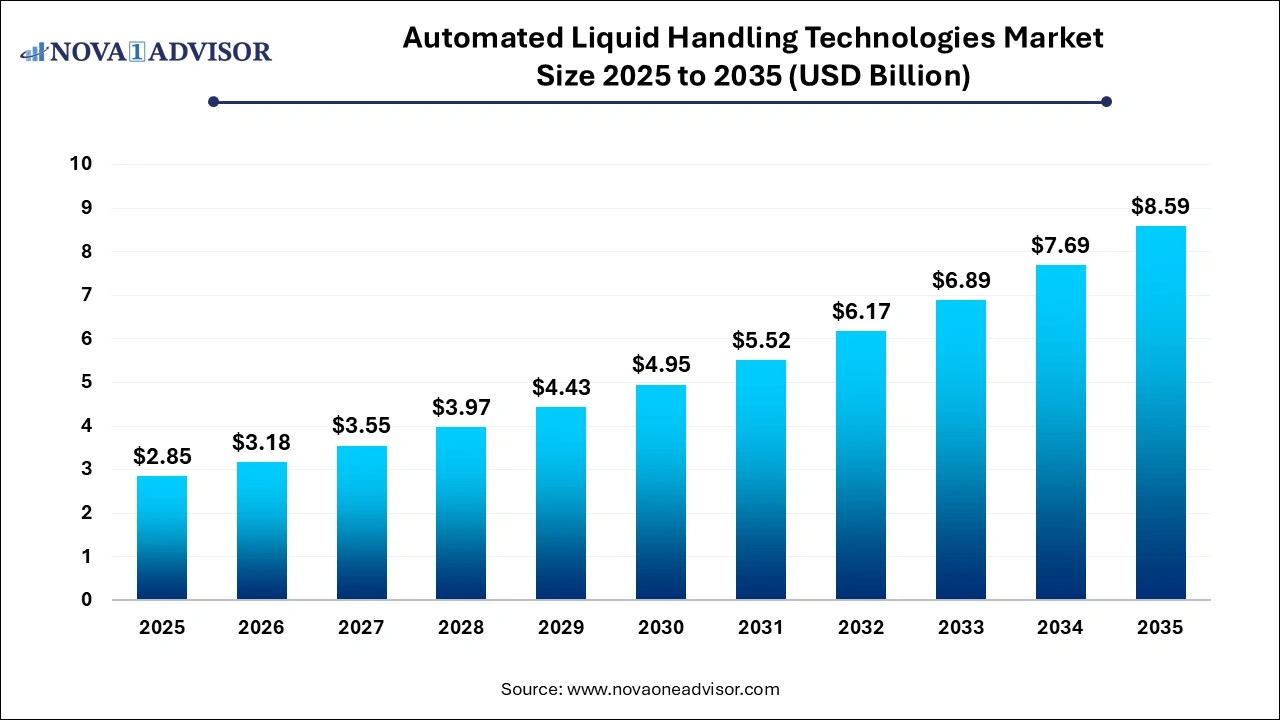
The global automated liquid handling technologies market was estimated at USD 2.85 billion in 2025 and is projected to reach USD 8.59 billion by 2035, growing at a CAGR of 11.66% over the forecast period 2026-2035. The market growth is driven by the rise of pharmaceutical and biotech research and development demand, the growing need for precision and reproducibility, integration of advanced technologies, such as AI, machine learning, and robotics, which allows for real-time monitoring and higher efficiency.
Automated Liquid Handling Technologies Market Key Takeaways
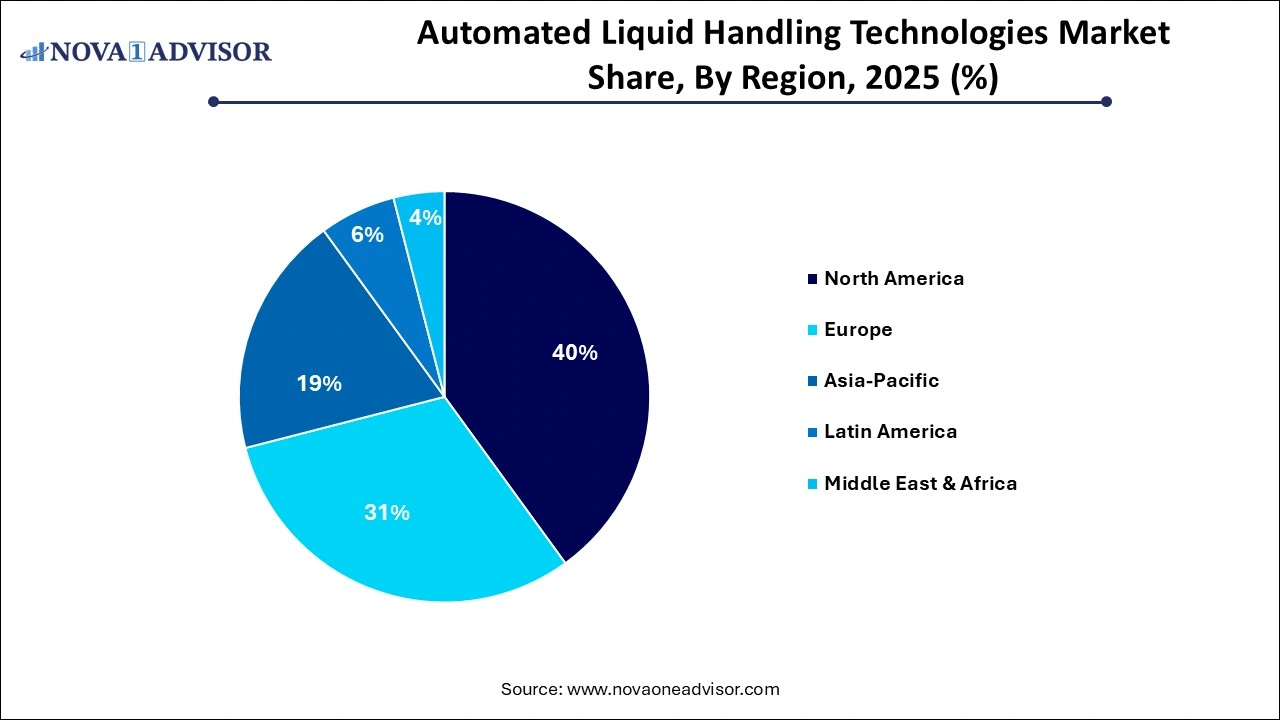
- By region, North America held the largest market share in 2025.
- By region, Asia Pacific is expected to experience the fastest growth between 2026 and 2035.
- By product, the automated liquid handling workstations segment led the market in 2025.
- By product, the reagents and consumables segment is expected to expand at the highest CAGR over the projected timeframe.
- By application, the drug discovery and ADME-Tox research segment led the market in 2025.
- By application, the cancer & genomic research segment is the fastest growing in the automated liquid handling technologies market.
- By end user, the pharmaceutical and biotechnology companies segment dominated the market in 2025.
Artificial Intelligence The Next Growth Catalyst in Automated Liquid Handling Technologies
AI and ML are transforming THE automated liquid handling technologies industry by shifting systems from simple robotic platforms to intelligent, self-optimizing ecosystems. AI algorithms enable real-time adjustments to liquid viscosity, temperature, and volume, thereby enhancing pipetting accuracy and reliability, particularly in low-volume, high-throughput applications, such as drug discovery and genomics. These technologies facilitate predictive maintenance by anticipating component failures, thereby reducing unplanned laboratory downtime and operational costs. ML streamlines assay setups, improves error handling, and integrates with cloud-based systems to provide data-driven insights that refine experimental designs.
Strategic Overview of the Global Automated Liquid Handling Technologies Industry
The automated liquid handling technologies market focuses on genomics, drug discovery, and clinical diagnostics, by offering enhanced accuracy, superior reproducibility, and improved safety through reduced contact with hazardous materials. Key advantages include high-throughput processing and efficient handling of small sample volumes, which reduce reagent costs and laboratory personnel fatigue. Market growth is heavily driven by the increasing need for high-throughput screening in drug discovery, the rising demand for lab automation to minimize human error, and the expanding adoption of AI-driven, smart laboratory systems. The expansion of personalized medicine and continuous R&D investment by pharmaceutical companies are key factors accelerating the adoption of these technologies, particularly in North America and the Asia-Pacific region.
Automated Liquid Handling Technologies Market Outlook
- Market Growth Overview: The automated liquid handling technologies market is expected to grow significantly between 2026 and 2035, driven by the increased investment in drug discovery and genomic research, integration of smart laboratory adoption, and the fact that laboratories are automating to reduce human error, minimise contamination risks, and enhance reproducibility, particularly with disposable tip systems.
- Sustainability Trends: Sustainability trends are maniturization for resource efficiency development of system capable of handling smaller liquid volumes, which significantly reduces consumption of expensive and often toxic reagents, lowering both costs and hazardus waste, energy efficiency and sustainable design, and growing focus on reducing the environmental impact of disposable tips through improved recycling initiatives, sustainable materials, and advanced software that optimizes tip usage, even as demand for high-throughput, disposable tips grows.
- Major Investors: Major investors in the market include Thermo Fisher Scientific, Danaher Corporation, Tecan Group Ltd., Hamilton Company, Agilent Technologies, and PerkinElmer. These firms drive the market by investing heavily in R&D to develop high-throughput, AI-integrated, and miniaturized systems that enhance precision and speed in drug discovery and genomics research. They accelerate adoption through strategic mergers and acquisitions, such as Hamilton's acquisition of BioFluidiX, aimed at broadening their portfolios and enhancing robotic capabilities.
- Startup Economy: The startup economy in the market focuses on lab automation robots and cloud-enabled software to schedule and orchestrate protocols, reshape biotech provides a scalable robotic platform with integrated imaging and incubation for microbiology, and startups are enhancing robots with AI for real-time error correction, cloud simulators for protocol generation, and data-driven lab-as-a-service models.
Automated Liquid Handling Technologies Market Report Scope
| Report Coverage | Details |
| Market Size in 2025 | USD 3.18 Billion |
| Market Size by 2035 | USD 8.59 Billion |
| Growth Rate From 2026 to 2035 | CAGR of 11.66% |
| Base Year | 2025 |
| Forecast Period | 2026 to 2035 |
| Market Analysis (Terms Used) | Value (USD Million/Billion) or (Volume/Units) |
| Segments Covered | By Product Insights, By Application Insights, By End User Insights |
| Regional Scope | North America; Europe; Asia Pacific; Central and South America; the Middle East and Africa |
| Key Companies Profiled | Thermo Fisher Scientific, Inc., Agilent Technologies, Inc., Aurora Biomed, Inc., AUTOGEN, INC. Danaher Corporation |
Automated Liquid Handling Technologies Market Dynamics
Drivers
Rising Demand in Drug Discovery & R&D
The necessity of high-throughput screening and increased precision in handling large compound libraries. As pharmaceutical and biotechnology companies strive to accelerate drug development timelines, they are adopting automated workstations to perform complex, repetitive tasks, such as serial dilutions and plate reformatting, which are impractical via manual methods. The need for miniaturization to reduce reagent costs and manage low sample volumes is accelerating the shift toward advanced, non-contact, and robotic dispensing solutions.
Rising Need for Improved Accuracy & Reproducibility
The laboratories strive to minimize human errors and ensure consistent, high-quality data in sensitive applications such as drug discovery, genomics, and clinical diagnostics. Automated systems offer precise, standardized, and repeatable liquid dispensing, overcoming the variability associated with manual pipetting, which is crucial for meeting stringent regulatory standards and ensuring experimental reliability. As research moves toward smaller sample volumes and high-throughput workflows, automated liquid handlers, including advanced non-contact systems, have become indispensable for providing accurate nanoliter-scale dispensing, increasing overall productivity, and reducing contamination risks.
Restraint
High Initial Capital Investment
The market growth is hindered by substantial upfront costs for equipment, software, and training hinder adoption among smaller laboratories, academic institutions, and startups with limited budgets. With advanced systems costing anywhere from tens of thousands or even millions for highly sophisticated robotic platforms, many potential users are forced to delay or forgo automation, favoring manual, low-cost alternatives.
Opportunities
Miniaturization and Acoustic Dispensing
The expansion of automated liquid handling technologies creates a significant opportunity by enabling high-throughput screening and reducing reagent costs. Miniaturization allows for the handling of nanoliter volumes, which significantly lowers the consumption of expensive reagents and samples in genomics and drug discovery applications. Acoustic dispensing enhances this by utilizing sound waves to transfer fluids without physical tips, creating tip-free, contamination-free, and high-reproducibility workflows.
Development of Cost-Effective/Compact Systems
The market is creating immersive opportunities by democratizing access to laboratory automation for smaller, budget-constrained laboratories. These affordable, benchtop, and modular systems lower the high capital expenditure barrier, allowing mid-sized CROs, academic institutions, and diagnostic labs to upgrade from manual to automated processes. Compact designs address the growing need for space-saving, portable solutions, particularly in rapidly expanding fields like genomics, proteomics, and drug discovery.
How Macroeconomic Variables Influence the Automated Liquid Handling Technologies Market?
- Economic Growth and GDP: Economic growth and rising GDP generally lead to positive growth. By fueling higher R&D investments in the pharmaceutical, biotechnology, and academic sectors. As countries experience economic development, increased funding allows laboratories to upgrade from manual to automated systems to achieve higher throughput, improved precision, and reduced sample contamination.
- Inflation & Drug Pricing Pressures: It can positively affect the growth of the automated liquid handling technologies market by forcing pharmaceutical companies to adopt automation to enhance laboratory efficiency, reduce operational costs, and lower the cost per batch of finished products.
- Exchange Rates: Exchange rate fluctuations can negatively affect international suppliers, as unfavorable fluctuations in currency can significantly inflate operational costs, disrupt global supply chains, and increase the landed cost of advanced equipment. While a weakening local currency might technically make exports cheaper, the high initial capital expenditure of these automated systems, often sourced across borders, makes the sensitive market vulnerable to currency volatility, causing some laboratories to delay adoption.
Automated Liquid Handling Technologies Market Segment Insights
By Product Insights
Why did the automated liquid handling workstations Segment Dominate the Automated Liquid Handling Technologies Market in 2025?
The automated liquid handling workstations segment dominated the market, accounting for the largest share in 2025. By providing the precision and speed necessary for modern high-throughput drug discovery and genomics. This system significantly reduced reagent costs through miniaturization while minimizing human error via AI-driven automation. Its ability to integrate complex, multi-step workflows made it an essential investment for pharmaceutical labs aiming to accelerate research and development timelines.
The reagents and consumables segment is expected to grow at the fastest CAGR during the projection period, driven by a recurring revenue model where the high installation base of workstations fueled a continuous demand for specialized, disposable consumables. The expansion of high-throughput research in genomics and drug discovery requires vast quantities of precision-engineered tips and plates. As smaller labs adopted these automated systems, the shift towards application-specific supplies ensured a stable and rapidly growing market. The integration of these consumables into standardized, high-volume workflows made them the most consistent and profitable segment of the industry.
By Application Insights
How Does the drug discovery and ADME-Tox research Segment Lead the Automated Liquid Handling Technologies Market in 2025?
The drug discovery and ADME-Tox research segment led the automated liquid handling technologies market in 2025 due to its ability to handle the massive throughput required for ADME-Tox and compound screening. By enabling nanoliter-range precision, these systems drastically reduced reagent costs and manual errors, directly accelerating drug development timelines. Their seamless integration with AI/ML for complex assays transformed them from simple tools into the central engines of modern pharmaceutical R&D. The combination of scalability and high-accuracy automation made workstations the essential backbone of the global drug discovery infrastructure.
The cancer and genomic research segment is projected to grow at the highest CAGR in the coming years. This is mainly because of the growing need to screen a vast number of samples in cancer studies, genomics, and personalized medicine, which necessitate rapid, consistent liquid handling. Precision in automated liquid handling allows for precise, low-volume dispensing onto substrates or microarrays, crucial for reducing costs and increasing efficiency in complex genomic assays. Growing investment in biotechnology and pharmaceutical research and development in cancer therapies.
By End User Insights
How Does the Pharmaceutical and Biotechnology Companies Segment Lead the Automated Liquid Handling Technologies Market in 2025?
The pharmaceutical and biotechnology companies segment led the automated liquid handling technologies market in 2025 due to serving as the essential engine for high-throughput screening and biologic precision. By integrating into CRO and research and development workflows, these systems drastically increased output while slashing the risk of human error in sensitive genomic tasks. Its ability to ensure GLP/GMP compliance made them indispensable for pharmaceutical companies navigating strict regulatory landscapes. The shift toward robotic precision and cost-effective outsourcing solidified workstations as the driver.
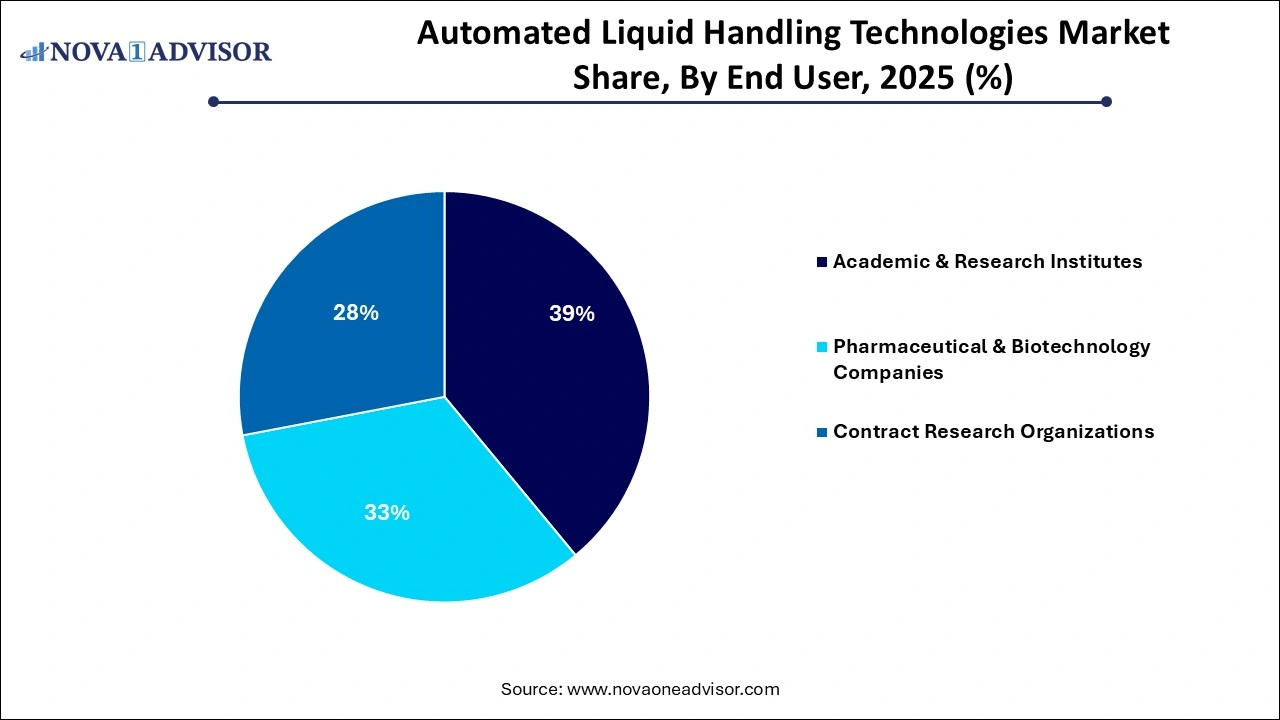
The academic and research institute segment is projected to grow at the highest CAGR in the coming years. This is mainly because of a global surge in research and development investment towards genomics and personalized medicine, which necessitated the transition from manual to automated systems. The high-precision and efficiency required for complex high-throughput screening effectively eliminate human error in critical drug development phases. The integration of AI and advanced robotics further expanded its utility in academic and emerging market labs, making them the standard for modern research infrastructure.
Automated Liquid Handling Technologies Market Regional Insights
What Made North America the Dominant Region in the Automated Liquid Handling Technologies Market?
North America maintained dominance in the automated liquid handling technologies market while holding the largest share in 2025. The region’s dominance is attributed to the robust research and development investment and the heavy presence of industry leaders, such as Thermo Fisher and PerkinElmer. The early and widespread adoption of robotic infrastructure. The advanced workstations became the primary tool for maintaining precision and scalability across North American biotech and clinical labs.
U.S. Automated Liquid Handling Technologies Market Trends
The U.S. is a major contributor to the market in North America due to the integration of AI and cloud services, which enabled predictive error detection and high-precision miniaturized assays. This technological lead met the critical demand for high-throughput screening, allowing labs to process millions of compounds while drastically reducing reagent costs. The shift toward modular, multi-instrument systems and the rapid growth of CROs further accelerated adoption. These advanced systems became the indispensable core of modern, automated, and remote-monitored laboratory environments.
What Makes Asia Pacific the Fastest-Growing Area in the Market?
Asia Pacific is expected to grow at the fastest rate in the coming years. This is due to the massive infrastructure modernization and research and development expansion, strategic government subsidies, such as China’s robotics plan, which incentivized the shift towards high-precision AI and machine learning integrated platforms. The critical need for high-throughput diagnostics and personalized medicine is to drastically reduce human errors.
China Automated Liquid Handling Technologies Market Trends
China is a key player in the Asia Pacific automated liquid handling technologies market due to the integration of AI and advanced robotics, optimized complex protocols, and enabled predictive maintenance, significantly reducing operational errors. The shift toward miniaturization and microfluidics allowed labs to maximize throughput while minimizing costly reagent usage. The specialized requirements of cell and gene therapy manufacturing solidified these high-precision automated systems as the industry standard. The rapid expansion of the biopharmaceutical and diagnostic sectors which required unprecedented speed and consistency.
How is the Opportunistic Rise of Europe in the Automated Liquid Handling Technologies Market?
Europe is experiencing a strategic growth in the market due to a surge in biotech research and development and genomics, which mandated the transition to high-throughput, precise liquid handling. The integration of AI-driven robotics and networked smart lab systems allowed for real-time optimization and seamless data management via LIMS. The long-term scaling of testing infrastructure post pandemic solidified these automated platforms as essential for modern molecular diagnostics. The combination of intelligence and connectivity made workstations the indispensable core of high-volume, automated laboratory workflows.
United Kingdom Automated Liquid Handling Technologies Market Trends
The United Kingdom is leading the market in Europe due to the integration of AI and machine learning revolutionized precision and predictive maintenance, while the trend toward assay miniaturization has significantly slashed reagent costs. The adoption of modular and flexible robotic solutions allows labs to rapidly scale high-throughput screening for complex compound libraries. These advanced workstations became the essential infrastructure for maintaining the UK’s competitive edge in genomics and proteomics.
Automated Liquid Handling Technologies Market Supply Chain Analysis
- R&D and Design: This foundational stage involves designing robotic arms, pipetting heads, sensors, and the integrated software that controls experimental workflows. It focuses on increasing precision, miniaturization, and software interoperability for AI-driven laboratory automation.
Key Players: Hamilton Company, Tecan Group, Agilent Technologies, Eppendorf, Thermo Fisher Scientific, and Opentrons Labworks. - Manufacturing and Assembly: At this stage, manufacturers assemble automated liquid handling workstations, including standalone and integrated systems, along with accessories such as microplate washers.
Key Players: Thermo Fisher Scientific, Tecan Trading AG, Hamilton Company, PerkinElmer, Beckman Coulter, and Analytik Jena. - System Integration and Distribution: This critical step involves installing the hardware and software in the end-user's lab and integrating it with the existing LIMS. System integrators ensure all components communicate effectively, providing tailored automation solutions to laboratories.
Key Players: Hamilton Company, Tecan Group, Biosero Inc. (BICO Group), Hudson Robotics, and Lab Services B.V.
Automated Liquid Handling Technologies Market Companies
- Thermo Fisher Scientific, Inc. provides a wide range of automated liquid handling systems, such as the Thermo Fisher Scientific Versette and Matrix series, designed to improve accuracy and reproducibility in liquid handling, particularly in drug discovery and genomics.
- Agilent Technologies, Inc. offers advanced, highly flexible robotic systems such as the Agilent Technologies Inc. Encore Multispan Liquid Handling System and Bravo Automated Liquid Handling Platform, which are designed to enhance speed and efficiency.
- Aurora Biomed, Inc. contributes to the market with its Versa automated liquid handling workstations, which are specialized for various applications, including sample preparation, drug screening, and genomics. These systems allow for high-throughput, automated pipetting that reduces manual labor and improves experimental consistency in research labs.
- AUTOGEN, INC. specializes in automated instrumentation for nucleic acid extraction and sample preparation, providing tailored liquid handling solutions for genomic research. Their automated platforms focus on maximizing laboratory efficiency and ensuring high-quality results in sample preparation workflows.
- Danaher Corporation is a market leader providing sophisticated liquid handling platforms through its subsidiaries, enabling precise, high-throughput liquid handling for complex biotechnology and clinical diagnostic applications.
Recent Developments
- In August 2025, Thermo Fisher Scientific opened a new 375,000-square-foot, carbon-neutral manufacturing center of excellence in Mebane, North Carolina, designed to produce 40 million pipette tips per week. Supported by a $192.5 million federal contract, the facility boosts domestic supply chain resilience and adds roughly 100 jobs to the company’s North Carolina operations.
- In January 2025, ABB Robotics and Agilent Technologies signed a major collaboration agreement to bridge the gap between heavy industrial robotics and delicate analytical laboratory work. The goal is to create a seamless, open ecosystem where robots handle sample transport, preparation, and data processing.
- In May 2025, BioSkryb Genomics and Tecan Group announced a landmark collaboration to launch a high-throughput, single-cell multiomics workflow. This integrated solution is designed to produce sequencing-ready libraries from hundreds to thousands of individual cells in under ten hours.
Exclusive Analysis on the Automated Liquid Handling Technologies Market
The global automated liquid handling technologies market is leveraging the accelerating demand for high-throughput screening in drug discovery and the need for enhanced precision in genomic/proteomic research. The automated workstations dominate due to their crucial role in pharma R&D, while the cancer and genomic research application is growing fastest, fueled by the rising adoption of NGS and personalized medicine. Geographically, North America leads with the highest market share, while Asia-Pacific is the fastest-growing region due to increased biopharmaceutical R&D investments and lab modernization, particularly in China and India.
Segments Covered in the Report
By Product
- Automated Liquid Handling Workstations
- By Assembly
- Standalone Workstations
- Integrated Workstations
- By Type
- Multipurpose Workstation
- Pipetting Workstation
- Specialized Liquid Handler
- Workstation Module
- Reagents & Consumables
- Reagents
- Accessories
By Application
- Drug Discovery & ADME-Tox Research
- Cancer & Genomic Research
- Bioprocessing/Biotechnology
- Others
By End-User
- Academic & Research Institutes
- Pharmaceutical & Biotechnology Companies
- Contract Research Organizations
By Region
- North America:
- U.S.
- Canada
- Mexico
- Rest of North America
- South America:
- Brazil
- Argentina
- Rest of South America
- Europe
- Western Europe
- Germany
- Italy
- France
- Netherlands
- Spain
- Portugal
- Belgium
- Ireland
- UK
- Iceland
- Switzerland
- Poland
- Rest of Western Europe
- Eastern Europe
- Austria
- Russia & Belarus
- Türkiye
- Albania
- Rest of Eastern Europe
- Asia Pacific:
- China
- Taiwan
- India
- Japan
- Australia and New Zealand,
- ASEAN Countries (Singapore, Malaysia)
- South Korea
- Rest of APAC
- MEA
- GCC Countries
- Saudi Arabia
- United Arab Emirates (UAE)
- Qatar
- Kuwait
- Oman
- Bahrain
- South Africa
- Egypt
- Rest of MEA

Proceed to Buy
Instant PDF delivery on confirmation

Automated Liquid Handling Technologies Market Size to Worth Around USD 8.59 Bn...
 Request Customization
 Download Sample

Get a Sample of this Report
Automated Liquid Handling Technologies Market