

Clinical Data Analytics Solutions Market Size, Share, and Trends 2026 to 2035
 Status Published
 Category Healthcare


Content
Clinical Data Analytics Solutions Market Size and Growth 2026 to 2035
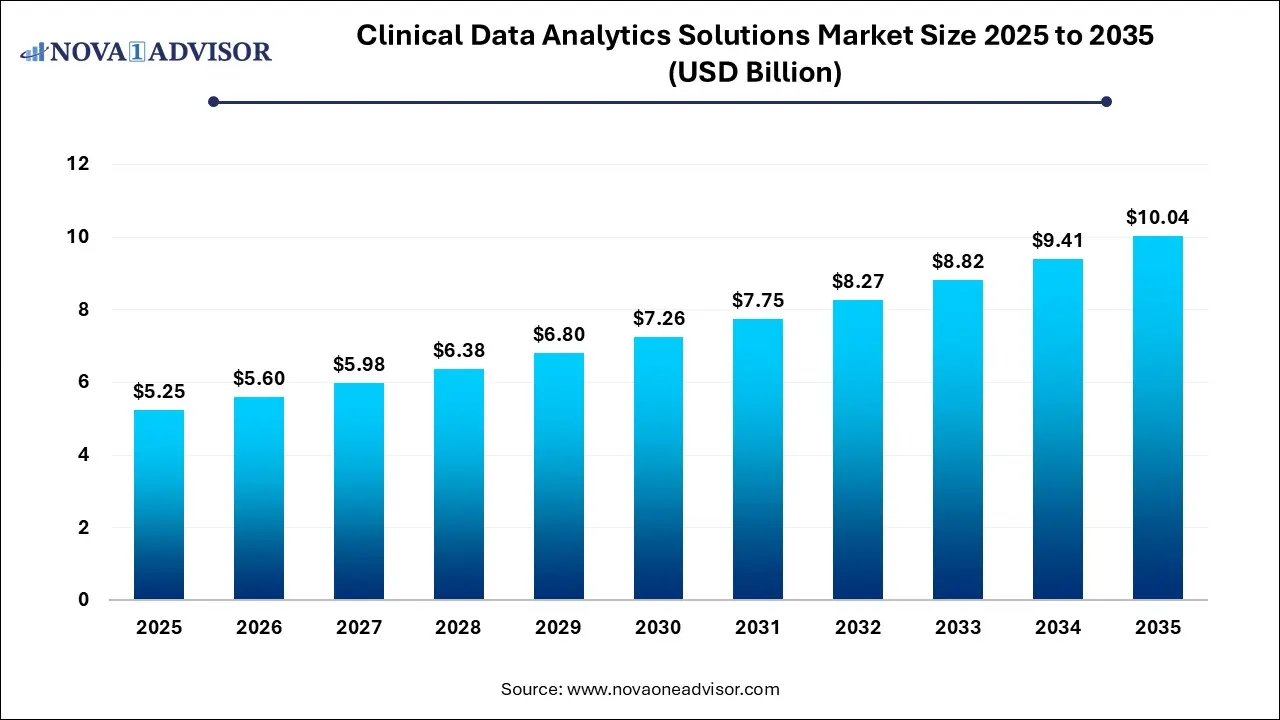
The clinical data analytics solutions market size was estimated at USD 5.25 billion in 2025 and is projected to increase from USD 5.60 billion in 2026 to approximately USD 10.04 billion by 2035, growing at a CAGR of 6.7% from 2026 to 2035. The clinical data analytics solutions market is driven by the rapid digitization of records and the use of wearables, which create massive, actionable datasets, the shift toward value-based care and personalization, and the growing need for cost reduction and quality care.
Key Takeaways
- By deployment, the cloud-based segment held a dominant position in the market with a share of 57% in 2025.
- By deployment, the on-premises segment is the fastest growing between 2026 and 2035.
- By application, the clinical trials segment held a dominant position in the market with a share of 35% in 2025.
- By application, the clinical decision support segment is the fastest growing between 2026 and 2035.
- By region, the North America region held a dominant position in the market with a share of 39% in 2025.
Innovation Driving Transformation in the Clinical Data Analytics Solutions Market
Clinical data analytics solutions comprise advanced software and tools designed to collect, process, and analyze vast volumes of electronic health records, imaging, and real-world data to generate actionable insights. These solutions provide significant benefits, including enhanced diagnostic accuracy, personalized medicine, improved patient outcomes, and reduced operational costs for healthcare providers. Applications are widespread, ranging from clinical trial optimization and drug discovery in pharma to early disease detection, predictive risk modeling, and population health management.
Clinical Data Analytics Solutions Market Trends
- Rapid Expansion of RWD and RWE Analytics
Regulators and pharmaceutical companies are increasingly relying on RWE data collected outside traditional clinical trials, such as wearable devices and electronic patient-reported outcomes, to speed up drug approvals and evaluate treatment effectiveness. This allows providers to understand how medicines work in diverse, real-world populations.
- Maturation of Hybrid and Cloud-Native Architectures
Cloud-based solutions now dominate the market, offering scalable computing power necessary for large-scale data processing. Hybrid models are also growing rapidly, allowing health systems to maintain local control over sensitive patient identifiers while using the cloud for high-intensity model training.
- Adoption of Precision Health and Personalized Care Analytics
Clinical analytics are shifting from one-size-fits-all approaches toward tailoring treatment plans based on a patient’s genetic, environmental, and lifestyle data. This trend is heavily reliant on advanced analytics to analyze genomic data alongside standard clinical data to optimize patient outcomes.
Key AI Integration in the Clinical Data Analytics Solutions Market
AI and ML are transforming the clinical data analytics industry by accelerating trial timelines and improving decision-making through advanced automation, and AI integration can speed up clinical trials. These technologies improve data quality and consistency by automating manual tasks such as coding and mapping, thereby enabling better processing of unstructured clinical data from EHRs. ML algorithms are enhancing predictive analytics, allowing providers to predict patient deterioration or adverse events before they happen, moving care from reactive to proactive.
Clinical Data Analytics Solutions Market Report Scope
| Report Coverage | Details |
| Market Size in 2026 | USD 5.60 Billion |
| Market Size by 2035 | USD 10.04 Billion |
| Growth Rate From 2026 to 2035 | CAGR of 6.7% |
| Base Year | 2025 |
| Forecast Period | 2026 to 2035 |
| Segments Covered | Deployment, Application, Region |
| Market Analysis (Terms Used) | Value (USD Million/Billion) or (Volume/Units) |
| Regional Scope | North America; Europe; Asia Pacific; Central and South America; the Middle East and Africa |
| Key Companies Profiled | Optum, Inc. (UnitedHealth Group); Oracle Corporation; SAS Institute; IQVIA; Health Catalyst; eClinical Solutions LLC; OSP; BD; Dassault Systèmes; Cognizant; Epic Systems; MedeAnalytics; Veradigm; ICON plc; IBM; Arcadia |
Market Dynamics
Driver
Rising Volume and Complexity of Clinical Trials
The intricate protocol decision, personalized medicine, and extensive data collection from electronic health records and wearables directly fuel the demand for advanced data analytics solutions to ensure efficient management and analysis. As trials generate massive, diverse, and disparate datasets, pharmaceutical companies and CROs rely on these analytics platforms for real-time monitoring, predictive modeling, and data-driven insights to streamline operational workflows and reduce trial timelines.
Restraint
High Implementation and Maintenance Costs
The market growth is hindered by creating a high barrier to entry, particularly for smaller hospitals and clinics with limited budgets. The substantial initial investment required for software and data security compliance leads to slow adoption rates and extended procurement timelines. These financial pressure forces many organizations to limit adoption to select use cases, which prevents the widespread implementation of comprehensive data strategies and limits the overall expansion of the market.
Opportunity
Integration of Real-World Data (RWD)
The enabling faster, more precise patient recruitment and trial design, reducing overall development timelines. By leveraging this data to generate actionable Real-World Evidence (RWE), pharmaceutical companies can better demonstrate drug efficacy and safety in diverse, non-controlled settings, facilitating regulatory approvals and post-market surveillance.
Segment Insights
By Deployment Insights
Why Did the On-Premise Segment Hold a 43% Share for the Clinical Data Analytics Solutions Market?
The On-premise segment held a dominant position in the market with a share of 43% in 2025. Owing to its advantages in control and security, the higher cost and maintenance requirements make cloud-based solutions more appealing. The regulatory requirements in various regions mandate that patient data stay within national borders, making local on-premise servers a reliable choice for compliance.
The cloud-based segment held a 57% share of the market in 2025, as the growing trend toward digital transformation and the flexibility of cloud solutions contribute to their market dominance. Advances in security measures and regulatory compliance have increased trust in cloud adoption for sensitive private health.
By Application Insights
Why Did the Clinical Decision Support Segment Lead the Clinical Data Analytics Solutions Market?
The clinical decision support segment registered its dominance over the market with a share of 30% in 2025, owing to the increased demand for precision medicine and real-time decision-making tools, which drive the adoption of clinical decision support systems. Advanced CDS systems use AI to analyze large datasets, fostering predictive analytics and personalized medicine.
The clinical trials segment held the 35% share of the market in 2025, with the growing focus on research and development in the healthcare sector is expanding the demand for clinical trial management solutions. The increasing number of clinical trials, combined with the rise of decentralized and hybrid trial models, and high investment in research and development.
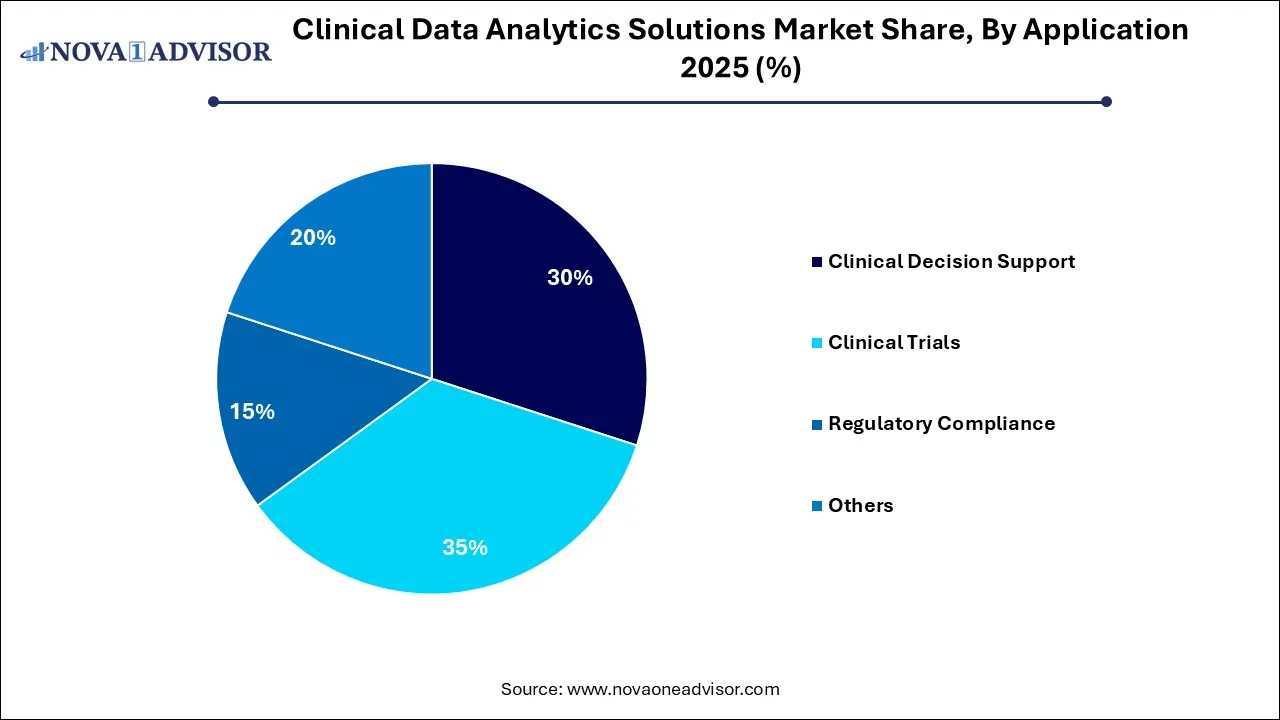
The regulatory compliance segment held the 15% share of the market in 2025, due to the fact that regulatory compliance is essential, but it is seen as more of a necessity than a growth driver compared to decision support and clinical trials. The industry's shift toward value-based care requires robust analytics for quality measurement and patient data management.
The other segment held a 20% shar of the market in 202, due to the increasing diversity of applications beyond clinical and regulatory domains, which is broadening the scope of the market. Industries are increasingly deploying specialized, often cloud-based, solutions to manage complex data from diverse sources and the integration of advanced technology.
By Regional Insights
Why Did the North America Region Lead the Clinical Data Analytics Solutions Market?
The North America region registered its dominance over the market with a share of 43% in 2025, owing to the high investments in healthcare IT and innovation, along with stringent regulations, which boost its market share. A strong emphasis on improving patient outcomes while reducing costs encourages the integration of predictive analytics and population health management tools.
The Europe region held the 28% share of the market in 2025, despite robust healthcare systems, the regulatory complexity and market fragmentation slowed. The high investment in AI, machine learning, and predictive analytics, especially in oncology and rare disease treatment, is accelerating the need for data analytics solutions.
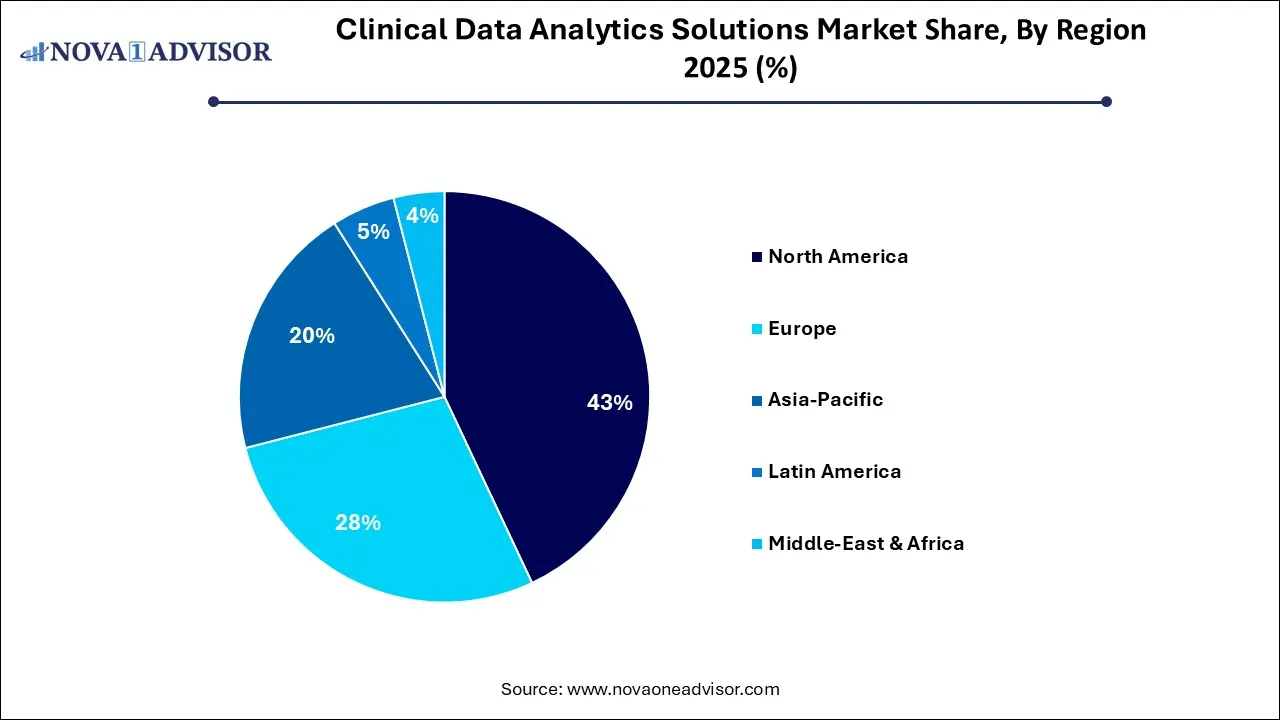
The Asia Pacific segment held 20% share of the market in 2025, due to the rising healthcare demand, especially in China and India, and increased government spending are driving growth in this region. The rising prevalence of chronic conditions requires sophisticated data analytics for monitoring and management, accelerating the adoption of specialized solutions.
The Latin America region held 5% share of the market in 2025, with growing demand for virtual care and digital intelligence, accelerating the need for data-driven, remote monitoring solutions. Growing emphasis on population health management, operational efficiency, and reducing costs.
The MEA region held 4% share of the market in 2025, due to the shift toward cloud-based deployment, driving the need for scalable, real-time data access. Growing demand for personalized medicine and managing chronic disease prevalence requires advanced analytics, driving adoption among providers.
Recent Developments
- In September 2025, developed by Epic, Yale University, and Microsoft Research, Curiosity is a generative healthcare intelligence platform trained on the Cosmos dataset to simulate patient health trajectories. Operating within the Epic EHR, this foundation model predicts clinical outcomes and optimizes hospital resources while maintaining a privacy-first architecture.
- In August 2025, IQVIA and Veeva Systems entered a long-term strategic partnership to integrate their clinical and commercial ecosystems, effectively resolving all pending legal litigation. This collaboration enables seamless data sharing between IQVIA’s vast information sets and Veeva’s Vault software suite, utilizing advanced AI and Agentic technologies to accelerate drug development and streamline commercial orchestration.
- In March 2025, Datavant, the industry's leading health data collaboration company, officially unveiled its Clinical Insights Platform, an end-to-end solution designed to eliminate data fragmentation for health plans and risk-bearing providers. Developed through the strategic integration of Apixio’s technology, the platform combines the nation’s largest medical record retrieval network, covering 75% of top U.S. health systems, with advanced, distinctively trained AI to automate chart identification, acquisition, and coding.
Clinical Data Analytics Solutions Market Companies
- Optum, Inc. (UnitedHealth Group)
- SAS Institute
- Oracle
- IQVIA
- eClinical Solutions LLC
- Health Catalyst
- OSP
- Dassautt Systèmes
- BD
- Cognizant
- MedeAnalytics
- Epic Systems
- ICON plc
- Arcadia
- IBM
Segments Covered in the Report
This report forecasts revenue growth at country levels and provides an analysis of the latest industry trends in each of the sub-segments from 2021 to 2035. For this study, Nova one advisor, Inc. has segmented the clinical data analytics solutions market.
By Deployment
- On-premise
- Cloud-based
By Application
- Clinical Decision Support
- Clinical Trials
- Regulatory Compliance
- Others
By Region
- North America
- Europe
- Asia Pacific
- Latin America
- Middle East and Africa (MEA)
FAQ's

Proceed to Buy
Instant PDF delivery on confirmation

Clinical Data Analytics Solutions Market Size to Hit USD 10.04 Billion by 2035
 Request Customization
 Download Sample

Get a Sample of this Report
Clinical Data Analytics Solutions Market