

European Medical Devices Market Size, Share, Forecast Report, 2026-2035
 Status Published
 Category Healthcare


Content
European Medical Devices Market Size, Growth and Trends 2026 to 2035
The global european medical devices market size was estimated at USD 61.85 billion in 2025 and is expected to reach USD 99.79 billion by 2035, growing at a CAGR of 4.9% from 2025 to 2035.
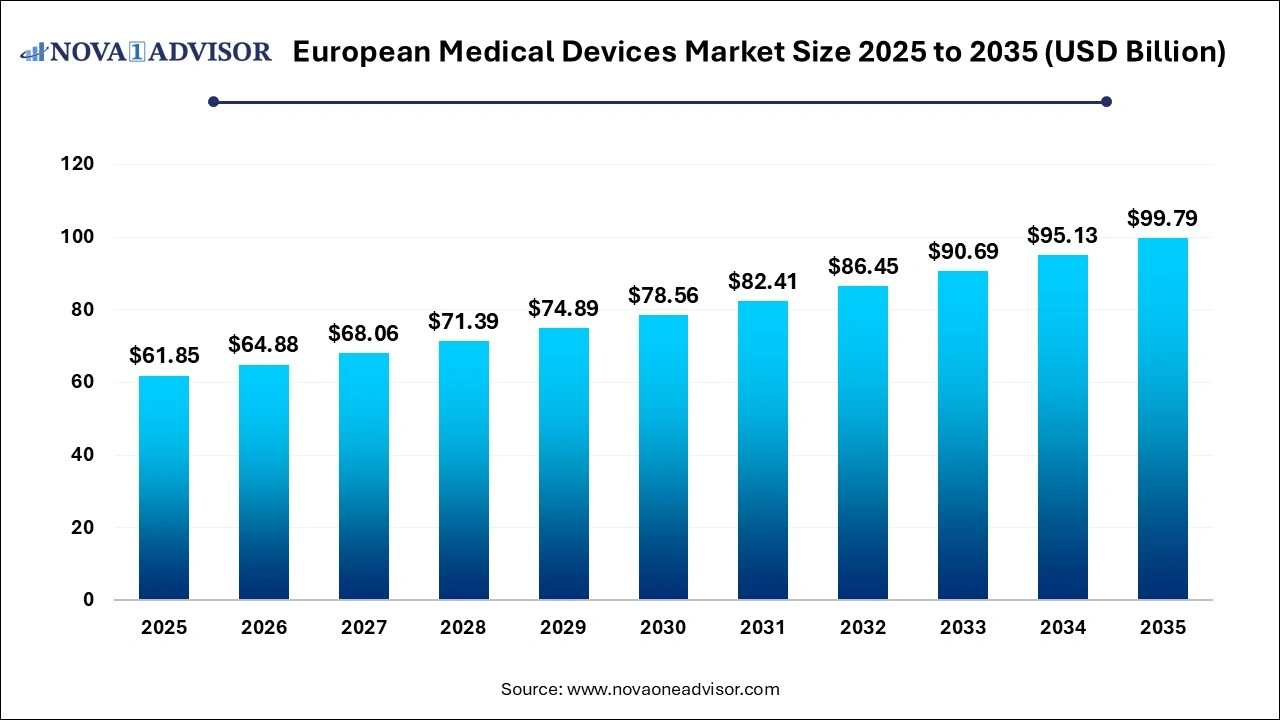
European Medical Devices Market Outlook
- Market Growth Overview: The European medical devices market is expected to grow significantly between 2026 and 2035, driven by the increasing aging population and chronic diseases, significant investment in technological advancement and digitalization, and high demand for diagnostic imaging and IVD.
- Sustainability Trends: Sustainability trends involve eco-friendly design and compliance, circular economy in reprocessing and refurbishment, and material innovation and substitution.
- Major Investors: Major investors in the market include Europa, EIC Fund, EIT Health, HTGF (High-Tech Gründerfonds), and Enterprise Ireland.
Report Scope of European Medical Devices Market
| Report Coverage | Details |
| Market Size in 2026 | USD 9.38 Billion |
| Market Size by 2035 | USD 64.88 Billion |
| Growth Rate From 2026 to 2035 | CAGR of 4.9% |
| Base Year | 2025 |
| Forecast Period | 2026 to 2035 |
| Segments Covered | By Device Type, By End User |
| Market Analysis (Terms Used) | Value (USD Million/Billion) or (Volume/Units) |
| Regional scope | North America; Europe; Asia Pacific; Latin America; MEA |
| Key Companies Profiled | Siemens Healthineers, GE Healthcare, Philips, Abbott (US) |
European Medical Devices Market Segment Insights
By Device Type Insights
How did the In-vitro Diagnostic Segment Dominate the European Medical Devices Market?
The adult stem cell segment is driven by a critical inflection point where technological acceleration meets definitive regulatory enforcement. With the aging population and chronic disease burden, the industry is shifting toward a decentralized, data-driven model powered by AI, molecular diagnostics, and point-of-care testing. The new era where operational resilience and digital integration serve as the primary competitive filters for market leadership.
How did the anaesthesia monitoring segment expect to hold the fastest-growing European Medical Devices market in the coming years?
The anaesthesia monitoring segment is driven by the critical convergence of AI-driven automation and a surge in complex surgeries for an aging population. The shift toward smart, wireless workstations that integrate seamlessly into modernised surgical suites and ambulatory centers, prioritising real-time patient safety and resource efficiency. With strict MDR/IVDR compliance and a shift toward sustainable, low-flow technologies, innovation is now measured by its ability to reduce human error and environmental impact.
By End User Insights
How did the Hospitals and Clinic Care Centres Segment Account for the Largest share in the European Medical Devices Market?
The hospitals and clinic care centres segment is driven by the massive scale of acute care and a decisive shift toward high-tech, automated infrastructure. Dominance is maintained through continuous investment in advanced imaging, robotic surgery, and ICU modernization, alongside robust government funding that prioritizes early diagnosis and chronic disease management. While outpatient care is growing, hospitals still capture the largest revenue share globally by serving as the essential hubs for complex surgeries and the integration of AI-driven clinical tools.
How did the Home Care Setting Segment Expect to Hold the Fastest-Growing European Medical Devices Market in the Coming years?
The home care setting segment is driven by a strategic shift from institutional to decentralized healthcare. The accelerating "hospital-at-home" models aim to achieve cost-optimization while maintaining high-quality outcomes through AI-driven remote monitoring. The integrated digital ecosystems where wearable sensors and therapeutic devices provide real-time, EHR-synced data, transforming chronic disease management into a proactive, personalized service.
Key Players in the European Medical Devices Market
- Siemens Healthineers: As a leader in medical imaging, laboratory diagnostics, and artificial intelligence, Siemens Healthineers shapes the European market by providing advanced diagnostic and therapeutic technologies to hospitals.
- GE Healthcare: GE HealthCare strengthens the European market through its focus on precision care, providing intelligent devices, data analytics, and software that enable faster, more informed clinical decisions.
- Philips: Headquartered in the Netherlands, Philips drives the European market by leading in health technology, particularly in diagnostic imaging, image-guided therapy, and patient monitoring.
- Abbott (US): Abbott plays a crucial role in the European medical devices market with its strong portfolio in point-of-care diagnostics, structural heart solutions, and vascular technologies.
Segments Covered in the Report
By Device Type
- Imaging Systems
- Endoscopy Devices
- Interventional Cardiology Devices
- Cardiac Monitoring and Cardiac Rhythm Management Devices
- Ventilators
- Orthopedic Devices
- Ophthalmic Devices
- Diabetes Care Devices
- Dialysis Devices
- Anesthesia Monitoring
- Respiratory Care Devices
By End-User
- Hospital and Clinic Care Settings
- Home-care Settings
By Country/Regio
- Europe
- Germany
- UK
- France
- Italy
- Spain
- Poland
- Rest of Europe (RoE)

Proceed to Buy
Instant PDF delivery on confirmation

European Medical Devices Market Size to Worth Around USD 99.79 Bn by 2035
 Request Customization
 Download Sample

Get a Sample of this Report
European Medical Devices Market