

HLA Typing for Transplant Market Size, Share, Forecast Report, 2026-2035
 Status Published
 Category Healthcare


Content
HLA Typing for Transplant Market Size, Growth and Trends 2026 to 2035
The global HLA typing for transplant market size was estimated at USD 968.25 million in 2025 and is expected to reach USD 1,817.54 million by 2035, growing at a CAGR of 6.5% from 2026 to 2035.
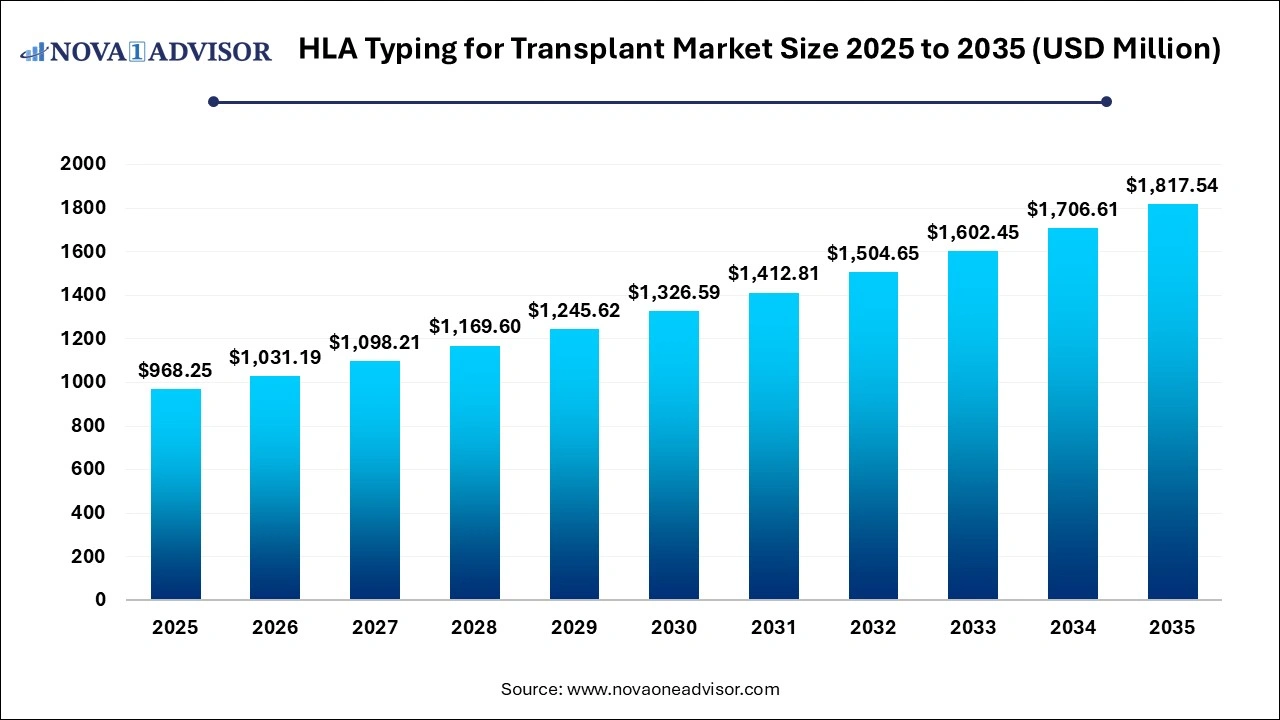
HLA Typing for Transplant Market Outlook
- Market Growth Overview: The HLA typing for transplant market is expected to grow significantly between 2026 and 2035, driven by the rising organ transplantation volumes, advancement in molecular diagnostics, and reduced rejection rates and enhanced success.
- Sustainability Trends: Sustainability trends involve the rise of high-throughput NGS platforms, automation in laboratory workflows, and growing focus on post-transplant monitoring.
- Major Investors: Major investors in the market include Thermo Fisher Scientific, Inc., CareDx, Inc., Bio-Rad Laboratories, Inc., F. Hoffmann-La Roche Ltd., and Illumina, Inc.
HLA Typing for Transplant Market Report Scope
| Report Coverage | Details |
| Market Size in 2026 | USD 1,031.19 Million |
| Market Size by 2035 | USD 1,817.54 Million |
| Growth Rate From 2026 to 2035 | CAGR of 6.5% |
| Base Year | 2025 |
| Forecast Period | 2026 to 2035 |
| Market Analysis (Terms Used) | Value (USD Million/Billion) or (Volume/Units) |
| Segments Covered | By Technology, By Product and Services, By End-User, By Application |
| Regional Scope | North America; Europe; Asia Pacific; Central and South America; the Middle East and Africa |
| Key Companies Profiled | Thermo Fisher Scientific, Inc., QIAGEN N.V., Illumina, CareDx, Inc |
HLA Typing for Transplant Market Segmental Insights
By Technology Insights
How did the PCR-Based Molecular Assays Segment Dominate the HLA Typing for Transplant Market?
The PCR-based molecular assays segment is driven by its ability to provide high-resolution results with the rapid turnaround times essential for transplant success. The widespread adoption, cost-effectiveness, and consistent demand for recurring consumables. As transplant volumes rise, PCR remains the foundational technology for ensuring precise donor-recipient matching across global clinical workflows.
How did the Next-Generation Sequencing Segment Expect to Hold the Fastest-Growing HLA Typing for Transplant Market in the Coming Years?
The next-generation sequencing segment is driven by the transformative shift in the HLA typing market, offering superior accuracy by eliminating the ambiguities of traditional PCR and Sanger methods through high-resolution, phased sequencing. Enhanced by automated workflows and decreasing costs, NGS platforms like those from Illumina and Thermo Fisher are becoming more accessible to mid-sized laboratories.
By Product & Services Insights
How did the Reagents and Consumables Segment Account for the Largest Share in the HLA Typing for Transplant Market?
The reagents and consumables segment is driven by the massive recurring revenue stream, as every HLA test requires specialized, proprietary kits and buffers. The global rise in transplant procedures and the shift toward high-throughput NGS and PCR assays. As laboratories increasingly adopt automated workflows, the continuous need for high-quality, compatible consumables ensures this segment remains the primary financial driver of the HLA typing industry.
How did the Software and Services Segment Expect to Hold the Fastest-Growing HLA Typing for Transplant Market in the Coming Years?
The software and services segment is driven by the massive data demands of next-generation sequencing, requiring specialized platforms for high-resolution HLA interpretation. The integration of AI-driven automation and predictive analytics is accelerating this growth by improving matching accuracy and reducing the risk of graft rejection. As hospitals increasingly outsource complex testing to technology-rich reference labs, this segment has become the fastest-growing critical link in modern transplant medicine.
By End-User Insights
How did the Independent Reference Laboratories Segment Account for the Largest Share in the HLA Typing for Transplant Market?
The independent reference laboratories segment is driven by the leveraging of high-throughput automation and state-of-the-art NGS platforms that most hospitals cannot maintain in-house. Their ability to deliver superior accuracy and rapid turnaround times makes them the primary choice for complex immunogenetic testing and post-transplant monitoring. As outsourcing trends grow, these centralized hubs remain the critical backbone for comprehensive allele matching and specialized diagnostic services globally.
How did the Hospitals and Transplant Centers Segment Expect to Hold the Fastest-Growing HLA Typing for Transplant Market in the Coming Years?
The hospitals and transplant centers segment is driven by the adoption of high-resolution NGS and automated molecular assays, allowing for precise, in-house HLA typing. By integrating these platforms with electronic health records (EHR), centers are significantly streamlining workflows to manage rising transplant volumes more efficiently. Strong strategic partnerships with diagnostic manufacturers further ensure specialized technology access, making these facilities the fastest-growing hub for comprehensive pre- and post-transplant monitoring.
By Application Insights
How did the Diagnostic Applications Segment Account for the Largest Share in the HLA Typing for Transplant Market?
The diagnostic applications segment is driven by the rising organ failure rates. This segment is evolving through high-resolution NGS for rapid allele detection and comprehensive infectious disease screening. The increasing focus on post-transplant antibody monitoring ensures that diagnostic services remain the primary, high-volume engine for long-term graft survival.
How did the Chimerism Monitoring Segment Expect to Hold the Fastest-Growing HLA Typing for Transplant Market in the Coming Years?
The chimerism monitoring segment is driven by the transition from traditional STR-PCR to highly sensitive NGS methods like CareDx’s AlloSeq HCT. This technology allows for the detection of microchimerism as low as 0.3%, enabling clinicians to predict relapses early and initiate preemptive therapies, such as Donor Lymphocyte Infusion (DLI). As hematological cancer treatments expand, the demand for automated, lineage-specific analysis is surging to ensure rapid, precise monitoring of graft health.
Key Players in the HLA Typing for Transplant Market
- Thermo Fisher Scientific, Inc.: As a market leader, Thermo Fisher provides a comprehensive portfolio of One Lambda brand products, including PCR-based assays, NGS-based technologies, and antibody detection tools, which are essential for high-precision HLA typing and donor–recipient matching.
QIAGEN N.V.: QIAGEN contributes to the HLA typing market by providing high-quality molecular diagnostic tools, specifically focusing on next-generation sequencing (NGS) platforms such as the QIAseq HLA Typing Panel to achieve high-resolution, precise results. - Illumina: As a pioneer in NGS technology, Illumina offers specialized sequencing instruments, such as the MiSeq System and Nextera Flex for Enrichment, that generate accurate, high-throughput, phase-resolved HLA typing data.
- CareDx, Inc.: CareDx specializes in transplant-specific diagnostics, offering advanced NGS-based HLA typing solutions such as the AlloSeq Tx platform, which enables high-resolution genotyping and haplotyping without the need for family studies.
This Research Report Categorizes the HLA Typing for Transplants Market into the Following Segments and Subsegments
By Technology
- Molecular Assay Technologies
- PCR-Based Molecular Assays
- Real-time PCR
- Sequence-specific Primer-PCR
- Sequence-specific Oligonucleotide-PCR
- Other PCR-based Molecular Assays
- Sequencing-based Molecular Assays
- Sanger Sequencing
- Next-generation Sequencing
- Other Sequencing-based Molecular Assays
- PCR-Based Molecular Assays
- Non-molecular Assay Technologies
By Product & Service
- Reagents & Consumables
- Instruments
- Software & Services
By Application
- Diagnostic Applications
- Antibody Screening
- Chimerism Monitoring
- Others
- Research Applications
By End-User
- Independent Reference Laboratories
- Hospitals & Transplant Centers
- Research Laboratories & Academic Institutes
By Region
- North America
- US
- Canada
- Europe
- Germany
- France
- UK
- Spain
- Italy
- RoE
- Asia Pacific
- China
- Japan
- Australia
- South Korea
- India
- RoAPAC
- Latin America
- Brazil
- Mexico
- RoLATAM
- Middle East and Africa

Proceed to Buy
Instant PDF delivery on confirmation

HLA Typing for Transplant Market Size to Worth Around USD 1,817.54 Mn by 2035
 Request Customization
 Download Sample

Get a Sample of this Report
HLA Typing for Transplant Market