

mHealth Solutions Market (By Product and Services; By Healthcare Apps; By Connected Devices )- Global Industry Analysis, Share, Growth, Regional Outlook And Forecasts, 2021-2027
 Status Published
 Category Healthcare


Content
mHealth Solutions Market Size, Growth and Trends 2026 to 2035
The global mHealth solutions market size was valued at USD 192.68 billion in 2025 and is expected to reach USD 2,099.87 billion by 2035, growing at a CAGR of 26.98% from 2025 to 2035.
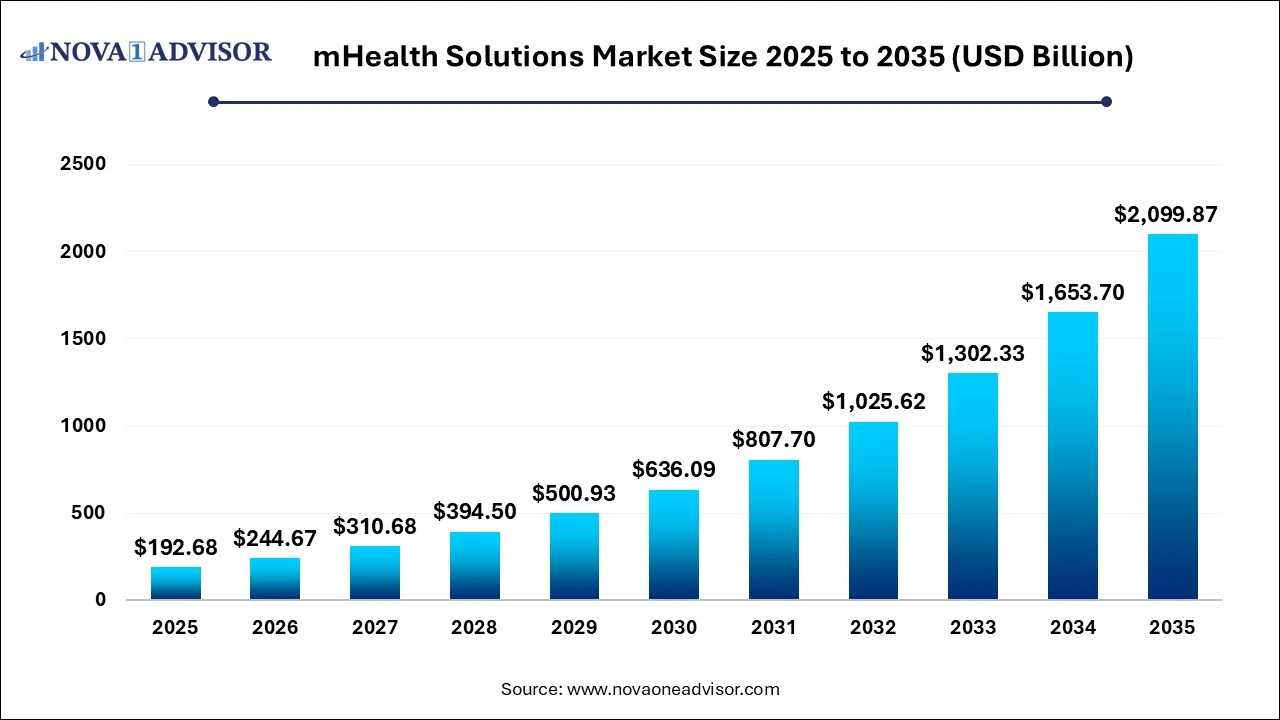
mHealth Solutions Market Outlook
- Market Growth Overview: The mhealth solutions market is expected to grow significantly between 2026 and 2035, driven by the proliferation of smartphones and connectivity, increasing chronic disease prevalence, and rising demand for personal health management.
- Sustainability Trends: Sustainability trends involve human-centered design for higher adoption, integration of AI for long term relevance, and interoperability and ecosystem integration.
- Major Investors: Major investors in the market include Apple, Google, Samsung, Philips Healthcare, Medtronic, and Qualcomm.
Unravelling the Critical Segments
mHealth Solutions Market Report Scope
| Report Coverage | Details |
| Market Size in 2025 | USD 244.67 Billion |
| Market Size by 2036 | USD 2,099.87 Billion |
| Growth Rate From 2026 to 2035 | CAGR of 26.98% |
| Base Year | 2025 |
| Forecast Period | 2026 to 2035 |
| Segments Covered | By Product and Services, By Healthcare Apps, By Connected Devices |
| Market Analysis (Terms Used) | Value (USD Million/Billion) or (Volume/Units) |
| Regional Scope | North America; Europe; Asia Pacific; Central and South America; the Middle East and Africa |
| Key Companies Profiled | Medtronic plc, AirStrip Technologies, Nike, Inc, Omron Corporation |
mHealth Solutions Market Segmental Insights
By Product and Services Insights
How did the mHealth Services segment dominate the mHealth Solutions market?
The mHealth services segment is driven by healthcare providers using professional services to manage post-acute care and long-term conditions through secure, specialized digital platforms. The proliferation of smartphones and high-speed internet has made these services globally accessible to a health-conscious consumer base. The shift toward remote-first healthcare has established services as the primary revenue engine for the mHealth ecosystem.
How did the mHealth Apps segment expect to hold the fastest-growing mHealth Solutions Market in the Coming Years?
The mHealth apps segment is driven by the integration of AI and real-time analytics with wearable devices, which significantly enhances clinical-decision-making and patient engagement. A rapid shift towards remote patient monitoring and virtual care apps is reducing the necessity for in-person medical visits. The rising adoption of specialized apps for mental health and women’s health ensures the most dynamic area of digital healthcare.
By Healthcare Apps Insights
How did the Fitness & Nutrition Segment Account for the Largest Share in the mHealth Solutions Market?
The fitness & nutrition segment is driven by rising health awareness and a global trend toward proactive wellness among millennials. Driven by a surge in obesity and sedentary lifestyles, consumers are increasingly adopting these tools for personalized nutrition, weight management, and exercise tracking. The seamless integration of wearable technology, such as smartwatches, has further simplified health data collection, boosting user engagement and retention.
How did the Chronic Care Management Segment Expect to Hold the Fastest-Growing mHealth Solutions Market in the Coming Years?
The chronic care management segment is driven by the global surge in diabetes, heart conditions, and respiratory issues. Real-time data transmission from wearables and mobile apps enables proactive remote care, significantly reducing costly hospital visits and readmissions. By favorable government policies in North America and Europe that incentivize the adoption of digital health platforms.
By Connected Devices Insights
How did the Blood Glucose Segment Account for the Notable Share in the mHealth Solutions Market?
The blood glucose segment is driven by the global surge in chronic conditions and the high demand for consistent monitoring tools. The integration of Continuous Glucose Monitoring (CGM) and wearable devices with smartphone apps has revolutionized care by enabling real-time data tracking and automated analysis. The shift toward telehealth and remote monitoring has established these apps as the most cost-effective and clinically adopted solutions in mHealth.
How did the Neurological Segment Expect to Hold the Fastest-Growing mHealth Solutions Market in the Coming Years?
The neurological segment is driven by the rising global prevalence of Parkinson’s and Alzheimer’s. Advanced medical-grade sensors and AI now enable real-time tracking of brain health and early disease detection, shifting care from clinics to the home. This growth is further accelerated by tele-neurology and digital therapeutic, which offer remote rehabilitation and cognitive therapy for patients with movement impairments. By targeted government funding, such as the BRAIN Initiative, these innovations are cementing neurological software as a critical pillar of modern mHealth.
Key Players in the mHealth Solutions Market
- Medtronic plc: Medtronic advances the mHealth market by providing connected, app-based remote patient monitoring systems for chronic disease management, such as advanced insulin pumps and pacemaker systems.
- AirStrip Technologies: AirStrip specializes in creating mobile interoperability platforms that allow healthcare professionals to securely access real-time patient data, including ECGs and fetal monitoring, on their smartphones.
- Nike, Inc.: Nike contributes to the mHealth space by integrating wellness-focused technologies into personal health through mobile applications that promote fitness tracking and active lifestyle management. Their digital apps serve a large consumer base, encouraging healthy habits that help in the broader prevention segment of mobile health.
- Omron Corporation: Omron is a leader in mobile-connected blood pressure monitors, promoting proactive health management by allowing users to track vital signs via app-based systems. They are expanding their Going for ZERO preventive care strategy by using data solutions to connect home health devices to electronic medical records for better chronic disease management.
This research report offers market revenue, sales volume, production assessment and prognoses by classifying it on the basis of various aspects including product type, application/end-user, and region. Further, this research study investigates market size, production, consumption and its development trends at global, regional, and country level for period 2017 to 2027 and covers subsequent region in its scope:
By Product & Service
- Connected Medical Devices
- Vital Signs Monitoring Devices
- Blood Pressure Monitors
- Blood Glucose Meters
- ECG/Heart Rate Monitors
- Pulse Oximeters
- Vital Signs Monitoring Devices
- Peak Flowmeters
- Fetal Monitoring Devices
- Multiparameter Trackers
- Sleep Apnea Monitors
- Neurological Monitoring Devices
- Other Connected Medical Devices
- Vital Signs Monitoring Devices
By Healthcare Apps
- Healthcare Apps
-
- Health Tracking Apps
- Obesity & Weight Management Apps
- Fitness & Nutrition Apps
- General Health & Fitness Apps
- Chronic Care Management Apps
- Mental Health & Behavioral Disorder Management Apps
- Diabetes Management Apps
- Blood Pressure & ECG Monitoring Apps
- Cancer Management Apps
- Other Chronic Care Management Apps
-
- Medication Management Apps
-
- Pregnancy Apps
- Fertility Apps
- Breastfeeding Apps
- Other Women’s Health Apps
- Women’s Health Apps
- Personal Health Record Apps
- Other Healthcare Apps
-
By Connected Devices
- Continuing Medical Education Apps
- Patient Management & Monitoring Apps
- Communication & Consulting Apps
By mHealth Services
- Remote Monitoring Services
- Diagnosis & Consultation Services
- Treatment Services
- Healthcare System Strengthening Services
- Fitness & Wellness Services
- Prevention Services
By Region
- North America
- U.S.
- Canada
- Europe
- Germany
- France
- United Kingdom
- Rest of Europe
- Asia Pacific
- China
- Japan
- India
- Southeast Asia
- Rest of Asia Pacific
- Latin America
- Brazil
- Rest of Latin America
- Middle East & Africa (MEA)
- GCC
- North Africa
- South Africa
- Rest of Middle East & Africa

Proceed to Buy
Instant PDF delivery on confirmation

MHealth Solutions Market Size to Worth Around USD 2,099.87 Bn by 2035
 Request Customization
 Download Sample
Warning: Trying to access array offset on value of type null in /home/multiwpmr/public_html/report-details.php on line 1145

Get a Sample of this Report
mHealth Solutions Market