

Global Pipettes, Pipettors, and Accessories Market Size, Share, Forecast Report, 2026-2035
 Status Published
 Category Healthcare


Content
Pipettes, Pipettors, and Accessories Market Size and Growth 2026 to 2035
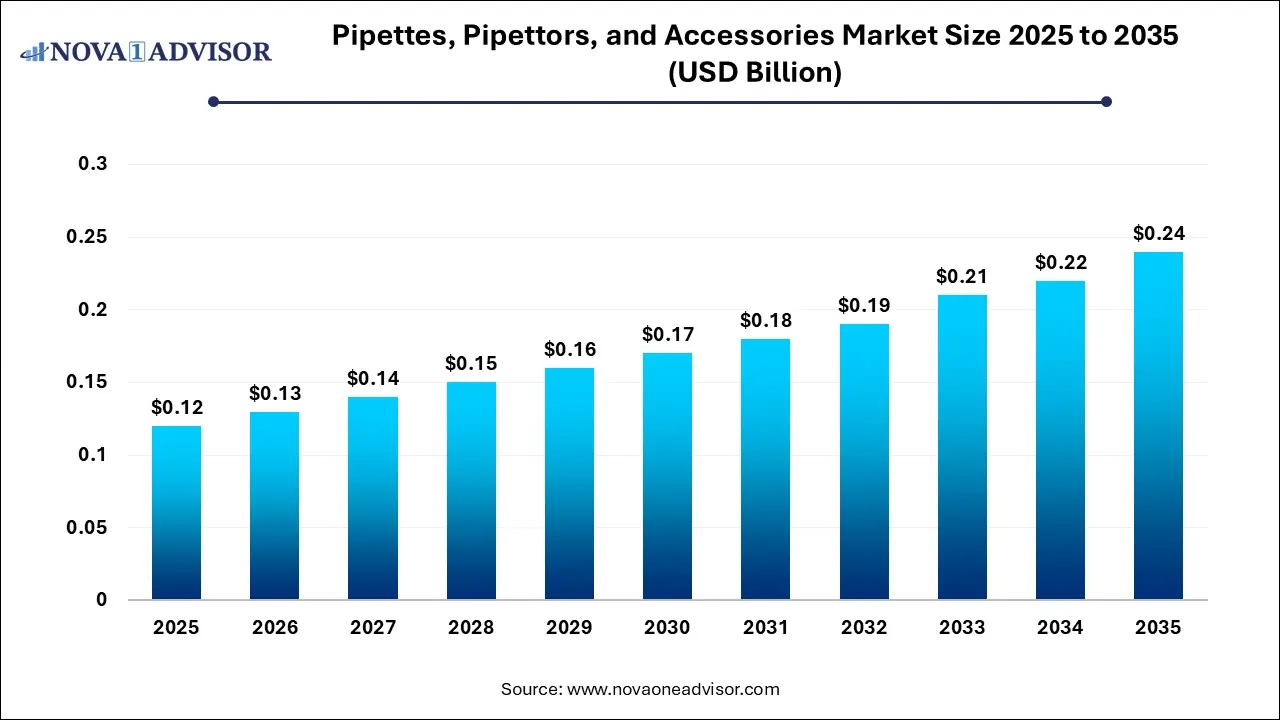
The global pipettes, pipettors, and accessories market size was estimated at USD 0.12 billion in 2025 and is projected to hit around USD 0.24 billion by 2035, growing at a CAGR of 7.23% during the forecast period from 2026 to 2035.
Market Overview
The pipettes, pipettors, and accessories market plays a critical role in modern laboratory and healthcare operations by enabling accurate liquid handling in scientific research, diagnostics, pharmaceutical development, and biotechnology applications. Pipettes and pipettors are essential laboratory instruments designed to measure and transfer precise liquid volumes, while accessories such as tips, fillers, calibration tools, and stands support operational efficiency and contamination control.
The market has experienced substantial growth over the past decade due to the increasing demand for laboratory testing, molecular diagnostics, and drug discovery activities. Growing prevalence of infectious diseases, rising demand for precision medicine, and expanding genomic research have significantly increased the requirement for reliable liquid handling systems. Pipettors are widely used in polymerase chain reaction (PCR), cell culture, immunoassays, sequencing, and microbiological testing, making them indispensable in laboratory environments.
The pharmaceutical and biotechnology industries are among the key contributors to market growth. Rising investments in biologics, vaccine development, and personalized therapeutics have accelerated demand for advanced pipetting systems capable of handling complex workflows. During the COVID-19 pandemic, the importance of automated liquid handling systems became especially evident as laboratories worldwide scaled up diagnostic testing capacities. This surge highlighted the need for highly accurate and contamination-free pipetting technologies.
Technological advancements are also transforming the market landscape. Electronic pipettors with programmable functions, ergonomic designs, and digital calibration capabilities are replacing traditional manual systems in many laboratories. Automated pipetting workstations integrated with robotic systems are increasingly used in high-throughput screening and pharmaceutical research. These systems improve productivity, reduce repetitive strain injuries among laboratory personnel, and ensure consistency in experimental outcomes.
Furthermore, increasing emphasis on laboratory quality standards and regulatory compliance is supporting the adoption of precision pipetting solutions. Accreditation bodies and healthcare organizations require laboratories to maintain stringent accuracy standards in diagnostic and research procedures. As a result, calibration services and high-quality disposable accessories are gaining growing importance.
Emerging economies are also contributing significantly to market expansion. Countries across Asia Pacific, Latin America, and the Middle East are investing heavily in healthcare infrastructure, clinical laboratories, and research institutions. Growing educational and scientific research initiatives are increasing the adoption of laboratory equipment, including pipettes and related accessories.
The competitive landscape is characterized by continuous product innovation, strategic collaborations, mergers, and expansion initiatives. Leading manufacturers are focusing on developing lightweight, user-friendly, and AI-enabled pipetting systems to improve workflow efficiency and laboratory productivity. Sustainability initiatives involving recyclable tips and environmentally friendly packaging are also becoming increasingly important in the market.
Market Outlook
- Market Growth Overview: The global pipettes, pipettors, and accessories market is expected to grow significantly between 2025 and 2035, driven by the strategic alignment of intensive biopharmaceutical R&D, scaling clinical trials, and high-throughput diagnostic frameworks is driving rapid global modernization across the liquid handling sector.
- Sustainability Trends: Sustainability trends involve eco-friendly and recyclable consumables, waste-reduction design, and electronic pipetting and energy efficiency.
- Major Investors: Major investors in the market include Thermo Fisher Scientific, Eppendorf, Sartorius, Mettler-Toledo, and Gilson.
How is AI Transforming the Pipettes, Pipettors, and Accessories Market
Artificial intelligence is increasingly transforming the pipettes, pipettors, and accessories market by enabling smarter laboratory workflows, improving liquid handling accuracy, and supporting automated research operations. AI integration in laboratory environments is revolutionizing the way scientists perform repetitive and complex experimental procedures.
One of the most significant applications of AI is in automated liquid handling systems. AI-powered pipetting platforms can optimize dispensing volumes, detect inconsistencies, and adjust pipetting parameters in real time. This improves reproducibility and minimizes human errors, which are critical in applications such as drug discovery, genomics, and clinical diagnostics. Laboratories performing high-throughput screening increasingly rely on AI-integrated robotic pipetting systems to accelerate sample processing while maintaining precision.
AI is also enhancing predictive maintenance and calibration processes. Modern electronic pipettors equipped with sensors can collect operational data and use machine learning algorithms to identify calibration deviations or performance issues before failures occur. This predictive capability helps laboratories reduce downtime and maintain compliance with quality standards.
In pharmaceutical research, AI-driven liquid handling systems are streamlining complex workflows involving thousands of samples. Automated platforms can analyze historical data and recommend optimal pipetting techniques for different reagents and viscosities. This improves experimental reliability while reducing reagent waste and operational costs.
Another emerging trend is the integration of AI with cloud-based laboratory management systems. Smart pipettors can automatically record data, track user activity, and generate compliance reports. Such systems improve traceability and support regulatory documentation requirements in pharmaceutical and clinical laboratories.
AI is also contributing to ergonomic advancements in pipettor design. Intelligent electronic pipettors can monitor user handling patterns and recommend adjustments to reduce repetitive strain injuries. As laboratory automation expands globally, AI-enabled pipetting technologies are expected to become essential components of next-generation research and diagnostic environments.
Pipettes, Pipettors, and Accessories Market Report Scope
| Report Coverage | Details |
| Market Size in 2026 | USD 0.13 Billion |
| Market Size by 2035 | USD 0.24 Billion |
| Growth Rate From 2026 to 2035 | CAGR of 7.23% |
| Base Year | 2025 |
| Forecast Period | 2026 to 2035 |
| Segments Covered | By Product, By End User, By Region |
| Market Analysis (Terms Used) | Value (USD Million/Billion) or (Volume/Units) |
| Regional Scope | North America; Europe; Asia Pacific; Central and South America; the Middle East and Africa |
| Key Companies Profiled | Thermo Fisher Scientific Inc., BRAND GMBH + CO KG, CAPP ApS, Thomas Scientific, Inc., Corning Incorporated, Eppendorf AG, Gilson Incorporated, Hamilton Company, Greiner Bio-One International GmbH, INTEGRA Biosciences AG, The Lab Depot, Inc., Sartorius AG, Socorex Isba S.A., Nichiryo Co.,Ltd., and Mettler-Toledo International Inc |
Segmental Insights
By Product
How did the pipettors segment dominate the Global Pipettes, Pipettors, and Accessories market?
The pipettors segment is driven by the shifting preference toward automated and electronic pipetting configurations, which require standard laboratories to continually invest in highly specialized, standardized consumables. The widespread demand from expanding biotechnology and drug discovery pipelines establishes these sophisticated pipetting instruments as a permanent, non-negotiable line item in capital procurement budgets.
How did the accessories segment expect to hold the fastest-growing Global Pipettes, Pipettors, and Accessories market in the coming years?
The accessories segment is driven by rising demand for high-throughput automation and IoT-enabled electronic pipetting networks, driving rapid commercial growth within the laboratory consumables sector. The laboratories that proactively standardize these high-precision, sustainable components will eliminate cross-contamination risks, maximize automated processing speed, and establish long-term supply chain resilience.
By End User
How did the hospitals segment dominate the Global Pipettes, Pipettors, and Accessories market?
The hospitals segment is driven by the integration of these high-throughput, automated consumables systems ensures that clinical facilities can optimize sample throughput, guarantee data traceability, and maintain rigorous diagnostic accuracy. To eliminate cross-contamination risks and false-positive results, diagnostic laboratories are heavily prioritizing specialized, filtered tips that guarantee absolute patient safety.
How did the pharmaceutical and biotechnology companies segment expect to hold the fastest-growing Global Pipettes, Pipettors, and Accessories market in the coming years?
The pharmaceutical and biotechnology companies’ segment is driven by the aggressive integration of IoT-enabled electronic pipettes and automated platforms into their workflows to maximize sample tracking accuracy and high-throughput precision. The strict FDA and EMA regulatory compliance mandates an unwavering reliance on high-quality, certified, contamination-free consumables to safeguard sensitive cell cultures and gene therapies.
By Regional
How did the North America region account for the largest share in the Global Pipettes, Pipettors, and Accessories market?
North America is driven by the world’s highest concentration of new medicine launches and biopharmaceutical sales, and domestic laboratory networks require an unparalleled volume of high-quality diagnostic consumables. The advanced healthcare infrastructure routinely processes complex clinical trials through automated laboratory systems. The continuously integrate these high-throughput, automated modalities will optimize research pipelines, scale clinical throughput, and maintain a commanding lead in global precision medicine innovation.
U.S. Global Pipettes, Pipettors, and Accessories Market Trends
The U.S. shift toward electronic and multichannel pipettes is rapidly modernizing laboratory infrastructure by significantly reducing operator strain and mitigating the risk of repetitive strain injury. The laboratory that adopts these smart, interconnected liquid-handling systems will dramatically enhance data integrity, scale operational throughput, and establish a highly efficient, future-ready research environment.
How did the Asia-Pacific region become the fastest-growing Global Pipettes, Pipettors, and Accessories Market during the forecast period?
Asia Pacific’s expansion of public-private collaboration and a regional push toward genomics are driving unprecedented demand for precision liquid handling solutions across emerging economies. Laboratories in these rapidly growing territories that integrate these sophisticated, high-throughput technologies will optimize data reproducibility and enhance clinical outcomes.
China Global Pipettes, Pipettors, and Accessories Market Trends
China’s expanding genomics research and strict compliance with good laboratory practice standards, advanced clinical facilities are aggressively replacing mechanical systems with precision digital platforms. Laboratories in the region that integrate these automated and highly localized modalities will eliminate human error, optimize clinical throughput, and challenge legacy international brands to lead global drug discovery pipelines.
How Did Europe Hold A Notable Share in the Global Pipettes, Pipettors, and Accessories Market?
Europe’s strategic convergence of massive pharmaceutical research and development, advanced academic infrastructure, and strict regulatory mandates ensures sustained, high-value demand for precision liquid handling solutions across Europe. To comply with rigorous laboratory standards, research facilities are heavily prioritizing highly accurate, certifiable equipment alongside innovative electronic and robotic pipetting automation.
Germany Global Pipettes, Pipettors, and Accessories Market Trends
Germany’s rapid transition toward electronic multi-channel pipettes and cloud-connected liquid handling systems is transforming advanced laboratory infrastructure. To satisfy the rigorous, high-precision demands of expanding genomics and personalized medicine workflows, research facilities are increasingly prioritizing IoT-enabled devices that seamlessly integrate with standard laboratory management software.
Key Players in the Global Pipettes, Pipettors, and Accessories Market
- Thermo Fisher Scientific Inc.
Thermo Fisher Scientific holds a leading global market share through its flagship Finnpipette line, offering a wide range of manual and electronic liquid handling tools designed with advanced volume gearing for ultimate precision.
- BRAND GMBH + CO KG
Brand supplies the market with precision German-engineered liquid handling instruments, including its Transferpette micropipettes and HandyStep electronic repeaters.
- CAPP ApS
CAPP stands out in the industry by producing highly customizable, eco-friendly liquid handling solutions, such as the CAPP Maestro electronic pipettes. Their unique approach to pipette accessories, such as offering interchangeable fixed-volume knobs, maximizes lab efficiency while significantly reducing equipment costs for users.
Segments Covered in the Report
This report forecasts revenue growth at country levels and provides an analysis of the latest industry trends in each of the sub-segments from 2021 to 2035. For this study, Nova one advisor, Inc. has pipettes, pipettors, and accessories market.
By Product
- Pipettors
- Accessories
By End User
- Hospitals
- Laboratories
- Academic & Research Institutes
- Pharmaceutical & Biotechnology Companies
- Others
By Region
- North America
- Europe
- Asia Pacific
- Latin America
- Middle East and Africa (MEA)
FAQ's

Proceed to Buy
Instant PDF delivery on confirmation

Pipettes, Pipettors, and Accessories Market Size to Hit USD 0.24 Billion by 2035
 Request Customization
 Download Sample

Get a Sample of this Report
Global Pipettes, Pipettors, and Accessories Market