

RNA Extraction And Purification Market Size, Share, and Trends 2026 to 2035
 Status Published
 Category Healthcare


Content
RNA Extraction And Purification Market Summary
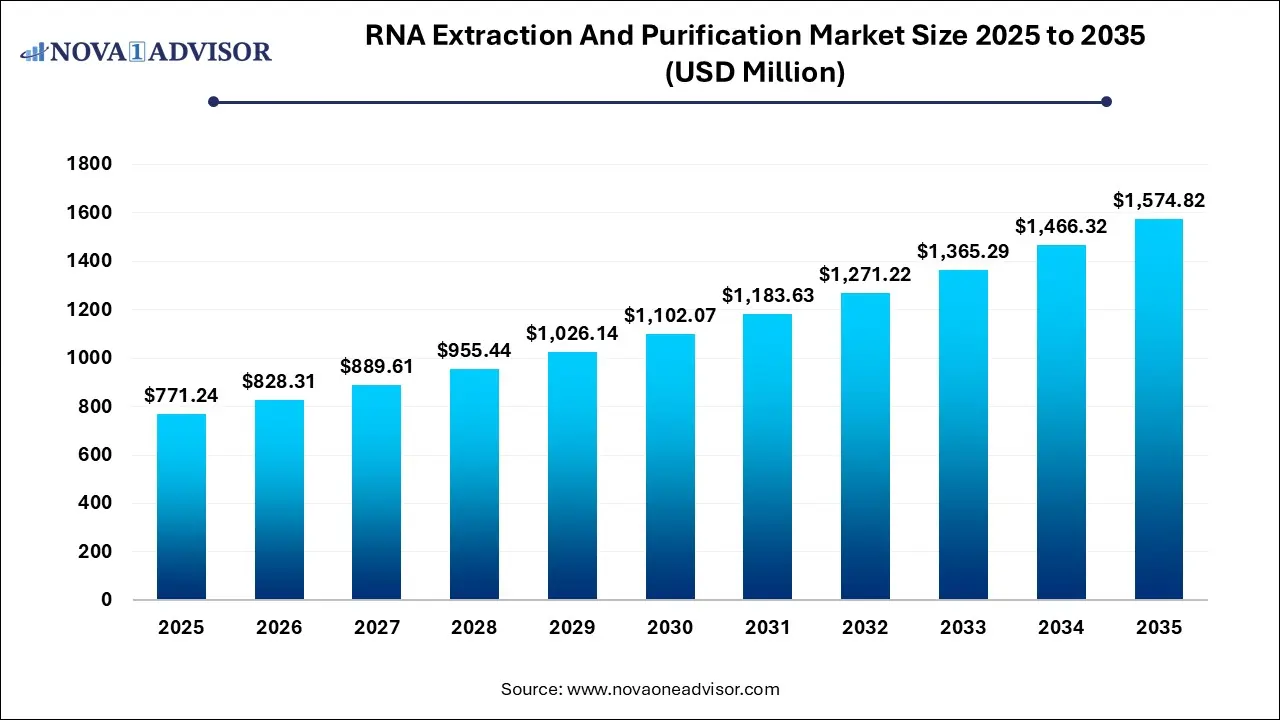
The RNA extraction and purification market size was estimated at USD 771.24 million in 2025 and is projected to increase from USD 828.31 million in 2026 to approximately USD 1,574.82 million by 2035, growing at a CAGR of 7.4% from 2026 to 2035. The RNA extraction and purification market is driven by the growing adoption of mRNA technology, creating a massive need for high-quality RNA purification, the growing prevalence of chronic illnesses and infectious diseases, and the rise in next-generation sequencing and genomic studies.
Key Takeaways
- By product, the kits and reagents segment held a dominant position in the market with a share of 75% in 2025.
- By product, the instruments segment is the fastest growing between 2026 and 2035.
- By end-user, the hospitals and diagnostic centers segment held a dominant position in the market with a share of 45% in 2025.
- By end-user, the academic research institutes segment is the fastest growing between 2026 and 2035.
Innovation Driving Transformation in the RNA Extraction And Purification Market
RNA extraction and purification comprise the provision of kits, reagents, and instruments designed to isolate high-quality RNA from biological samples, crucial for downstream molecular biology applications. Key benefits include improved extraction efficiency, high yield, and rapid, standardized results that reduce contamination risk, which is invaluable for accelerating vaccine development and personalized medicine. Market growth is primarily driven by the rising prevalence of chronic and infectious diseases, increased funding for genomics research, and the widespread adoption of automation in labs to achieve high-throughput processing.
RNA Extraction And Purification Market Trends
- Precision Engineered Solutions for Complex Matrices
Increasing demand for specialized kits designed to extract high-quality, pure RNA from challenging sample types, including formalin-fixed, paraffin-embedded tissues, liquid biopsies, and low-abundance samples. These innovations are essential for ensuring accurate results in downstream applications such as next-generation sequencing (NGS) and RNA-Seq, which are sensitive to degradation and contaminants.
- Expansion into Decentralized Diagnostics
The need for immediate clinical diagnostics is driving the development of fast, equipment-free, and handheld RNA extraction methods. These user-friendly, rapid, and often portable kits allow for decentralized molecular testing in clinics or field settings, especially for infectious diseases.
- Integration of Multi-Omics and Combined Extraction Workflows
To maximize data collection from limited biological materials, new technologies are increasingly enabling the simultaneous extraction and purification of RNA, DNA, and proteins from a single sample. This multi-omics trend enhances efficiency for researchers studying complex diseases by ensuring consistent sample input across different analytical platforms.
Key AI Integration in the RNA Extraction And Purification Market
AI and ML are transforming the RNA extraction and purification industry by driving the development of automated, high-throughput systems that significantly improve efficiency and reduce human error. ML algorithms analyze vast datasets to optimize reagent formulations and predict optimal extraction conditions, leading to higher RNA yields and purity from diverse, challenging sample types. AI-powered image analysis and sensor data enhance real-time quality control during the purification process, ensuring the integrity of the RNA for sensitive downstream applications, such as NGS and diagnostics.
RNA Extraction And Purification Market Report Scope
| Report Coverage | Details |
| Market Size in 2026 | USD 828.31 Million |
| Market Size by 2035 | USD 1,574.82 Million |
| Growth Rate From 2026 to 2035 | CAGR of 7.4% |
| Base Year | 2025 |
| Forecast Period | 2026 to 2035 |
| Segments Covered | By Product, By End-user, By Region |
| Market Analysis (Terms Used) | Value (USD Million/Billion) or (Volume/Units) |
| Regional Scope | North America; Europe; Asia Pacific; Central and South America; the Middle East and Africa |
| Key Companies Profiled | Agilent Technologies, Inc., Danaher Corporation, Bio-Rad Laboratories, Inc., F. Hoffmann-La Roche Ltd., HiMedia Laboratories Private Limited, Geno Technology, Inc., Illumina, Inc., Norgen Biotek Corp., New England Biolabs, Inc., Promega Corporation |
Market Dynamics
Driver
Expansion of RNA-based Therapeutics and Vaccines
The creating massive demand for high-quality, clinical-grade RNA raw materials. The shift towards mRNA vaccines and RNA therapies necessitates rigorous purification processes to remove contaminants like double-stranded RNA (dsRNA) and residual DNA, thereby bolstering sales of specialized purification kits and chromatographic technologies. As pharmaceutical companies increase investments in personalized medicine and target-specific therapies, the need for scalable and automated extraction techniques to improve yield consistency and accelerate production timelines grows.
Restraint
Complexity of Sample Types
The market growth is hindered by requiring specialized, time-consuming, and often less efficient protocols. These complex samples typically contain high concentrations of contaminants, such as polyphenols, humic acids, and tannins, or high levels of RNases that degrade RNA, leading to low yield and poor purity that limit the success of downstream applications like NGS library preparation.
Opportunity
Wastewater and Environmental Surveillance
The driving demand for specialized kits designed to isolate low-abundance, degraded viral and bacterial RNA from complex environmental samples. The rapid adoption of wastewater-based epidemiology for monitoring pathogens, such as SARS-CoV-2 and its variants, has mandated consistent, high-volume testing of sewage, resulting in a surge of procurement for automated extraction technologies and specialized reagents.
Segment Insights
By Product Insights
Why Did the Kits and Reagents Segment Hold a 75% Share for the RNA Extraction And Purification Market?
The kits and reagents segment held a dominant position in the market with a share of 75% in 2025, owing to high repeat usage in routine testing and research workflows. The specialized kits are available for varied sample types and applications, from infectious disease diagnostics to oncology research.
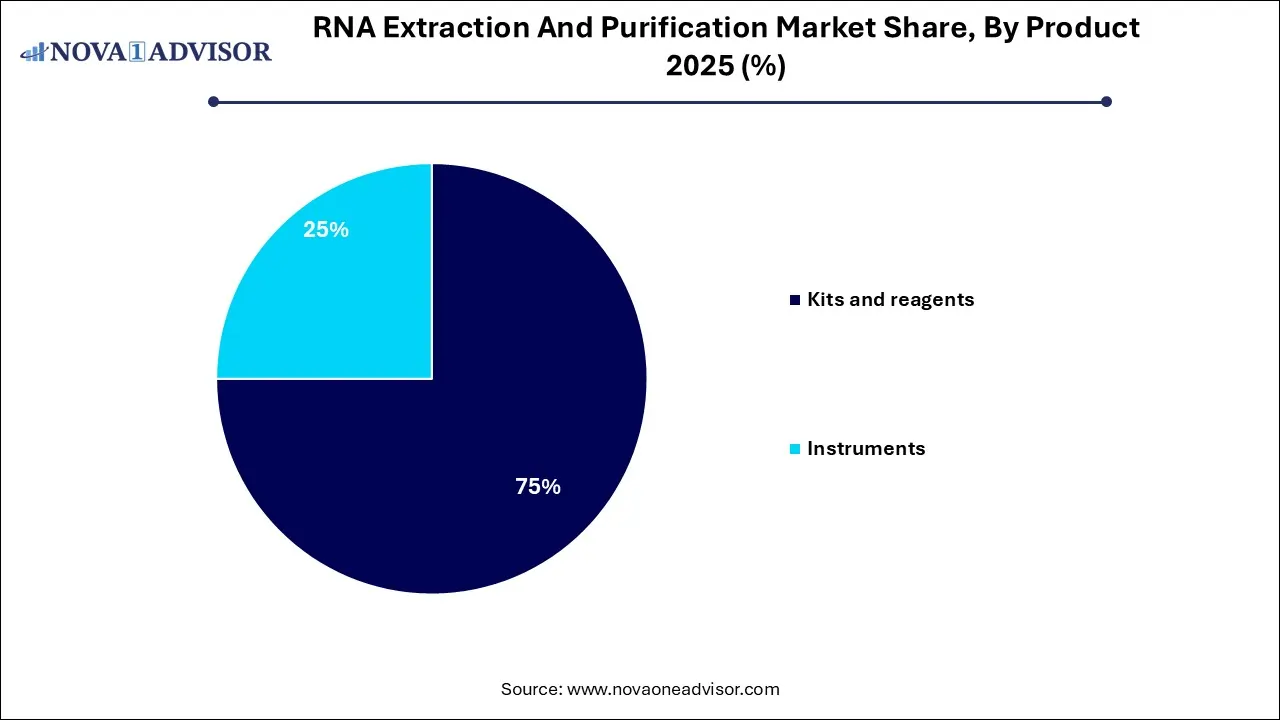
The instruments segment held a 25% share of the market in 2025, due to the increased investment in research and clinical labs for high-throughput screening driven the adoption of automated instruments. The rise in infectious disease diagnostics, cancer research, and personalized medicine necessitates precise, reliable, and standardized RNA extraction, which these instruments provide.
By End Use Insights
Why Did the Hospitals and Diagnostic Centers Segment Lead the RNA Extraction And Purification Market?
The hospitals and diagnostic centers segment registered its dominance over the market with a share of 45% in 2025, owing to the high patient testing volumes and integration of molecular diagnostics. The rapid adoption of liquid biopsies and molecular oncology panels, which identify cancer biomarkers, requires high-quality RNA purification from blood and tissue samples.
The academic research institutes segment held the 35% share of the market in 2025, with strong growth and gaining importance due to rising funding in genomics and transcriptomics research. The high reliance on cost-effective, annual or semi-automated spin-column kits, which are popular in academic settings for various sample types.
The others segment held 20% share of the market in 2025, due to the increased investment in mRNA vaccine research and customized gene therapy development, which requires specialized isolation protocols, often provided by firms falling. Growing expansion of molecular diagnostics and growing outsourcing to CROs.
By Regional Insights
Why Did the North America Region Lead the RNA Extraction And Purification Market?
The North America region registered its dominance over the market with a share of 38% in 2025, owing to the strong R&D infrastructure and early adoption of molecular technologies. The high incidence of cancer, infectious diseases, and genetic disorders in the region necessitates widespread molecular testing.
The Europe region held the 27% share of the market in 2025, with the mature markets and steady public healthcare investments. Significant investment in research and development, particularly in genomics, oncology, and personalized medicine, fuels the need for high-quality pure RNA for research. The shift toward the adoption of automation and supportive regulatory frameworks.
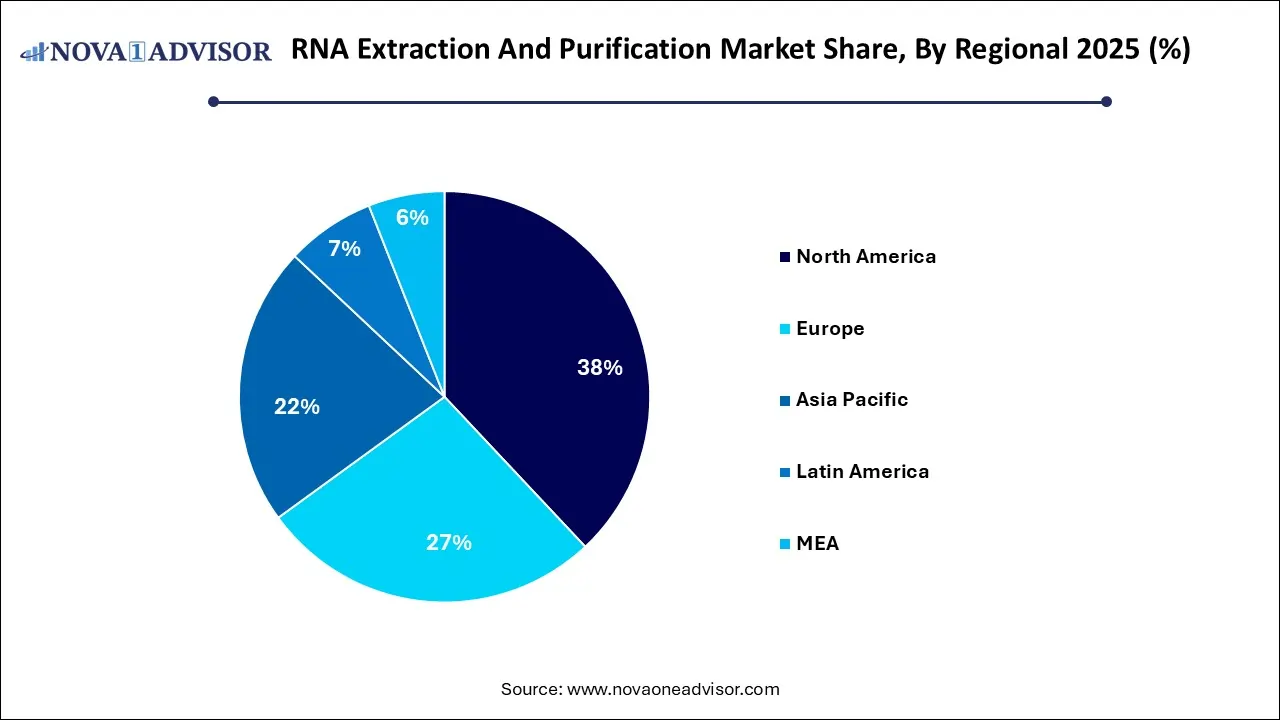
The Asia Pacific segment held 22% share of the market in 2025, due to the expanding biotech industry and increasing healthcare access. Adoption of automated, high-throughput RNA extraction kits for PCR and next-generation sequencing has increased to support large-scale clinical trials and public health screening. Increased focus on genomics and personalized medicine, and rising diagnosis burden and diagnostics.
The Latin America region held 7% share of the market in 2025, with infrastructure and funding limitations. Increasing adoption of genomics research, next-generation sequencing, and personalized medicine initiatives in the region. Growing in agricultural biotechnology and pharmaceutical testing centers, and robust RNA extraction tools.
The MEA region held 6% share of the market in 2025, due to the limited access to advanced diagnostic technologies. Rising of personalized medicine, infectious diseases testing, and adoption of automated technologies.
RNA Extraction And Purification Market Companies
- Agilent Technologies, Inc.
- Danaher Corporation
- Bio-Rad Laboratories, Inc.
- F. Hoffmann-La Roche Ltd.
- HiMedia Laboratories Private Limited
- Geno Technology, Inc.
- Illumina, Inc.
- Norgen Biotek Corp.
- New England Biolabs, Inc.
- Promega Corporation
Recent Developments
- In February 2026, Thermo Fisher Scientific introduced the Thermo Scientific™ Sequential Protein/DNA/RNA Extraction Kit, enabling high-quality, multi-omic analysis from a single, low-volume specimen (1,000 cells or 1–2 mg tissue). The magnetic bead-based kit allows for the sequential extraction of proteins, DNA, and RNA, enhancing efficiency for NGS and mass spectrometry workflows in research and translational oncology.
- In April 2024, New England Biolabs (NEB) introduced the Monarch Mag Viral DNA/RNA Extraction Kit, a magnetic bead-based system designed for highly sensitive detection and automated, high-throughput processing of viral nucleic acids from saliva, respiratory swabs, and wastewater. The kit enhances recovery of low-amount viral loads using optimized buffer chemistry and is compatible with major automation platforms like KingFisher Flex, offering a sustainable alternative to spin-column methods.
- In January 2026, Acuitas Therapeutics acquired a majority stake in RNA Technologies & Therapeutics (RNA T&T) to combine LNP delivery systems with advanced RNA design and optimization, aiming to accelerate the development of next-generation RNA-LNP therapies. This strategic investment enables partners to access integrated, "one-stop" expertise for both mRNA payloads and carriers, supporting enhanced production and faster clinical timelines.
Segments Covered in the Report
This report forecasts revenue growth at country levels and provides an analysis of the latest industry trends in each of the sub-segments from 2021 to 2035. For this study, Nova one advisor, Inc. has segmented the RNA extraction and purification market.
By Product
- Kits and reagents
- Instruments
By End-user
- Hospitals and diagnostic centers
- Academic research institutes
- Others
By Region
- North America
- Europe
- Asia Pacific
- Latin America
- Middle East and Africa (MEA)
FAQ's

Proceed to Buy
Instant PDF delivery on confirmation

RNA Extraction And Purification Market Size to Hit USD 1,574.82 Million by 2035
 Request Customization
 Download Sample

Get a Sample of this Report
RNA Extraction And Purification Market