

Wearable Healthcare Devices Market Size, Share, Forecast Report, 2026-2035
 Status Published
 Category Healthcare


Content
Wearable Healthcare Devices Market Size, Growth and Trends 2026 to 2035
The global wearable healthcare devices market size was estimated at USD 46.60 billion in 2025 and is expected to be worth around USD 305.81 billion by 2035 with a CAGR of 20.7% from 2026 to 2035
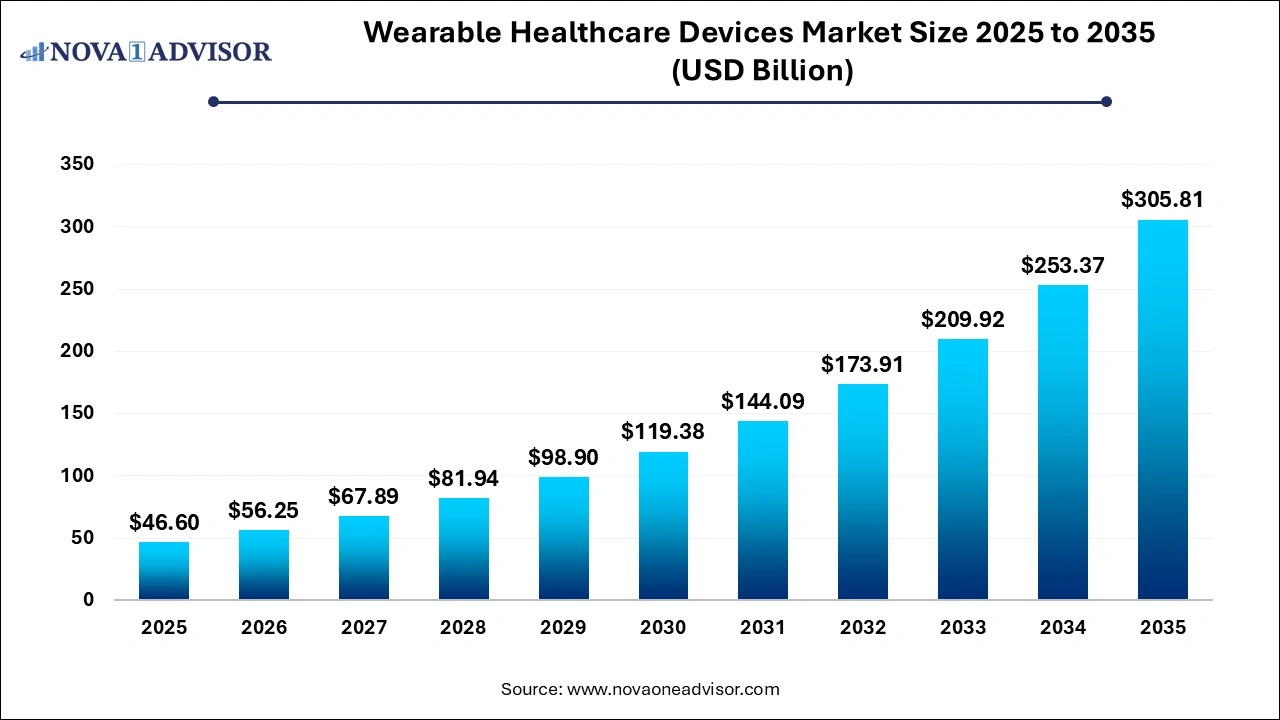
Wearable Healthcare Devices Market Outlook
- Market Growth Overview: The wearable healthcare devices market is expected to grow significantly between 2026 and 2035, driven by the rising chronic diseases prevalence, increased shift towards preventive healthcare, and integration with ecosystems.
- Sustainability Trends: Sustainability trends involve eco-friendly and biodegradable materials, energy harvesting and self-powered devices, and the circular economy and right to repair.
- Major Investors: Major investors in the market include Apple, Google (Fitbit), Samsung, Huawei, and Sony Corporation.
Report Scope of Wearable Healthcare Devices Market
| Report Coverage | Details |
| Market Size in 2026 | USD 56.25 Billion |
| Market Size by 2035 | USD 305.81 Billion |
| Growth Rate From 2026 to 2035 | CAGR of 20.7% |
| Base Year | 2025 |
| Forecast Period | 2026 to 2035 |
| Segments Covered | By Device Type, By Product Type, By Grade Type, By Application, By Distribution Channel |
| Market Analysis (Terms Used) | Value (USD Million/Billion) or (Volume/Units) |
| Regional Covered | North America; Europe; Asia Pacific; Latin America; MEA |
| Key Companies Profiled | Medtronic plc. (Ireland), Koninklijke Philips N.V. (Netherlands), OMRON Corporation |
Wearable Healthcare Devices Market Segment Insights
By Device Type Insights
How did the Diagnostic Monitoring Devices Segment Dominate the Wearable Healthcare Devices Market?
The diagnostic monitoring devices segment is driven by the rising urgent need for continuous chronic disease management. The evaluation is supported by breakthroughs in sensor miniaturization and AI integration. The industry is successfully bridging the gap between consumer wellness and professional medical intervention. The synergy of technology and healthcare accessibility is reducing hospital dependencies while empowering patients through data-driven preventative care.
How did the Therapeutic Devices Segment Expect to Hold the Fastest-Growing Wearable Healthcare Devices Market in the Coming Years?
The therapeutic devices segment is driven by integrating AI and 5G connectivity; these devices have evolved into high-precision medical tools capable of real-time intervention and automated drug delivery, such as insulin. The shift toward home-based geriatric care is moving the market away from passive monitoring toward active, remote clinical treatment. The miniaturization of sensors is ensuring that these life-saving therapeutic capabilities remain convenient and accessible for long-term patient use.
By Product Type Insights
How did the Smartwatches Segment Account for the largest Share in the Wearable Healthcare Devices Market?
The smartwatches segment is driven by the sophisticated personal health ecosystems, leveraging miniaturized sensors and AI to provide clinical-grade insights like ECG and monitoring. The shift toward preventative healthcare has transformed these devices from mere accessories into essential tools for managing lifestyle diseases and daily wellness targets. By ensuring seamless connectivity with cloud platforms and health apps, major players like Apple and Samsung have solidified the smartwatch's role as a primary gateway for real-time health data sharing.
How did the fitness trackers segment expect to hold the fastest-growing Wearable Healthcare Devices market in the coming years?
The fitness trackers segment is driven by leveraging AI-driven cloud analytics; these devices now provide personalized health coaching and early warning signs for chronic conditions at a fraction of the cost of traditional medical equipment Rental. Their seamless integration into telemedicine ecosystems bridges the gap between daily self-monitoring and professional clinical oversight, enhancing the quality of remote patient-provider communication. The global shift toward proactive health management is making sophisticated wellness data available to a broader, more health-conscious demographic.
By Grade Type Insights
How did the Consumer-grade Segment Dominate the Wearable Healthcare Devices Market?
The consumer-grade segment is driven by blending high affordability with advanced sensor thath track critical metrics like SpO2 and heart rate, making sophisticated health data accessible to the general public. With the global surge in preventative care awareness, these devices leverage seamless smartphone integration to transform real-time personal data into actionable wellness insights. The fusion of retail accessibility and user-friendly ecosystems has solidified consumer wearables as the primary gateway for proactive, everyday health management.
How did the Clinical-Grade Segment Expect to Hold the Fastest-Growing Wearable Healthcare Devices Market in the Coming Years?
The clinical-grade segment is driven by a rapid evolution from simple monitoring to advanced diagnostic ecosystems, utilizing FDA-cleared sensors and AI to provide real-time predictive analytics for complex conditions like epilepsy and heart disease. This shift is powered by biosensor breakthroughs, such as non-invasive glucose monitors and high-precision ECG patches, which offer the accuracy required for professional chronic disease management. With the integration of 5G connectivity and miniaturised form factors like smart rings, these devices are becoming seamless components of the "hospital-at-home" model.
By Application Insights
How did the Home Healthcare Segment Account for the Largest Share in the Wearable Healthcare Devices Market?
The home healthcare segment is driven by the integration of wearables that allow for the continuous, real-time management of chronic diseases outside traditional clinical environments. Increased regulatory approvals for user-friendly sensors have validated these tools as reliable clinical assets, ensuring faster medical interventions and better patient outcomes. The home-based wearable technology is redefining long-term care by making it more affordable, convenient, and proactive.
How did the Remote Patient Monitoring Segment Expect to Hold the Fastest-Growing Wearable Healthcare Devices Market in the coming years?
The remote patient monitoring segment is driven by the rapid growth in clinical-grade therapeutic devices and remote patient monitoring (RPM) applications, with North America leading in revenue share. While smartwatches dominate in volume, the market is shifting toward specialized, regulatory-approved monitoring solutions for chronic disease management.
By Distribution Channel Insights
How did the Retail Pharmacies Segment Account for the Largest Share in the Wearable Healthcare Devices Market?
The retail pharmacies segment is driven by serving as integrated health hubs; these locations allow patients to receive expert, in-person guidance on device setup and data interpretation, a critical service that purely digital channels cannot replicate. The physical presence of extensive pharmacy networks ensures that consumers can interact with diagnostic tools before purchase, bridging the gap between retail convenience and professional medical support.
How did the Online Channels Segment expect to Hold the Fastest-Growing Wearable Healthcare Devices Market in the Coming Years?
The online channels segment is driven by a post-pandemic rise in health awareness and has successfully transitioned smartwatches and fitness bands from niche gadgets into essential health-monitoring staples. By integrating advanced digital experiences such as AR virtual try-ons and deep-dive analytics, online platforms have overcome traditional retail barriers, providing consumers with the confidence to purchase complex medical-grade tech remotely.
Key Players in the Wearable Healthcare Devices Market
- Medtronic plc. (Ireland): Medtronic drives the wearable healthcare market by developing advanced, FDA-approved, continuous glucose monitoring (CGM) systems and smart insulin pens that allow for automated, personalized diabetes management.
- Koninklijke Philips N.V. (Netherlands): hilips focuses on clinical-grade wearable biosensors, such as the wearable Biosensor BX100, which enable continuous, remote monitoring of patients to detect early signs of deterioration in hospitals and home care environments.
- OMRON Corporation: OMRON specializes in cardiovascular health, having developed the world's first FDA-cleared wristwatch-type wearable blood pressure monitor, which tracks blood pressure fluctuations continuously.
Wearable Healthcare Devices Market Segments Covered
By Device Type
- Diagnostic & Monitoring Devices
- Vital Signs Monitoring Devices
- Multiparameter Trackers
- ECG/Heart Rate Monitors
- Pulse Oximeters
- Blood Pressure Monitors
- Glucose Monitoring Devices
- Sleep Monitoring Devices
- Fetal Monitoring & Obstetric Devices
- Neuromonitoring Devices
- Vital Signs Monitoring Devices
- Therapeutic Devices
- Pain Management Devices
- Rehabilitation Devices
- Respiratory Therapy Devices
- Insulin Pumps
By Products
- Activity Monitors/Trackers
- Smartwatches
- Patches
- Smart Clothing
By Grade Type
- Consumer-grade
- Clinical-grade
By Application
- General Health & Fitness
- Remote Patient Monitoring
- Home Healthcare
By Distribution Channel
- Pharmacies
- Online Channel
- Hypermarkets
By Region
- North America
- US
- Canada
- Europe
- Germany
- UK
- France
- Italy
- Spain
- Rest of Europe
- Asia Pacific
- Japan
- China
- India
- Australia & New Zealand
- Rest of Asia Pacific
- Latin America
- Middle East & Africa

Proceed to Buy
Instant PDF delivery on confirmation

Wearable Healthcare Devices Market Size to Worth Around USD 305.81 Bn by 2035
 Request Customization
 Download Sample

Get a Sample of this Report
Wearable Healthcare Devices Market