

Bio-Process Technology Market Size, Share, and Trends 2026 to 2035
 Status Published
 Category Healthcare


Content
Bio-process Technology Market Summary
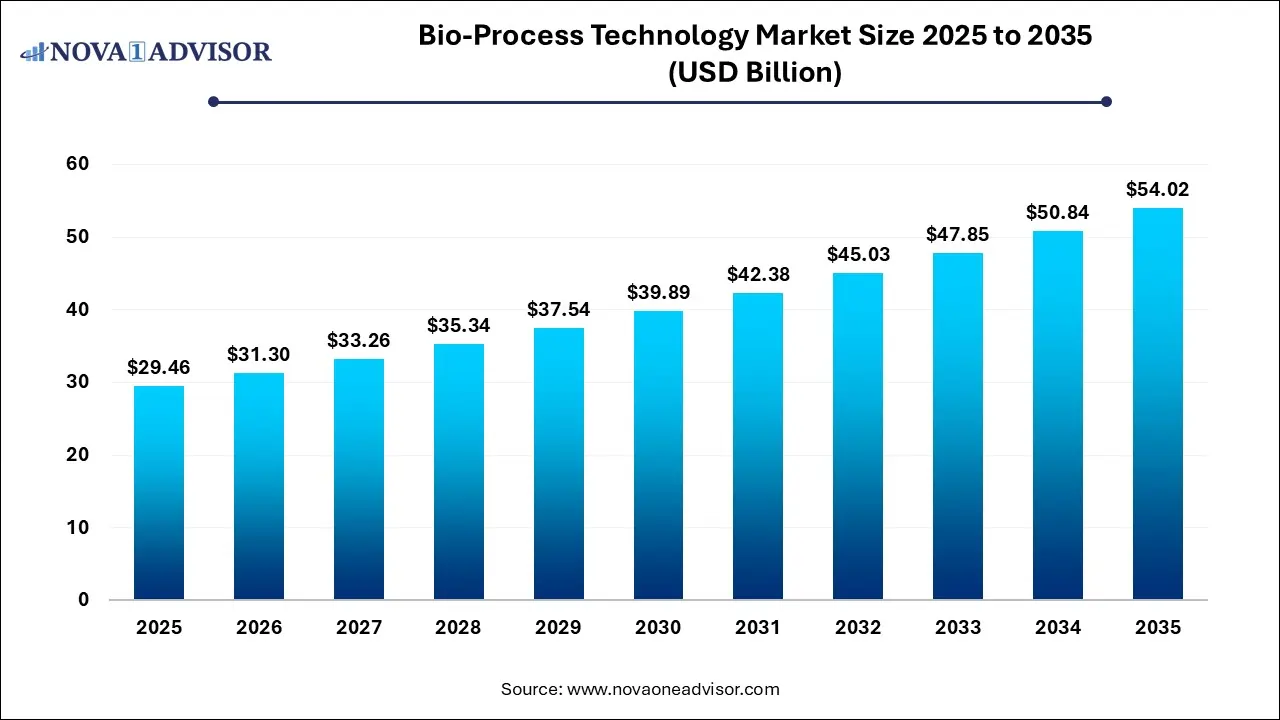
The global bio-process technology market size was estimated at USD 29.46 billion in 2025 and is projected to hit around USD 54.02 billion by 2035, growing at a CAGR of 6.25% during the forecast period from 2026 to 2035.
Market Key Takeaways
- The bio-process technology market is experiencing strong growth driven by increasing demand for biologics, vaccines, and advanced therapeutics.
- Pharmaceutical companies remain the largest end-user segment due to large-scale production needs.
- Monoclonal antibodies dominate application segments owing to their widespread use in oncology and autoimmune diseases.
- Bioreactors hold the largest share among product types due to their critical role in cell culture processes.
- Industrial-scale operations dominate the market, supported by commercialization of biologics.
- Asia Pacific is emerging as the fastest-growing region due to expanding biopharmaceutical manufacturing infrastructure.
- Integration of AI and automation is significantly enhancing production efficiency and reducing operational costs.
Market Overview
The bio-process technology market represents a critical pillar within the biopharmaceutical and life sciences industries, enabling the development, scale-up, and commercialization of biologically derived products. These technologies encompass a wide range of systems and processes used in cell culture, fermentation, purification, and downstream processing. With the global healthcare sector shifting toward biologics, including monoclonal antibodies, vaccines, recombinant proteins, and gene therapies, the demand for advanced bio-processing solutions has increased substantially.
Bio-process technologies are essential for ensuring consistency, quality, and scalability in the production of complex biological molecules. Unlike traditional chemical synthesis, biologics require highly controlled environments and sophisticated equipment such as bioreactors, filtration systems, and separation units. The rise of personalized medicine, cell and gene therapies, and biosimilars has further amplified the need for flexible and efficient manufacturing platforms.
Moreover, regulatory agencies across the globe are emphasizing stringent quality standards, pushing manufacturers to adopt advanced technologies that enhance reproducibility and compliance. Continuous processing, single-use systems, and automation are gaining traction as companies strive to optimize operational efficiency while minimizing contamination risks.
Market Outlook
- Market Growth Overview: The global bio-process technology market is expected to grow significantly between 2025 and 2035, driven by the rising demand for biologics and biosimilars, the adoption of single-use systems, and the expansion of continuous bioprocessing.
- Sustainability Trends: Sustainability trends involve single-use systems, continuous bioprocessing, and alternative feedstock and waste utilization.
- Major Investors: Major investors in the market include Thermo Fisher Scientific, Merck KGaA, Danaher Corporation (Cytiva), Sartorius AG, and Lonza Group AG.
How is AI Transforming the Bio-process Technology Market?
Artificial Intelligence (AI) is playing a transformative role in reshaping the bio-process technology landscape. Traditionally, bio-processing has been labor-intensive and reliant on trial-and-error approaches for optimization. AI is changing this paradigm by introducing predictive analytics, real-time monitoring, and intelligent automation.
AI-driven algorithms are increasingly used to optimize cell culture conditions by analyzing vast datasets related to temperature, pH, nutrient levels, and oxygen concentration. For example, machine learning models can predict optimal growth conditions for specific cell lines, reducing development timelines significantly. This is particularly valuable in monoclonal antibody production, where even minor variations can impact yield and quality.
Another significant application of AI is in process control. Advanced sensors integrated with AI systems enable real-time monitoring of bioprocess parameters, allowing for immediate adjustments to maintain optimal conditions. This reduces batch failures and enhances consistency, which is crucial for regulatory compliance.
AI is also improving downstream processing by optimizing filtration and purification steps. Predictive maintenance powered by AI helps identify equipment issues before they lead to downtime, thereby improving operational efficiency. In gene therapy production, AI is being used to streamline viral vector manufacturing, a process that is traditionally complex and resource-intensive.
Overall, AI is enabling faster development cycles, improved product quality, and reduced costs, making it a key enabler for the future of bio-process technology.
Bio-Process Technology Market Report Scope
| Report Coverage | Details |
| Market Size in 2026 | USD 31.30 Billion |
| Market Size by 2035 | USD 54.02 Billion |
| Growth Rate From 2026 to 2035 | CAGR of 6.25% |
| Base Year | 2025 |
| Forecast Period | 2026 to 2035 |
| Segments Covered | By End User, By Application, By Product Type, By Scale of Operation, By Region |
| Market Analysis (Terms Used) | Value (USD Million/Billion) or (Volume/Units) |
| Regional Scope | North America; Europe; Asia Pacific; Central and South America; the Middle East and Africa |
| Key Companies Profiled | Merck Millipore (Germany), Thermo Fisher Scientific, Inc. (U.S.), Becton, Dickinson and Company (U.S.), Danaher Corporation (U.S.), Lonza Group AG (Switzerland), Sartorius Stedim Biotech S.A (France), Corning, Inc.(U.S.), Bio-Rad Laboratories (U.S.), and Charles River Laboratories (U.S.). |
Market Driver
Rising Demand for Biologics
One of the primary drivers of the bio-process technology market is the increasing demand for biologics. Biologics, including monoclonal antibodies, vaccines, and recombinant proteins, have become essential in treating complex diseases such as cancer, autoimmune disorders, and rare genetic conditions.
Unlike small-molecule drugs, biologics offer higher specificity and effectiveness, leading to better patient outcomes. For instance, monoclonal antibodies are widely used in oncology treatments due to their ability to target specific cancer cells without harming healthy tissues. This has led to a surge in their production, requiring advanced bio-processing technologies.
Additionally, the COVID-19 pandemic highlighted the importance of rapid vaccine development and manufacturing capabilities. Governments and private organizations invested heavily in bioprocessing infrastructure, further accelerating market growth. As new diseases emerge and the global population ages, the demand for biologics is expected to continue rising, driving the need for efficient bio-process technologies.
Market Restraint
High Capital Investment and Operational Costs
Despite its growth potential, the bio-process technology market faces significant challenges related to high capital investment and operational costs. Establishing a biopharmaceutical manufacturing facility requires substantial financial resources, including investments in advanced equipment such as bioreactors, filtration systems, and automation technologies.
Moreover, maintaining these facilities involves high operational costs, including skilled labor, quality control, and compliance with stringent regulatory standards. Small and medium-sized enterprises (SMEs) often find it difficult to enter the market due to these financial barriers.
Additionally, the complexity of bio-processing operations increases the risk of batch failures, which can result in significant financial losses. For example, contamination in a bioreactor can lead to the loss of an entire production batch, costing millions of dollars. These challenges can hinder market growth, particularly in developing regions where access to capital is limited.
Market Opportunity
Growth of Gene Therapy and Personalized Medicine
The emergence of gene therapy and personalized medicine presents a significant opportunity for the bio-process technology market. These advanced therapies require highly specialized and flexible manufacturing processes, creating demand for innovative bio-processing solutions.
Gene therapy involves modifying genetic material to treat or prevent diseases, often requiring viral vectors produced through complex bio-processes. As more gene therapies receive regulatory approval, the demand for scalable and efficient production technologies is increasing.
Personalized medicine, which tailors treatments to individual patients, also relies heavily on bio-processing technologies. For example, CAR-T cell therapy involves extracting a patient’s immune cells, modifying them in a laboratory, and reintroducing them into the body. This process requires precise and controlled bio-processing systems.
Companies that invest in developing flexible and modular bio-processing platforms are well-positioned to capitalize on this growing market opportunity.
Segmental Insights
By Product Type
How did the bioreactors segment account for the largest share in the Global Bio-Process Technology market?
The bioreactors segment is driven by the strategic shift toward single-use stirred-tank technologies, which offer superior oxygen transfer and operational flexibility over traditional stainless steel. The soaring demand for biologics and biosimilars is urging manufacturers to adopt high-efficiency fed-batch and continuous processing models.
How did the filtration systems segment expect to hold the fastest-growing Global Bio-Process Technology market in the coming years?
The filtration systems segment is driven by accelerating production speeds and mitigating cross-contamination risks. The soaring demand for monoclonal antibodies and vaccines requires high-efficiency separation and rigorous adherence to global sterility standards. Continuous innovation in filter media and tangential flow filtration (TFF) is further driving operational cost-effectiveness and process robustness.
By Application
How did the monoclonal antibodies segment account for the largest share in the Global Bio-Process Technology market?
The monoclonal antibodies segment is driven by the upstream cell culture and specialized manufacturing systems. Their high specificity in treating cancers and autoimmune diseases fuels sustained demand for advanced production technologies, such as mammalian cell expression and single-use bioreactors. The industry's shift toward high-yield recombinant DNA and a robust biosimilar pipeline ensures continuous capacity expansion and operational scalability.
How did the vaccines segment expect to hold the fastest-growing Global Bio-Process Technology market in the coming years?
The vaccines segment is driven by the rapid adoption of single-use bioprocessing systems and a booming contract manufacturing sector, enabling faster batch turnover and global production surges. Innovation is further expanding into novel delivery systems, such as nasal and oral vaccines, to improve patient access and mucosal immunity. The massive strategic investments in pandemic preparedness are solidifying a highly agile and technologically advanced infrastructure for future global health security.
By End User
How did the pharmaceuticals segment dominate the Global Bio-Process Technology market?
The pharmaceuticals segment is driven by a surge in research and development investment for complex biologics and biosimilars to address the rising burden of chronic diseases. The trend toward outsourcing to CMOs allows pharmaceutical firms to achieve massive scalability and faster market entry for innovative therapies.
How did the biotechnology companies segment expect to hold the fastest-growing Global Bio-Process Technology market in the coming years?
The biotechnology companies segment is driven by the rapid adoption of single-use technologies, and continuous manufacturing is transforming the biotech landscape by enhancing operational flexibility and significantly lowering production costs. The soaring demand for cell and gene therapies (CGT) and personalized medicines requires highly scalable and precise culture systems. By integrating AI-driven automation and advanced digital controls, manufacturers are achieving unprecedented process consistency and regulatory compliance.
By Scale of Operation
How did the industrial scale segment dominate the Global Bio-Process Technology market?
The industrial scale segment is driven by contract manufacturing organizations (CMOs), which provide the large-scale, cost-effective infrastructure essential for rapid market entry and consistent batch quality. The shift toward large-scale processing aligns with global sustainability goals, as these advanced systems offer higher yields and help reduce the overall carbon footprint of bio-based manufacturing.
How did the laboratory scale segment expect to hold the fastest-growing Global Bio-Process Technology market in the coming years?
The laboratory scale segment is driven by the rapid adoption of single-use bioreactors at this scale is providing researchers with the flexibility to quickly pivot between projects while drastically reducing the risk of cross-contamination and capital expenditure. The integration of AI-driven automation is significantly shortening development timelines by optimizing cell line performance and automating repetitive laboratory tasks.
By Regional
How did the North America region account for the largest share in the Global Bio-Process Technology market?
North America is leveraging its dense network of top-tier pharmaceutical giants and CDMOS that drive demand for lab-scale and industrial bioprocessing. The unparalleled research and development investments and the aggressive adoption of single-use, closed system technologies to maximize production speed and cost-efficiency. The integration of advanced biotechnology and sophisticated quality controls ensures North America remains the primary engine for global biopharmaceutical innovation.
U.S. Global Bio-Process Technology Market Trends
The U.S. dominance of single-use systems and a strategic pivot toward continuous manufacturing to maximize operational flexibility and productivity. The integration of AI and advanced analytics is now standard for achieving superior batch consistency and predictive quality control. This evolution is further accelerated by a surge in investment for specialized cell and gene therapy equipment, particularly for gene-editing technologies.
How did the Asia Pacific region hold the fastest-growing Global Bio-Process Technology Market in the forecast period?
Asia Pacific is experiencing a massive surge in biopharmaceutical and biosimilar production and a booming CDMO sector. Significant strategic investments in China and South Korea are rapidly scaling the infrastructure needed for advanced biologics development and clinical research. This growth is underpinned by the aggressive adoption of automation and single-use technologies, which maximize manufacturing efficiency while drastically lowering operational costs.
China Global Bio-Process Technology Market Trends
China’s strategic shift toward high-value innovation in monoclonal antibodies and gene therapies is supported by the 14th Five-Year Plan. As the region evolves from a low-cost manufacturer to a global R&D leader, CDMOs are rapidly scaling infrastructure to meet sophisticated clinical demands. China's aggressive adoption of flexible, efficient biomanufacturing is solidifying its position as a primary engine of global biotech advancement.
Key Players in the Global Bio-Process Technology Market
- Merck Millipore: Merck provides essential bioprocessing tools, including filtration, chromatography, and dry powder cell culture media designed to enhance efficiency in drug production. Their BioContinuum™ platform further supports the industry's shift toward continuous manufacturing to accelerate drug development.
- Thermo Fisher Scientific, Inc.: As a leader in serving science, Thermo Fisher delivers end-to-end solutions, including single-use bioreactors like the DynaDrive and advanced purification technologies that improve biopharmaceutical production yields. They provide critical analytical instruments and raw materials that support the entire biopharma value chain, from research to commercial manufacturing.
- Becton, Dickinson and Company (BD): BD contributes to bioprocessing by offering advanced cell analysis tools, including flow cytometers and automated cell imaging systems, which are essential for quality control in cell culture development.
Recent Developments
- March 2025: A leading biopharmaceutical company announced the expansion of its biologics manufacturing facility to increase monoclonal antibody production capacity.
- January 2025: A biotechnology firm launched an AI-driven bio-process optimization platform to enhance production efficiency.
- November 2024: A major industry player introduced a next-generation single-use bioreactor system designed for large-scale production.
- September 2024: A contract research organization expanded its bio-processing capabilities through a new facility in Asia Pacific.
- June 2024: A global healthcare company partnered with a technology provider to integrate automation into bio-processing workflows.
Segments Covered in the Report
This report forecasts revenue growth at country levels and provides an analysis of the latest industry trends in each of the sub-segments from 2021 to 2035. For this study, Nova one advisor, Inc. has segmented the bio-process technology market.
By End User
- Pharmaceuticals
- Biotechnology Companies
- Academic Research Institutions
- Contract Research Organizations
By Application
- Monoclonal Antibodies
- Vaccines
- Recombinant Proteins
- Gene Therapy
By Product Type
- Bioreactors
- Filtration Systems
- Separation Systems
- Cell Culture Systems
By Scale of Operation
- Laboratory Scale
- Pilot Scale
- Industrial Scale
By Region
- North America
- Europe
- Asia Pacific
- Latin America
- Middle East and Africa (MEA)
FAQ's

Proceed to Buy
Instant PDF delivery on confirmation

Bio-Process Technology Market Size to Hit USD 54.02 Billion by 2035
 Request Customization
 Download Sample

Get a Sample of this Report
Bio-Process Technology Market