

Cryogenic Freezers Market Size, Share, and Trends 2026 to 2035
 Status Published
 Category Healthcare


Content
Cryogenic Freezers Market Size and Growth 2026 to 2035
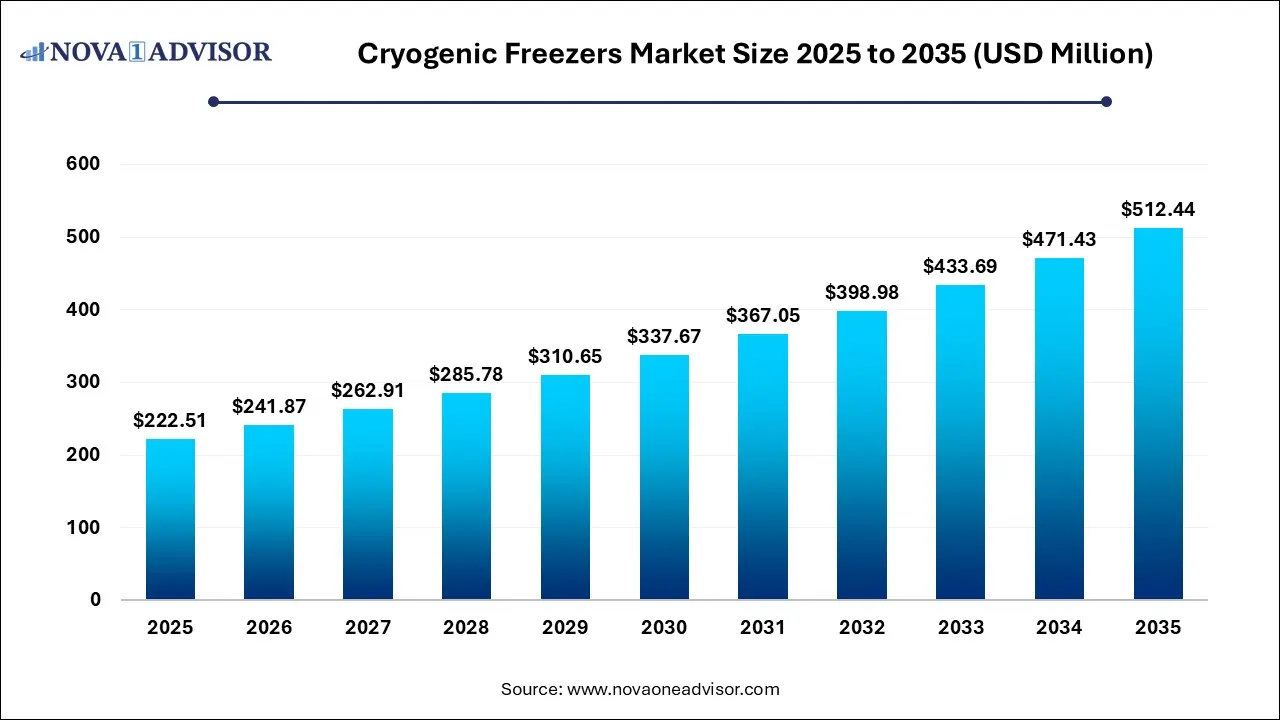
The cryogenic freezers market size was estimated at USD 222.51 million in 2025 and is projected to increase from USD 241.87 million in 2026 to approximately USD 512.44 million by 2035, growing at a CAGR of 8.7% from 2026 to 2035. The cryogenic freezers market is driven by the increasing resilience of bio-banking for long-term storage of biological samples, vaccines, and therapeutic drug products, the growing expansion of personalized medicine, and stringent regulatory standards of safe transport and storage of blood products, organs, and pharmaceuticals, driving adoption.
Key Takeaways
- By type, the IQF freezer segment held a dominant position in the market with a share of 30% in 2025.
- By type, the immersion freezers segment is the fastest growing between 2026 and 2035.
- By end-user, the academic and research institution segment held a dominant position in the market with a share of 42% in 2025.
- By end-user, the hospitals and blood centers segment is the fastest growing between 2026 and 2035.
- By product type, the liquid helium freezers segment held a dominant position in the market with a share of 50% in 2025.
- By region, the North America region held a dominant position in the market with a share of 39% in 2025.
Innovation Driving Transformation in the Cryogenic Freezers Market
Cryogenic freezers comprise specialized, ultra-low-temperature, high-efficiency refrigeration systems that typically operate below 150°C and use liquid nitrogen or CO2 for long-term storage. These systems offer significant benefits, such as rapid, enhanced preservation of biological samples, enhanced food quality retention, and superior operational flexibility for biomedical and pharmaceutical applications. The market growth is driven by the rising demand for sophisticated bio-banking and genomic research, increased adoption of personalized medicine, and the need for stringent cold chain management for vaccines.
Cryogenic Freezers Market Trends
- Strategic Integration of IoT and Intelligent Monitoring
Cytogenic freezers are increasingly integrating IoT sensors and cloud-based systems for real-time monitoring of temperature, liquid nitrogen levels, and freezer performance. These systems provide automatic data logging and remote alert capabilities, which reduce the risk of sample degeneration due to unnoticed system failures.
- Adoption of Automated and Robotic Bio-Logistics
To maximize efficiency and enhanced safety, laboratories are moving toward automated storage and retrieval systems that minimize human handling of samples. These automated units, often operating at 150°C or lower, protect sample viability by preventing exposure to room temperature during retrieval.
- Transition to Sustainable and Energy-Optimized Infrastructure
As operational costs and environmental regulations rise, manufacturers are developing energy-efficient, eco-friendly models that utilize next-generation refrigerants. Modern cryogenic systems now focus on improving conditions, efficiency, and reducing power consumption, leading to a decrease in operational costs for users by 2028.
Key AI Integration in the Cryogenic Freezers Market
AI and ML are transforming the cryogenic freezers industry by enabling proactive, data-driven management, notably through predictive maintenance that minimizes costly equipment downtime. These technologies, combined with IoT sensors, facilitate real-time monitoring of temperature and performance, ensuring superior sample integrity for sensitive biological materials and reducing the risk of failures. ML algorithms optimize energy consumption in smart freezers, significantly enhancing sustainability efforts and lowering operational costs, which is crucial for high-end biobanking and pharmaceutical research.
Cryogenic Freezers Market Report Scope
| Report Coverage | Details |
| Market Size in 2026 | USD 241.87 Million |
| Market Size by 2035 | USD 512.44 Million |
| Growth Rate From 2026 to 2035 | CAGR of 8.7% |
| Base Year | 2025 |
| Forecast Period | 2026 to 2035 |
| Segments Covered | By Type, By End User, By Product Type, By Region |
| Market Analysis (Terms Used) | Value (USD Million/Billion) or (Volume/Units) |
| Regional Scope | North America; Europe; Asia Pacific; Central and South America; the Middle East and Africa |
| Key Companies Profiled | Thermo Fisher Scientific, Linde (DE), Chart Industries, Air Products and Chemicals, Cryofab, MVE Biological Solutions, Panasonic Healthcare, Helmer Scientific, Eppendorf |
Market Dynamics
Driver
Rising Demand in Bio-banking and Genomics
The surging demand for long-term, ultra-low temperature preservation of biological samples within the expanding bio-banking sectors. The rapid acceleration of genomics, personalized medicine, and cell/gene therapy pipelines requires highly reliable storage for sensitive samples, such as DNA, tissue, and stem cells, to ensure sample viability and integrity. The increasing investments in pharmaceutical R&D, clinical trials, and the need for high-quality biospecimens in drug discovery are fueling the adoption of advanced, automated cryogenic storage solutions.
Restraint
High Operational and Capital Costs
The market growth is hindered by restricting adoption among smaller research laboratories and clinics with limited budgets. The substantial upfront investment is needed for advanced, high-performance units. The initial investment for specialized equipment is high, while ongoing expenses, driven by high energy consumption for ultra-low temperature maintenance and the high cost of liquid nitrogen, strain user budgets. Furthermore, these systems demand specialized, expensive maintenance and skilled personnel, increasing the total cost of ownership.
Opportunity
Integration of IoT and Real-time Monitoring
The enabling continuous, remote tracking of ultra-low temperatures, which ensures the integrity of sensitive biological samples. This technology creates substantial opportunities by offering predictive maintenance capabilities that analyze equipment data to prevent costly, unexpected failures and minimize downtime. Furthermore, IoT-enabled systems address strict regulatory compliance and audit requirements in the biopharmaceutical and healthcare sectors through automated, transparent data logging.
Segment Insights
By Type Insights
Why Did the Tunnel Freezer Segment Hold a 15% Share for the Cryogenic Freezers Market?
The tunnel freezer segment held a dominant position in the market with a share of 15% in 2025. Owing to the widespread use in large-scale food freezing applications. The rapid expansion of the global frozen food, convenience food, and ready-to-eat meal markets drives the need for efficient, rapid freezing technologies, and a growing focus on food safety regulations pushes manufacturers to adopt advanced freezing solutions that maintain product integrity.
The IQF freezer segment held a 30% share of the market in 2025, with its efficiency in preserving food quality and texture. Growing consumer demand for ready-to-eat and high-quality frozen foods increased the need for efficient freezing technologies.
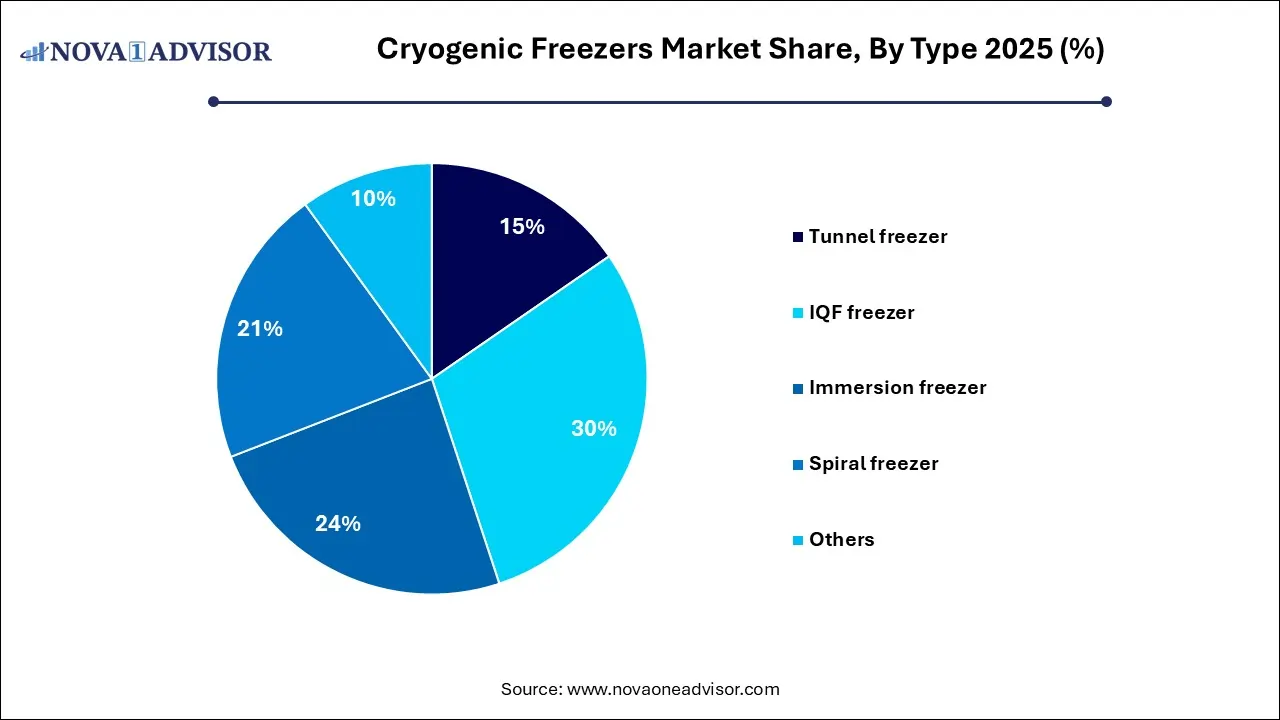
The immersion freezer segment held a 24% share of the market in 2025, due to its efficiency in freezing delicate products. Innovation in immersion freezer designs focuses on increased energy efficiency, enhanced safety, and better integration into automated production lines, making them more attractive to manufacturers.
The spiral freezer segment held a 21% share of the market in 2025, as its adoption is in continuous, high-capacity freezing for large products. The surge in consumer preference for ready-to-eat meals, improved hygiene standards, and lower energy consumption, addressing food safety regulations and sustainability mandates.
The others segment held a 10% share of the market in 2025, representing niche solutions that are less common but useful for specific industries. The increasing reliance on specialized cryogenic storage for non-standard biological samples in niche research areas, such as specialized stem cell research or specialized environmental samples, contributes to the market growth.
By End User Insights
Why Did the Hospitals and Blood Centers Segment Lead the Cryogenic Freezers Market?
The hospitals and blood centers segment registered its dominance over the market with a share of 15% in 2025, owing to the critical need for cold storage in healthcare. The growing role of stem cell therapy and biobanking requires high-performance freezers for long-term preservation of biological materials. Rising demand for blood and plasma storage, and technological innovation in storage.
The biotechnology companies segment held the 11% share of the market in 2025, with the rapid expansion of clinical and commercial cell and gene therapy pipelines requiring specialized, high-capacity cryogenic storage to protect engineered cells before infusion. Expansion of the biobanking and advancement in personalized medicine.
The academic and research institutions segment held the 42% share of the market in 2025, due to the high demand in experimental research and biotechnology development. Increasing need for storing genetic materials, nucleic acids, and proteins, particularly for stem cell research and personalized medicine.
The other segment held a 32% shar of the market in 202, due to the suggests a broad range of industrial applications, including food preservation and pharmaceuticals. Increasing focus on tailored treatments requires the cryopreservation of specialized high-volume samples.
By Product Type Insights
Why Did the Liquid Nitrogen Freezers Segment Lead the Cryogenic Freezers Market?
The liquid nitrogen freezer segment registered its dominance over the market with a share of 39% in 2025, owing to its provides deep cooling and is widely used in industries from biotech to food preservation. The rapid expansion of biobanking for genomic research and liquid nitrogen is used in specialized equipment for fast, uniform freezing to maintain quality in food and pharmaceutical manufacturing.
The liquid carbon dioxide freezers segment held the 11% share of the market in 2025, with its more niche application compared to liquid nitrogen in low-temperature freezing. By spraying or immersing products in liquid CO2, the freezing process is accelerated, boosting efficiency for commercial users and enhancing production capacity.
The liquid helium freezers segment held the 50% share of the market in 2025, due to its use in specialized scientific applications that require ultra-cold storage. Advancements in technology and increasing investment in research and development within the medical and physical sectors are indispensable in cooling investment in research and development within the medical and physical sectors.
By Regional Insights
Why Did the North America Region Lead the Cryogenic Freezers Market?
The North America region registered its dominance over the market with a share of 39% in 2025, owing to the high healthcare investments, and industrial demand for cryogenic freezers. The food industry is increasingly adopting high-throughput, automated cryogenic freezing solutions for rapid cooling and food preservation. Strict government regulations regarding food safety and biological sample storage necessitate the use of high-quality, reliable cryogenic equipment.
The Europe region held the 29% share of the market in 2025, due to the well-established industries in pharmaceuticals and food preservation. Increasing funding for public and private stakeholders for large-scale projection and an increase in cancer and other chronic diseases drives the need for biobankers, which rely on cryogenic storage to preserve samples.
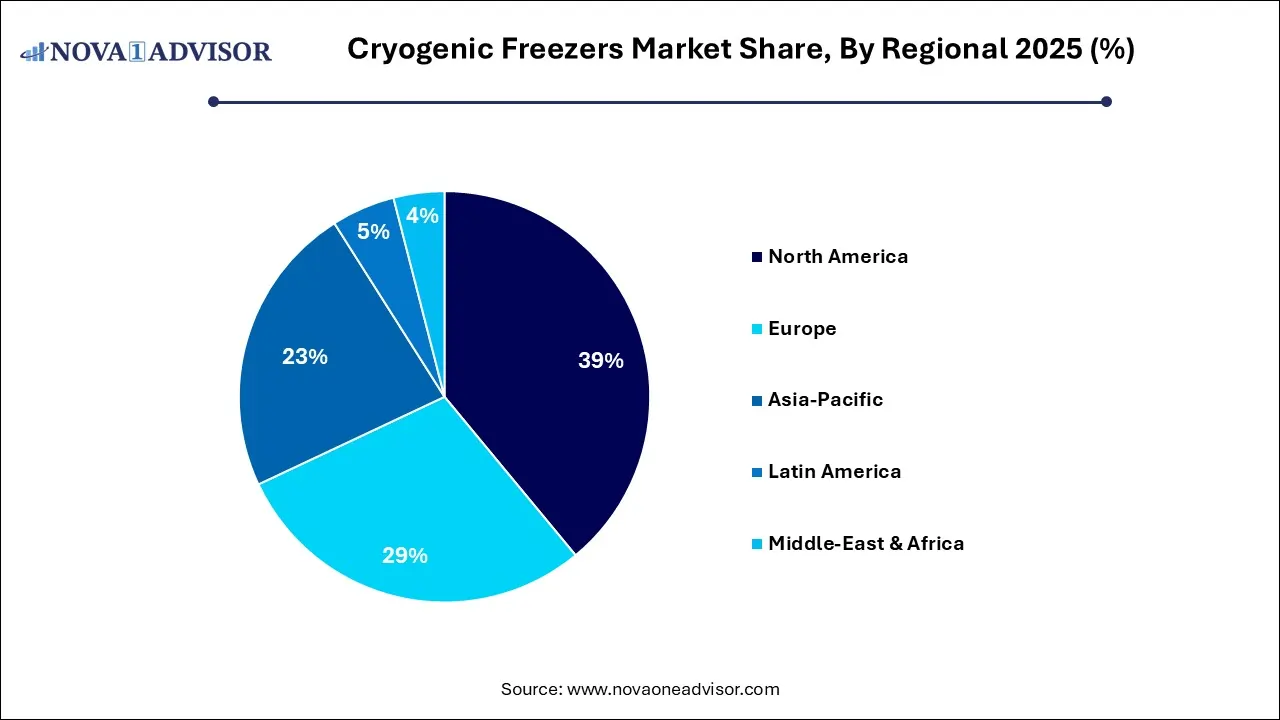
The Asia Pacific segment held 23% share of the market in 2025, due to the growing food and biotech sectors in the region. With the shift toward cleaner energy, there is a surge in LGN consumption. The need to store and transport LNG requires extensive cryogenic tank and equipment infrastructure.
The Latin America region held 5% share of the market in 2025, with governments prioritizing upgrades to healthcare facilities, driving the adoption of advanced medical storage in regional hubs. The growing fields of biotechnology, personalized medicine, and infectious disease researchers require high-capacity, reliable cryogenic storage.
The MEA region held 4% share of the market in 2025, due to the rising demand for the storage and transportation of pharmaceutical products, including vaccines, driving the adoption of advanced aseptic systems to ensure product integrity. Growing focus on genomic and biobanking requires specialized storage solutions to maintain the viability of biological samples.
Recent Developments
- In May 2026, Starfrost launched a new Hybrid Tunnel Freezer, delivering up to 60% more production capacity through a compact, multi-belt design that retains the same energy consumption and footprint as previous models. The system prioritizes clean-by-design engineering for improved hygiene, while utilizing crust-freezing technology to enhance product quality and reducing installation time to one week.
- In March 2024, Cryo-Cell International has opened a 56,000-square-foot facility in Durham, NC, increasing its cryogenic storage capacity tenfold and establishing a 13,000-gallon LN2 system for long-term stem cell preservation. The new site launches ExtraVault, a third-party biobanking service for biopharma, while integrating 22,000 square feet for clean room manufacturing and clinical trials.
- In February 2026, Cryoport’s MVE Biological Solutions launched the Fusion 800 Series, a self-sustaining cryogenic freezer that eliminates the need for a continuous liquid nitrogen (LNâ‚‚) supply. This lab-sized design is specifically engineered for space-constrained environments, fitting through standard doorways while maintaining ultra-low temperatures for high-capacity storage.
Cryogenic Freezers Market Companies
- Thermo Fisher Scientific
- Linde (DE)
- Chart Industries
- Air Products and Chemicals
- Cryofab
- MVE Biological Solutions
- Panasonic Healthcare
- Helmer Scientific
- Eppendorf
Segments Covered in the Report
This report forecasts revenue growth at country levels and provides an analysis of the latest industry trends in each of the sub-segments from 2021 to 2035. For this study, Nova one advisor, Inc. has segmented the cryogenic freezers market.
By Type
- Tunnel freezer
- IQF freezer
- Immersion freezer
- Spiral freezer
- Others
By End-user
- Hospitals and blood centers
- Biotechnology companies
- Academic and research institutions
- Others
By Product Type
- Liquid nitrogen freezers
- Liquid carbon dioxide freezers
- Liquid helium freezers
By Region
- North America
- Europe
- Asia Pacific
- Latin America
- Middle East and Africa (MEA)
FAQ's

Proceed to Buy
Instant PDF delivery on confirmation

Cryogenic Freezers Market Size to Hit USD 512.44 million by 2035
 Request Customization
 Download Sample
Warning: Trying to access array offset on value of type null in /home/multiwpmr/public_html/report-details.php on line 1145

Get a Sample of this Report
Cryogenic Freezers Market