

Genetic Engineering Market Size, Share, Growth, Report 2026 to 2035
 Status Published
 Category Healthcare


Content
Genetic Engineering Market Summary
The global genetic engineering market size was estimated at USD 2.03 billion in 2025 and is projected to hit around USD 13.63 billion by 2035, growing at a CAGR of 20.96% during the forecast period from 2026 to 2035.
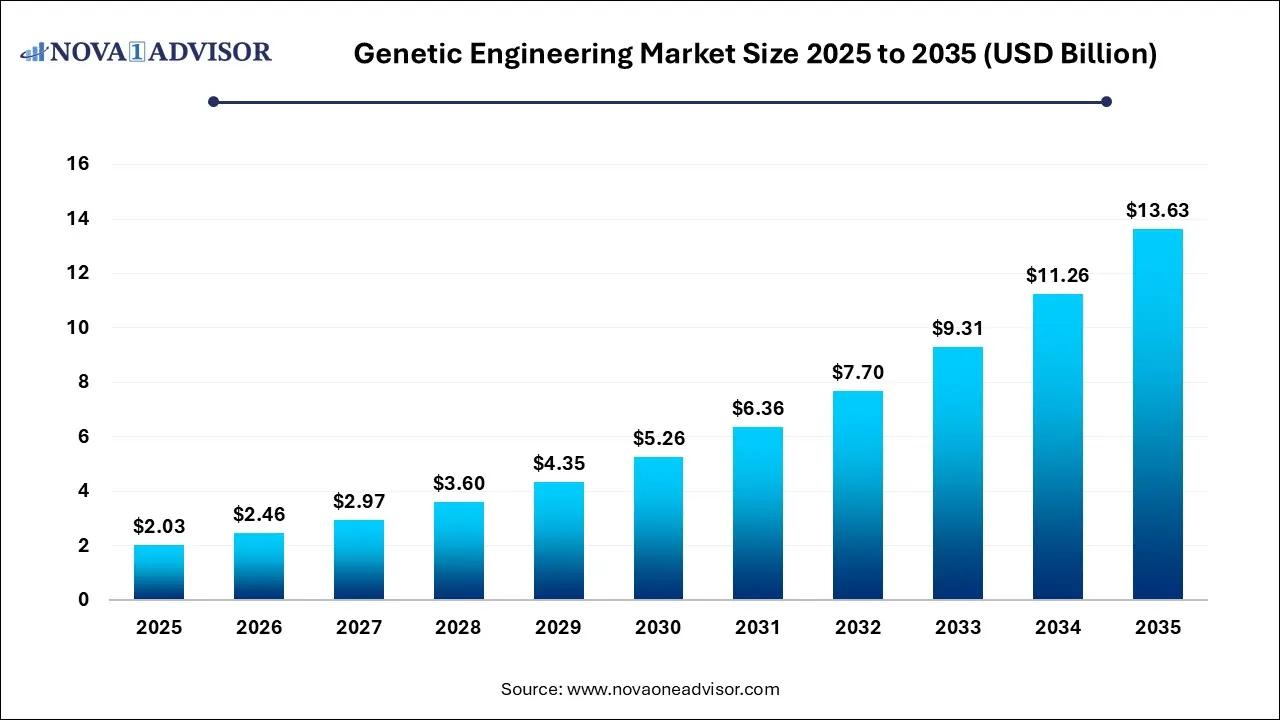
Market Key Takeaways
- The genetic engineering market is experiencing rapid expansion due to advancements in biotechnology and increasing demand for precision medicine.
- PCR remains the dominant device segment due to its widespread use in diagnostics and research.
- Gene splicing is the fastest-growing technique segment owing to its applications in CRISPR and gene-editing technologies.
- The medical industry leads the application segment, driven by gene therapy and personalized medicine.
- Asia Pacific is emerging as the fastest-growing regional market due to expanding biotech infrastructure and government support.
- AI integration is accelerating research efficiency, reducing development timelines, and improving genetic data analysis.
Market Overview
The genetic engineering market has evolved into a cornerstone of modern biotechnology, enabling scientists to manipulate genetic material for diverse applications across healthcare, agriculture, and industrial biotechnology. The market is witnessing significant growth driven by increasing investments in genomics research, rising demand for genetically modified crops, and the expanding use of gene-editing technologies such as CRISPR-Cas9.
In healthcare, genetic engineering is revolutionizing treatment paradigms by enabling targeted therapies for previously untreatable genetic disorders. For example, gene therapies for conditions like sickle cell anemia and spinal muscular atrophy are transforming patient outcomes. In agriculture, genetically engineered crops are improving yield, pest resistance, and climate resilience, addressing global food security challenges.
Additionally, advancements in sequencing technologies and molecular diagnostics are fueling demand for genetic engineering tools such as PCR and gel electrophoresis systems. Governments and private organizations are heavily investing in biotechnology innovation, further strengthening the market outlook. The convergence of biology with digital technologies is expected to accelerate breakthroughs, making genetic engineering a critical driver of future scientific progress.
Market Outlook
- Market Growth Overview: The global genetic engineering market is expected to grow significantly between 2025 and 2035, driven by the technological advancements in gene editing, the rising prevalence of chronic diseases, and the expansion of agricultural genomics.
- Sustainability Trends: Sustainability trends involve agricultural biotechnology and crop resilience, synthetic biology for eco-friendly materials, and precision medicine and gene therapy.
- Major Investors: Major investors in the market include Thermo Fisher Scientific Inc., Merck KGaA, Lonza Group AG, GenScript Biotech Corporation, and Agilent Technologies Inc.
How is AI Transforming the Genetic Engineering Market
Artificial intelligence is fundamentally reshaping the genetic engineering landscape by enhancing data analysis, accelerating research, and enabling predictive modeling. AI algorithms can process vast genomic datasets, identifying patterns and mutations that would take years for traditional methods to uncover. This capability significantly shortens drug discovery timelines and improves the accuracy of gene-editing processes.
For instance, AI-driven platforms are being used to design CRISPR guides with higher precision, reducing off-target effects. Companies are leveraging machine learning to predict protein folding structures, which directly impacts genetic modification outcomes. A notable example is AI-assisted drug discovery, where algorithms identify potential gene targets for rare diseases.
Moreover, AI is enhancing agricultural genetic engineering by predicting crop performance under different environmental conditions. This allows for the development of genetically modified crops tailored to specific climates. AI-powered automation in laboratories is also improving efficiency in PCR testing and gene sequencing workflows.
Overall, AI is not just a supporting tool but a transformative force that is redefining the speed, accuracy, and scalability of genetic engineering processes.
Genetic Engineering Market Report Scope
| Report Coverage | Details |
| Market Size in 2026 | USD 2.46 Billion |
| Market Size by 2035 | USD 13.63 Million |
| Growth Rate From 2026 to 2035 | CAGR of 20.96% |
| Base Year | 2025 |
| Forecast Period | 2026 to 2035 |
| Segments Covered | Product, Devices, Techniques, Application, Region |
| Market Analysis (Terms Used) | Value (USD Million/Billion) or (Volume/Units) |
| Regional Scope | North America; Europe; Asia Pacific; Central and South America; the Middle East and Africa |
| Key Companies Profiled | Thermo Fisher Scientific Inc., GenScript, Amgen Inc., Genentech, Inc., Merck KGaA, Horizon Discovery Group plc, Sangamo Therapeutics, Inc., Transposagen Biopharmaceuticals, Inc., OriGene Technologies, Inc., Segmentation |
Market Driver
Growing Demand for Personalized Medicine
One of the most significant drivers of the genetic engineering market is the increasing demand for personalized medicine. Traditional treatment approaches often follow a one-size-fits-all model, which may not be effective for all patients. Genetic engineering enables the development of therapies tailored to an individual's genetic makeup, improving treatment outcomes and reducing side effects.
For example, oncology has seen a major shift toward targeted therapies based on genetic mutations in tumors. Treatments such as CAR-T cell therapy involve genetically modifying a patient’s immune cells to attack cancer cells more effectively. Similarly, pharmacogenomics allows healthcare providers to select medications based on a patient’s genetic profile, ensuring optimal efficacy.
As healthcare systems worldwide move toward precision medicine, the demand for genetic engineering tools and technologies is expected to surge, driving sustained market growth.
Market Restraint
Ethical and Regulatory Concerns
Despite its transformative potential, the genetic engineering market faces significant challenges due to ethical and regulatory concerns. Genetic modification, particularly in humans, raises questions about safety, long-term effects, and moral implications. Issues such as germline editing, which can pass genetic changes to future generations, are highly controversial.
Regulatory frameworks vary across regions, creating uncertainty for companies operating globally. Strict approval processes for gene therapies can delay product launches and increase development costs. For instance, regulatory agencies often require extensive clinical trials to ensure safety and efficacy, which can take years to complete.
Additionally, public perception plays a crucial role. Resistance to genetically modified organisms (GMOs) in certain regions can limit market adoption, especially in agriculture. These factors collectively act as barriers to market growth.
Market Opportunity
Expansion in Emerging Economies
Emerging economies present significant growth opportunities for the genetic engineering market. Countries in Asia Pacific and Latin America are investing heavily in biotechnology infrastructure, research institutions, and healthcare systems. Governments are introducing favorable policies to attract investments and promote innovation in genetic research.
For example, countries like India and China are rapidly expanding their genomics research capabilities, supported by large population datasets and increasing healthcare expenditure. In agriculture, genetic engineering is being used to develop crops resistant to local environmental challenges, boosting productivity.
Furthermore, the rising prevalence of genetic disorders in these regions is driving demand for advanced diagnostic and therapeutic solutions. As awareness and accessibility improve, emerging markets are expected to become key growth engines for the global genetic engineering industry.
Segmental Insights
By Product
How did the biochemical segment account for the largest share in the Global Genetic Engineering market?
The biochemical segment is driven by the aggressive biopharmaceutical investments, shifting the industry toward a standard of high-precision, personalized medicine. Rapid advancements in sequencing and synthetic circuits are accelerating discovery timelines, ensuring greater accuracy in therapeutic development. These innovations provide the critical infrastructure for the next generation of genomic breakthroughs and agricultural sustainability.
How did the genetic markers segment expect to hold the fastest-growing Global Genetic Engineering market in the coming years?
The genetic markers segment is driven by technologies that have become the backbone of modern drug discovery, enabling the precise identification of disease traits and the regulation of genetic material. This technological leap is essential for addressing the global rise in chronic diseases through highly targeted, "precision" pharmaceuticals and diagnostic tools.
By Devices
How did the PCR segment account for the largest share in the Global Genetic Engineering market?
The PCR segment is driven by the constant demand for high-volume diagnostics and longitudinal research. Critical applications in oncology and gene therapy ensure that precise DNA quantification remains a non-negotiable standard for personalized clinical outcomes. The shift toward automation and digital PCR is significantly enhancing lab productivity and detection sensitivity across the biotechnology landscape.
How did the gene gun segment expect to hold the fastest-growing Global Genetic Engineering market in the coming years?
The gene gun segment is driven by the strategic expansion of gene gun technology, which ensures a high-precision future for both agricultural engineering and clinical therapeutics. By overcoming the biological limitations of traditional vectors, these tools are now indispensable for the complex transformation of recalcitrant plant species and the delivery of novel vaccines. Manufacturers are simultaneously refining device portability and efficiency, drastically reducing cellular damage while accelerating transgene integration.
By Technique
How did the gene splicing segment dominate the Global Genetic Engineering market?
The gene splicing segment, driven by CRISPR-Cas9, has transformed biological engineering into a high precision industrialized process. This technological leap catalyst for multi-billion dollar investments in curative gene therapies and the global scaling of resilient, high-yield agricultural systems. By enabling the programmable production of therapeutic proteins and engineered microbes, gene splicing has solidified its role as the foundational engine of the modern bioeconomy.
How did the artificial selection segment expect to hold the fastest-growing Global Genetic Engineering market in the coming years?
The artificial selection segment is driven by the synergy between precision agriculture and advanced biotechnology is fundamentally transforming the agricultural sector into a high-tech, data-driven industry. This integration is powered by gene editing tools like CRISPR-Cas9, which allow for rapid, targeted modifications that were previously impossible with traditional breeding. By combining AI-driven genomics with precision breeding, researchers can now identify and scale beneficial traits with unprecedented speed and accuracy to meet the urgent needs of global food security.
By Application
How did the agriculture segment dominate the Global Genetic Engineering market?
The agriculture segment is driven by massive commercial investment and addresses critical climate challenges by engineering staple crops to withstand extreme conditions. The resulting gains in productivity and the significant reduction in chemical inputs have generated billions in economic value for global farming communities.
How did the medical industry segment expect to hold the fastest-growing Global Genetic Engineering market in the coming years?
The medical industry segment is driven by a shift that is supported by a robust global infrastructure and massive biopharmaceutical investments, particularly in North America and the Asia-Pacific regions. Strategic collaborations are further industrialising the production of vaccines and cell therapies, ensuring that these advanced modalities move rapidly from the lab to the clinic. These integrated advancements provide the scalable framework necessary to redefine the standard of care for previously untreatable genetic disorders.
By Regional
How did the North America region account for the largest share in the Global Genetic Engineering market?
North America’s high-density ecosystem of elite research institutions and industry leaders is supported by research and development investments in genome engineering and stem cell therapies. The sophisticated healthcare infrastructure and a favourable regulatory framework that prioritizes rapid clinical translation and robust intellectual property protection.
U.S. Global Genetic Engineering Market Trends
The U.S. AI integration, which optimizes gene editing accuracy and significantly reduces the risk of off-target effects in therapeutic development. Supported by a robust infrastructure and massive private-sector investment, North America continues to lead the global market in scaling these personalized and resilient biological solutions. These integrated technologies provide the essential, scalable framework required to address complex human health challenges and global food security.
How did the Asia Pacific region hold the fastest-growing Global Genetic Engineering Market in the forecast period?
Asia Pacific is rapidly emerging as a global powerhouse in biotechnology, fuelled by aggressive government funding and a surge in local start-up investments in the region. The widespread adoption of CRISPR/Cas9 is being deployed at scale to address the region’s high incidence of chronic diseases and to modernize its vast agricultural sector.
China Global Genetic Engineering Market Trends
China’s strategic push is evidenced by a decisive regulatory shift that has moved high-yield, gene-edited staple crops from the laboratory to large-scale cultivation to secure national food security. Supported by a robust ecosystem of domestic leaders like BGI and GenScript, the nation is industrializing both agricultural engineering and advanced clinical applications at an unprecedented pace.
Key Players in the Global Genetic Engineering Market
- Thermo Fisher Scientific Inc.: As a market leader, Thermo Fisher provides essential tools, instruments, and reagents for genetic engineering, including CRISPR kits, gene synthesis, and sequencing technology. By 2026, the company continues to expand its CDMO capabilities, acting as a critical end-to-end partner for accelerating gene therapy development.
- GenScript: GenScript is a major player specializing in high-throughput gene synthesis, peptide synthesis, and antibody discovery, which powers genetic research and novel therapeutic development globally.
- Amgen Inc. : Amgen is a pioneer in biotechnology, leveraging advanced genetic engineering, protein engineering, and AI to develop groundbreaking biologic therapies for chronic diseases and oncology.
Segments Covered in the Report
This report forecasts revenue growth at country levels and provides an analysis of the latest industry trends in each of the sub-segments from 2021 to 2035. For this study, Nova one advisor, Inc. has segmented the genetic engineering market.
By Devices
- PCR
- Gene Gun
- Gel Assemblies
By Product
- Biochemical
- Genetic Markers
By Technique
- Artificial Selection
- Gene Splicing
By Application
- Agriculture
- Medical Industry
By Region
- North America
- Europe
- Asia Pacific
- Latin America
- Middle East and Africa (MEA)

Proceed to Buy
Instant PDF delivery on confirmation

Genetic Engineering Market Size to Hit USD 13.63 Billion by 2035
 Request Customization
 Download Sample

Get a Sample of this Report
Genetic Engineering Market