

Genotyping Market Size, Share, Forecast Report, 2026-2035
 Status Published
 Category Healthcare


Content
Genotyping Market Size and Growth 2026 to 2035
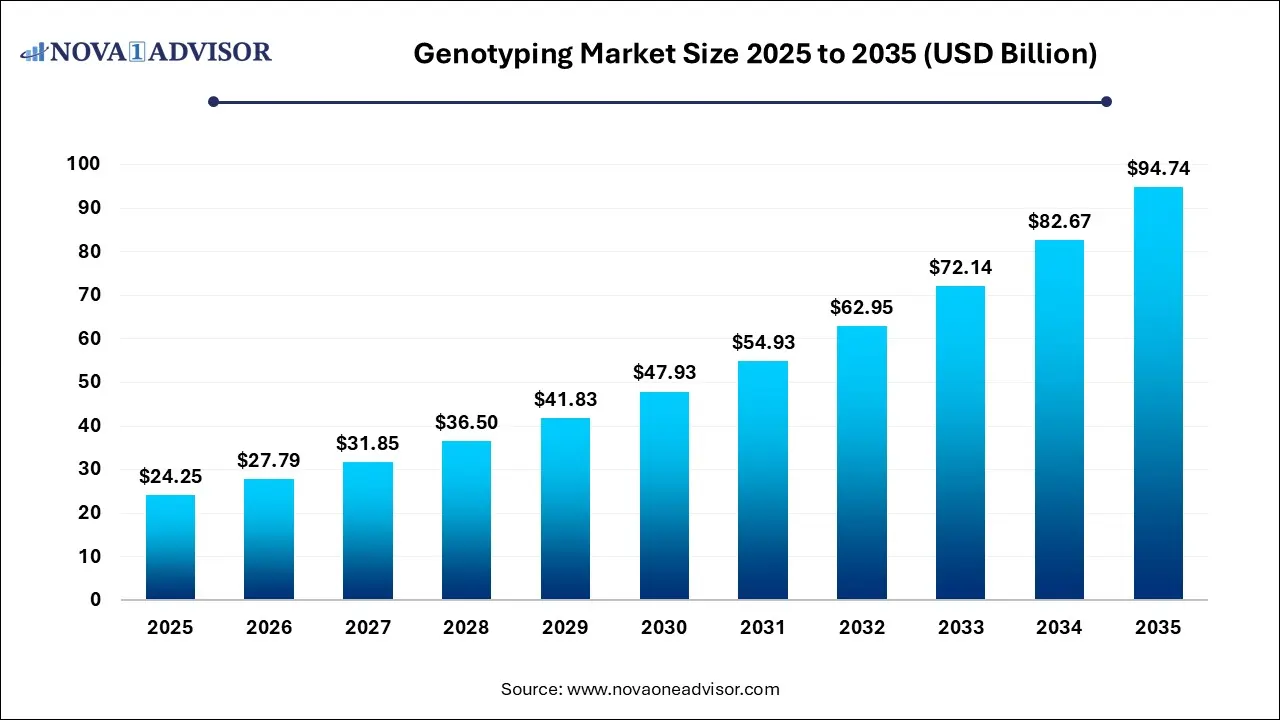
The global Genotyping Market size was estimated at USD 24.25 billion in 2025 and is projected to hit around USD 94.74 billion by 2035, growing at a CAGR of 14.6% during the forecast period from 2026 to 2035.
Market Key Takeaways:
- The global Genotyping Market is witnessing significant growth driven by technological advancements, particularly in sequencing technologies and their applications across various industries.
- AI has a transformative role in automating and enhancing the accuracy of genotyping processes, offering faster, more accurate results in diagnostics and research.
- Major trends include the increasing adoption of Next-Generation Sequencing (NGS), growing interest in personalized medicine, and the expansion of genetic testing services.
- The market is being driven by the rising demand for genetic testing in healthcare, but faces challenges due to regulatory complexities.
- There is a significant opportunity in the expansion of genomic data storage and the application of AI for data analysis.
Market Overview
The Genotyping Market involves techniques and technologies used to identify genetic differences, variations, or mutations in an individual's genome. It is used widely across diagnostics, drug discovery, personalized medicine, and academic research. The market has been expanding rapidly due to increased applications in genetic testing, particularly for rare diseases and cancer, alongside growing government investments in genomics and personalized medicine.
The increasing awareness of genetic diseases and the rising demand for personalized medicine have accelerated the growth of this market. Genotyping technologies, such as Next-Generation Sequencing (NGS), are evolving rapidly, offering more precise and cost-effective genetic insights. With the adoption of genomics becoming more widespread, there is also a focus on improving the integration of genomic data with AI for analysis, which is expected to further drive growth.
Market Outlook
- Market Growth Overview: The global genotyping market is expected to grow significantly between 2026 and 2035, driven by the rising adoption of precision medicine, growth in agricultural and animal genetics, and increasing government funding and research institutions.
- Sustainability Trends: Sustainability trends involve green lab practices and waste reduction, agronomics for sustainable food production, and energy-efficient data processing.
- Major Investors: Major investors in the market include Illumina, Inc., Thermo Fisher Scientific Inc, QIAGEN N.V., Danaher Corporation, and Agilent Technologies, Inc.
How is AI Transforming the Genotyping Market?
Artificial Intelligence (AI) has become an indispensable tool in the Genotyping Market, especially in the analysis of vast amounts of genomic data. AI's role in predictive genomics is paramount as it enhances the processing capabilities, enabling faster and more accurate results. With the use of machine learning algorithms, AI can predict gene mutations, understand complex genetic traits, and even help with personalized drug development.
In the field of diagnostics, AI algorithms are being used to improve the detection of genetic disorders from sequencing data. This leads to faster diagnosis and better treatment outcomes. The combination of AI with advanced sequencing techniques allows researchers to not only generate high-throughput genetic data but also interpret it in a much more efficient way, which was not possible before.
Major Trends in the Market:
- Increasing Adoption of NGS: Next-Generation Sequencing has revolutionized genotyping by providing high throughput, scalability, and affordability compared to traditional methods like Sanger sequencing. NGS is being increasingly adopted in diagnostics, drug development, and genomic research.
- Growing Demand for Personalized Medicine: As the focus shifts towards personalized treatment plans, genetic testing is becoming essential for understanding individual health risks and tailoring treatments accordingly.
- Expansion of Genomic Databases: The construction and expansion of genomic databases such as the 1000 Genomes Project and human genome databases are fueling advancements in genetic research and applications in medicine.
- AI Integration for Data Interpretation: AI tools are increasingly being integrated into genomics research, helping scientists and clinicians interpret complex genetic data more efficiently and accurately.
Genotyping Market Report Scope
| Report Coverage | Details |
| Market Size in 2026 | USD 27.79 Billion |
| Market Size by 2035 | USD 94.74 Billion |
| Growth Rate From 2026 to 2035 | CAGR of 14.6% |
| Base Year | 2025 |
| Forecast Period | 2026 to 2035 |
| Segments Covered | Technology, Product, Application,End User, Region |
| Market Analysis (Terms Used) | Value (USD Million/Billion) or (Volume/Units) |
| Regional Scope | North America; Europe; Asia Pacific; Central and South America; the Middle East and Africa |
| Key Companies Profiled | QIAGEN, Affymetrix, Inc., Illumina, Inc, Thermo Fisher Scientific, Inc., General Electric Company, Agilent Technologies, Inc., Fluidigm Corporation, Sequenom, F. Hoffmann-La Roche Ltd, and Beckman Coulter, Inc. |
Driver
One of the major drivers of the Genotyping Market is the increasing demand for genetic testing, particularly in diagnostics. With advancements in genomic medicine, patients can now get insights into their genetic predisposition to various diseases, enabling early diagnosis and better disease management. Genetic testing for conditions such as cancer, heart disease, and rare genetic disorders is gaining traction in hospitals and diagnostic centers globally. This is fueled by the rising awareness of genetic diseases and the need for early intervention, making genetic testing a cornerstone of modern healthcare.
Moreover, the growing demand for precision medicine, which tailors treatment to the individual based on their genetic profile, is a crucial driver. The ability to design drugs and treatments based on a patient’s genetic makeup promises improved outcomes and minimal side effects, thus driving the genotyping market.
Restraint
Despite the growth, one of the major restraints in the Genotyping Market is the complex and evolving regulatory landscape. Regulatory approval for genetic testing products, especially in diagnostics, remains a challenge due to differing guidelines across regions. The approval process for new genetic tests can be lengthy, and the lack of standardization in testing methods can lead to discrepancies in results. Furthermore, privacy concerns regarding genetic data and its use in research and healthcare are contributing to regulatory hurdles. These barriers can slow down the adoption of genotyping technologies, particularly in sensitive applications like diagnostics.
Opportunity
A significant opportunity in the Genotyping Market lies in the development of AI-powered tools for genomic data analysis. While sequencing technologies generate vast amounts of data, there is still a need for efficient tools to interpret and utilize this information effectively. AI's ability to analyze big data quickly and predict genetic outcomes presents an opportunity for companies to develop more advanced software and platforms for genomic data analysis. The application of AI to genomics could help automate data interpretation, offer more personalized results, and improve the accessibility of genetic testing, making it a key growth area.
Additionally, the growing interest in non-invasive prenatal testing (NIPT) and genetic testing for inherited diseases offers a promising avenue for market expansion. As healthcare providers begin to adopt these technologies on a broader scale, new opportunities for innovative applications in diagnostics and personalized treatments will emerge.
Segmental Insights
By Technology
How did the PCR (polymerase chain reaction) segment dominate the Global Genotyping market?
The PCR 9polyperase chain reaction) segment is driven by the high recurring demand for reagents and consumables, real-time PCR has emerged as a game-changer in oncology and pharmacogenomics, enabling precise identification of genetic mutations and tailoring of personalized treatments. The global expansion of molecular diagnostic infrastructure post-pandemic has solidified PCR's position as the indispensable standard for both small labs and major hospitals.
How did the sequencing segment expect to hold the fastest-growing Global Genotyping market in the coming years?
The sequencing segment is driven by the accelerating global adoption, its ability to generate large-scale genomic data with high efficiency positions it as the future cornerstone of precision medicine and targeted oncology. The high-throughput capabilities in cancer genome analysis and liquid biopsies. Rapidly declining operational costs and the rise of targeted consumables have made these complex genetic insights accessible to smaller laboratories and clinical settings.
By Product
How did the reagents and kits segment account for the largest share in the Global Genotyping market?
The reagents and kits segment is driven by the rising demand in the pharmacogenomics and agricultural biotechnology, coupled with the rise of next-generation sequencing, which is increasing the volume of high-purity enzymes and nucleic acids required. Laboratories increasingly prefer pre-packaged, high-throughput kits for their standardized efficiency and reduced error rates compared to manual in-house preparations.
How did the software and services segment expect to hold the fastest-growing Global Genotyping market in the coming years?
The software and services segment is driven by the critical need for cloud-based bioinformatics to manage the massive datasets produced by NGS. The integration of AI and machine learning is revolutionizing variant interpretation, providing the predictive accuracy essential for high-stakes oncology and precision medicine. The development of automated, user-friendly platforms is lowering the barrier to entry, allowing clinicians to transform raw genetic data into actionable insights with unprecedented speed.
By Application
How did the diagnostics and personalized medicine segment account for the largest share in the Global Genotyping market?
The diagnostics and personalized medicine segment is driven by the leveraging of pharmacogenomics; clinicians can now determine precise drug responses, significantly improving patient outcomes while minimizing adverse side effects. The genotyping expands into rare disease diagnostics, serving as the foundational tool for transitioning global healthcare from a "one-size-fits-all" model to individualized genetic care.
How did the pharmacogenomics segment expect to hold the fastest-growing Global Genotyping market in the coming years?
The pharmacogenomics segment is driven by the critical shift from generalized medicine to targeted therapies for cancer and chronic disease. The integration of next-generation sequencing and AI-powered analytics allows for the simultaneous analysis of complex genetic variants, drastically reducing trial-and-error prescribing. The rising adoption of companion diagnostics and massive healthcare investments in the region, which provide diverse genomic data for research.
By End User
How did the diagnostics and research laboratories segment account for the largest share in the Global Genotyping market?
The diagnostics and research laboratories segment is driven by the critical role genotyping plays in managing the rising burden of chronic and infectious diseases. The significant government and private funding aimed at expanding specialized diagnostic infrastructure. Its ability to bridge the gap between basic research and personalized clinical application make them the indispensable engine of the global genotyping market.
How did the pharmaceutical and biopharmaceutical companies segment expect to hold the fastest-growing Global Genotyping market in the coming years?
The pharmaceutical and biopharmaceutical companies segment is driven by the strategic investments in genotyping into targeted drug development and critical trial design. By identifying specific patient subsets through biomarker identification, these firms significantly increase the success rates of novel therapies while meeting FDA recommendations for pharmacogenomic studies. The rise of companion diagnostics, co-developed to ensure drug effectiveness, further accelerates the demand for specialized genotyping services and kits. The industry's shift toward high-value precision medicine and reduced trial-and -error in drug pipelines.
Key Players in the Global Genotyping Market
- QIAGEN : QIAGEN contributes to the global genotyping market by providing comprehensive "Sample to Insight" solutions, including sample technologies that isolate DNA/RNA and assay technologies like QIAcuity digital PCR for precise quantification.
- Affymetrix, Inc. : Affymetrix, now a brand under Thermo Fisher Scientific, pioneered microarray technology with its GeneChip platform and high-density Axiom array plates, which remain pivotal for genome-wide association studies (GWAS) and SNP genotyping.
- Illumina, Inc.: Illumina dominates the genotyping market with its next-generation sequencing (NGS) platforms and Infinium microarray technologies, such as the Global Diversity Array, designed to accelerate population genomics and precision medicine.
- Thermo Fisher Scientific, Inc. : Thermo Fisher holds a leading position in the genotyping assay market by offering a vast portfolio of PCR-based tools (TaqMan assays), capillary electrophoresis, and microarray analysis tools (via Affymetrix) for diverse applications.
Segments Covered in the Report
This report forecasts revenue growth at country levels and provides an analysis of the latest industry trends in each of the sub-segments from 2021 to 2035. For this study, Nova one advisor, Inc. has segmented the genotyping market.
By Technology
- Sequencing
-
- Next-Generation Sequencing
- Pyrosequencing
- Sanger Sequencing
- Capillary Electrophoresis
-
- Amplified Fragment Length Polymorphism (AFLP)
- Single-Strand Conformation Polymorphism (SSCP)
- Restriction Fragment Length Polymorphism (RFLP)
- PCR
- Microarray
-
- DNA Microarrays
- Antibody Microarrays
- Mmchips
- Peptide Microarrays
- Mass Spectrometry
By Product
- Reagents and Kits
- Instruments
- Sequencer
- Amplifiers
- Services
By Application
- Diagnostics
- Drug Discovery and Development
- Academic Research
- Research and Development Centers
By End User
- Hospitals
- Diagnostic Centers
- Academic Institutes
- Research and Development Centers
By Region
- Americas
- North America
- US
- Canada
- South America
- North America
- Europe
- Western Europe
- Germany
- France
- Italy
- Spain
- UK
- Rest of Western Europe
- Eastern Europe
- Western Europe
- Asia-Pacific
- Japan
- China
- India
- Australia
- South Korea
- Rest of Asia-Pacific
- Middle East & Africa
- Middle East
- Africa
FAQ's

Proceed to Buy
Instant PDF delivery on confirmation

 Request Customization
 Download Sample

Get a Sample of this Report
Genotyping Market