

Contract Research Organization (CRO) Market Size, Share, Forecast Report, 2026-2035
 Status Published
 Category Healthcare


Content
Contract Research Organization (CRO) Market Size, Growth and Trends 2026 to 2035
The global contract research organization market size was estimated at USD 51.87 billion in 2025 and is expected to reach USD 119.46 billion by 2035, growing at a CAGR of 8.7% from 2025 to 2035.
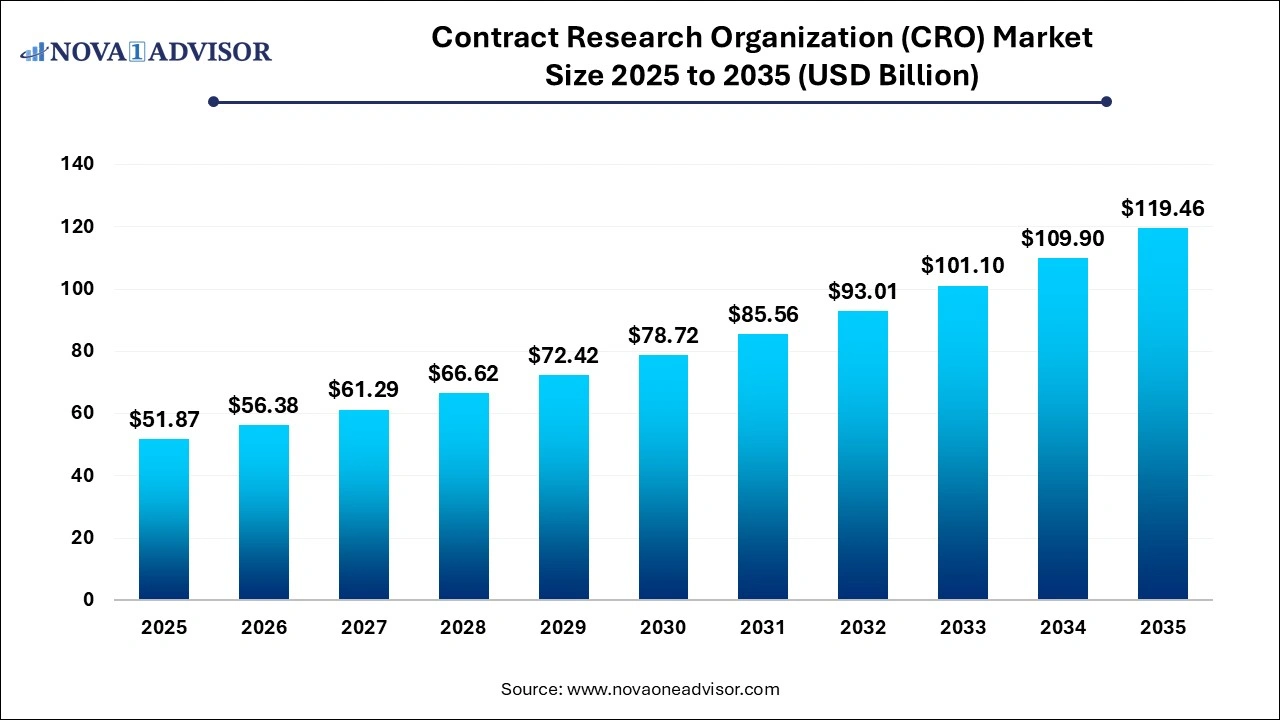
Contract Research Organization (CRO) Services Market Outlook
- Market Growth Overview: The contract research organization (CRO) market is expected to grow significantly between 2026 and 2035, driven by the rising research and development spending and outsourcing, complex drug development and specialization, and high prevalence of cancer.
- Sustainability Trends: Sustainability trends involve sustainable clinical trials, waste management, green logistics, and green lab practices.
- Major Investors: Major investors in the market include QVIA, Labcorp (Covance), Thermo Fisher Scientific (PPD), Charles River Laboratories, ICON plc, and Syneos Health.
Contract Research Organization (CRO) Market Report Scope
| Report Coverage | Details |
| Market Size in 2026 | USD 56.38 Billion |
| Market Size by 2035 | USD 119.46 Billion |
| Growth Rate From 2026 to 2035 | CAGR of 8.7% |
| Base Year | 2025 |
| Forecast Period | 2026 to 2035 |
| Market Analysis (Terms Used) | Value (USD Million/Billion) or (Volume/Units) |
| Segments Covered | By Service Type, By Therapeutic Indication, By End-user |
| Regional Scope | North America; Europe; Asia Pacific; Central and South America; the Middle East and Africa |
| Key Companies Profiled | Laboratory Corporation of America Holdings (LabCorp/Fortrea, IQVIA Inc., Parexel International Corporation |
Contract Research Organization (CRO) Market Segmental Insights
By Service Type Insights
How did the Clinical Research Services Segment Dominate the Contract Research Organization (CRO) Market?
The clinical research services segment is driven by pharmaceutical companies increasingly shifted fixed costs to CROs to manage the high volume and regulatory complexity of modern global trials. By integrating AI-driven data analytics and electronic management systems, CROs reduced trial startup times by over 25% while ensuring strict compliance with FDA and EMA standards. The rising demand for specialized expertise in biologics and personalized medicine made outsourced clinical services the primary engine for drug development.
How did the Early Phase Development Segment Expect to Hold the Fastest-Growing Contract Research Organization (CRO) Market in the Coming Years?
The early phase development segment is driven by the integration of AI-driven predictive analytics and data monitoring, which has significantly improved trial design and shortened recruitment timelines. The continuous surge in startup funding has turned early-phase development into a critical, high-efficiency engine for the global pharmaceutical pipeline. The ability to achieve 85–90% accuracy in drug target identification ensures that only the most promising candidates proceed, drastically reducing overall operational costs.
By Therapeutic Indication Insights
How did the Oncology Segment Account for the Largest Share in the Contract Research Organization (CRO) Market?
The oncology segment is driven by the commands the highest volume of phase III trials, which are inherently longer, more expensive, and complex to manage. The industry has shifted toward sophisticated biomarker-driven and combination therapies. This complexity requires specialized CRO expertise in personalized medicine and global regulatory navigation that internal teams often lack.
How did the Infectious Diseases Segment Expect to Hold the Fastest-Growing Contract Research Organization (CRO) Market in the Coming Years?
The infectious diseases segment is driven by growing demand for pandemic preparedness, and antimicrobial pipelines have triggered a surge in fast-tracked viral and bacterial therapies. High-level government and institutional funding is fueling this expansion, particularly in the development of next-generation mRNA vaccines and diagnostics. To capture this market, CROs are rapidly scaling specialized BSL-2/3 infrastructure to safely handle emerging pathogens in a highly regulated environment.
By End-user Insights
How did the Biopharmaceutical Companies Segment Account for the Largest Share in the Contract Research Organization (CRO) Market?
The biopharmaceutical companies segment is driven by leveraging CROs for specialized expertise in biologics and antibody-drug conjugates. These companies can navigate complex global regulatory frameworks more efficiently than internal teams. The massive shift toward Cell & Gene therapy has further solidified this dominance, as CROs provide the niche infrastructure required for these advanced modalities. The ability to transform fixed R&D expenses into variable, scalable costs makes this end-user segment the primary revenue engine for the global CRO market.
How did the Other Segment Expect to Hold the Fastest-Growing Contract Research Organization (CRO) Market in the Coming Years?
The other segment is driven by the adoption of AI-powered platforms and synthetic control arms; these firms are slashing clinical expenses by up to 70% and accelerating timelines for complex biologics and gene therapies. Their aggressive expansion into the Asia-Pacific market leverages lower costs and rapid patient enrollment, further fueled by a shift toward flexible functional service provider (FSP) models. This move away from one-size-fits-all contracts toward strategic, high-touch alliances has made small biotech the primary engine of new demand in the CRO landscape.
Key Players in the Contract Research Organization (CRO) Market
- Laboratory Corporation of America Holdings (LabCorp/Fortrea): LabCorp (through its spin-off Fortrea) provides comprehensive early-stage to late-stage clinical trial management, specializing in bioanalytical, central laboratory, and companion diagnostics to accelerate drug development.
IQVIA Inc.: As a leading global CRO, IQVIA utilizes its proprietary "Connected Intelligence, which combines vast healthcare data, advanced - technology, and AI, to deliver faster, more personalized clinical trial solutions. They specialize in transforming clinical development, commercialization, and real-world evidence research, particularly in high-growth areas like oncology and immunology.
- Syneos Health, Inc.: Syneos Health operates as a fully integrated biopharmaceutical solutions organization, uniquely combining deep clinical research capabilities with commercialization services to speed the delivery of therapies.
- Parexel International Corporation: Parexel contributes as a top-tier full-service provider with over 40 years of experience, specializing in Phase I to IV clinical trials across complex therapeutic areas like oncology and neuroscience.
Contract Research Organization (CRO) Services Market Segmentation
By Service Type
- Early Phase Development
- Discovery Services
- Chemistry
- Preclinical Services
- Toxicology
- Pharmacokinetics
- Others
- Clinical Research Services
- Phase I
- Phase II
- Phase III
- Phase IV
- Laboratory Services
- Bioanalytical Services
- Analytical Services
- Others
- Consulting Services
By Therapeutic Indication
- Oncology
- Infectious Diseases
- Immunological Disorders
- Respiratory Diseases
- Cardiovascular Diseases
- Neurological Disorders
- Others
By End User
- Medical Device Companies
- Biopharmaceutical Companies
- Others
Regional Analysis and Forecast
Further, this research study analyses market size, production, consumption and its advancement trends at global, regional, and country level for period 2026 to 2035 and covers following region in its scope:
- North America
- United States
- Canada
- Europe
- Germany
- United Kingdom
- Italy
- France
- Rest of EU
- Asia Pacific
- China
- India
- Japan
- Southeast Asia
- Rest of APAC
- Central & South America
- Brazil
- Argentina
- Rest of Central & South America
- Middle East and Africa
- UAE
- Saudi Arabia
- Rest of MEA

Proceed to Buy
Instant PDF delivery on confirmation

Contract Research Organization (CRO) Market Size and Top Key Players
 Request Customization
 Download Sample

Get a Sample of this Report
Contract Research Organization (CRO) Market