

Drug Discovery Technology Market Size, Share, and Trends 2026 to 2035
 Status Published
 Category Healthcare


Content
Drug Discovery Technology Market Summary
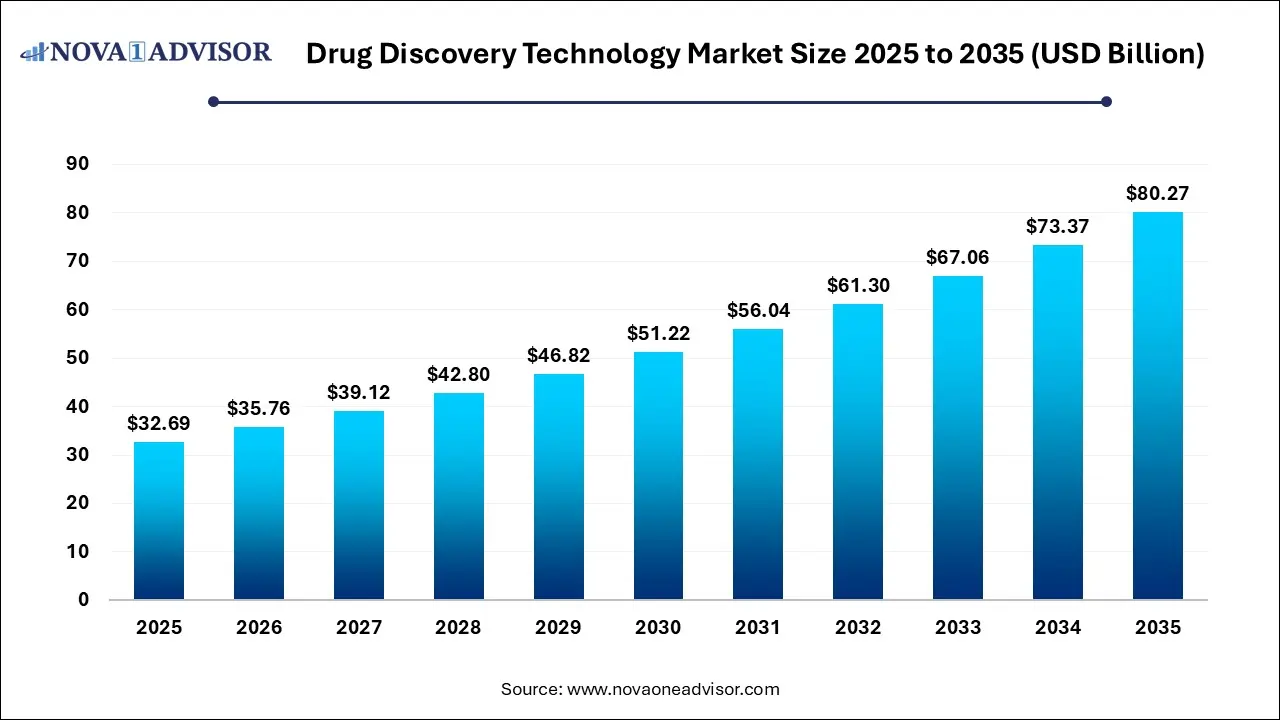
The drug discovery technology market was estimated at USD 32.69 billion in 2025 and is projected to increase from USD 35.76 billion in 2026 to approximately USD 80.27 billion by 2035, growing at a CAGR of 9.4% from 2026 to 2035. The drug discovery technology market is driven by the acceleration in 3D cell cultures, organ-on-chip models, and high-throughput screening, the rising prevalence of chronic diseases demands effective therapeutics, and pharmaceutical firms are shifting toward specialized expertise, driving the need for technological tools.
Key Takeaways
- By product, the genomics segment held a dominant position in the market with a share of 25% in 2025.
- By product, the proteomics segment is the fastest growing between 2026 and 2035.
- By end-user, the pharmaceutical and biotechnology companies segment held a dominant position in the market with a share of 55% in 2025.
- By end-user, the academic and research institutes segment is the fastest growing between 2026 and 2035.
- By region, the North America region held a dominant position in the market with a share of 38% in 2025.
Innovation Driving Transformation in the Drug Discovery Technology Market
Drug discovery technology comprises an ecosystem of AI-driven platforms, automated high-throughput screening, and molecular modeling tools used to identify and optimize new therapeutic candidates. These technologies bring significant advantages by enabling faster hit identification, enhancing lead optimization, and predicting drug ADMET properties earlier to reduce expensive clinical failures. Applications are widespread, ranging from AI-driven small molecule generation and gene-editing therapies (CRISPR) for complex diseases to advanced 3D organ-on-chip models for safety testing.
Drug Discovery Technology Market Trends
- Expansion of Self-Driving Robotic Laboratories
Automation is scaling into fully autonomous closed-loop discovery systems where AI agents design experiments, and robotic liquid handling systems execute them, often operating 24/7 with minimal human intervention. These labs generate high-fidelity data that is immediately fed back into AI models, drastically accelerating the Design–Make–Test–Analyze (DMTA) cycle.
- Shift to Human-Relevant Testing Methods
Moving away from `traditional animal testing, the industry is widely adopting new approach methodologies, such as organ-on-chip and organoids, which better mimic human biology. These 3D cell structures provide more accurate safety prediction, reducing preclinical failure rates and assisting with regulatory approval.
- Commercialization of Targeted Protein Degradation (TPD) Platforms
Protein degradation has moved from experimental research to commercial reality, with researchers utilizing PROTACs and molecular glues to treat previously unmanageable diseases. These technologies target and destroy disease-causing proteins by hijacking the cell's natural disposal system.
Key AI Integration in the Drug Discovery Technology Market
AI and ML are profoundly transforming work from empirical, trial-and-error methods to data-driven, generative approaches that significantly slash research timelines from years to months. Generative AI, including GANs and diffusion models, is now heavily used for de novo molecular design, creating entirely new, optimized drug candidates rather than merely screening existing chemical libraries. The market has entered a "proof era" where AI-designed molecules are successfully advancing into Phase II trials, boosting confidence in AI's ability to reduce high failure rates in preclinical stages.
Drug Discovery Technology Market Report Scope
| Report Coverage | Details |
| Market Size in 2026 | USD 35.76 Billion |
| Market Size by 2035 | USD 80.27 Billion |
| Growth Rate From 2026 to 2035 | CAGR of 9.4% |
| Base Year | 2025 |
| Forecast Period | 2026 to 2035 |
| Segments Covered | By Product, By End-user, By Region |
| Market Analysis (Terms Used) | Value (USD Million/Billion) or (Volume/Units) |
| Regional Scope | North America; Europe; Asia Pacific; Central and South America; the Middle East and Africa |
| Key Companies Profiled | Agilent Technologies Inc., Amgen Inc., AstraZeneca Plc, Bayer AG, Bruker Corp., Charles River Laboratories International Inc., Danaher Corp., Eli Lilly and Co., General Electric Co., GlaxoSmithKline Plc, Illumina Inc., Merck KGaA, Novartis AG, Novo Nordisk AS, Promega Corp., QIAGEN N.V., Revvity Inc., Sanofi SA, Takeda Pharmaceutical Co. Ltd., Thermo Fisher Scientific Inc. |
Market Dynamics
Driver
Increasing Demand for Targeted Therapies
The surging demand for targeted therapies, particularly in oncology and for rare diseases, is a primary driver of the drug discovery technologies market. To develop these precise treatments, pharmaceutical companies are increasingly investing in sophisticated technologies, such as high-throughput screening, and boosting the demand for advanced instruments and services. This shift toward personalized medicine requires accelerating the identification of specific disease pathways, which in turn fuels the growth.
Restraint
High Initial Investment Cost
The market growth is hindered by the advanced laboratory automation, AI software, and specialized data infrastructure, which act as significant barriers to the widespread adoption of new drug discovery technologies. The intense upfront financial burden often results in a success or die scenario, restricting the number of projects that can be pursued and ultimately reducing the pace of R&D innovation.
Opportunity
Targeted Protein Degradation and Digital Twin Technology in Oncology
The transformation of the traditional lock-and-key drug approach into efficient, event-driven, and predictive therapeutic development. TDP, including PROTACs and molecular glues, allows for the targeting of previously unmarketable cancer-causing proteins, opening significant new segments in the drug discovery market. Digital Twins create virtual patient representations that integrate multi-omics data with AI to simulate drug reactions, reducing reliance on slow wet-lab experiments and cutting R&D costs.
Segment Insights
By Product Insights
Why Did the Genomics Segment Hold a 25% Share for the Drug Discovery Technology Market?
The genomics segment held a dominant position in the market with a share of 25% in 2025, owing to the strong demand for precision medicine and gene-based therapies. The convergence of data with artificial intelligence has allowed predict therapeutic outcomes, attracting significant investments. The growing investment in genomics-drug discovery to improve success rates and reduce late-stage failures in clinical trials.
The proteomics segment held a 22% share of the market in 2025, due to this providing early, actionable insights into a drug's potential efficacy and toxicity, helping companies avoid costly failures. Growing investment in research and development investments, rising in complex biologic and antibody drug pipelines, necessitates intensive protein-related research.
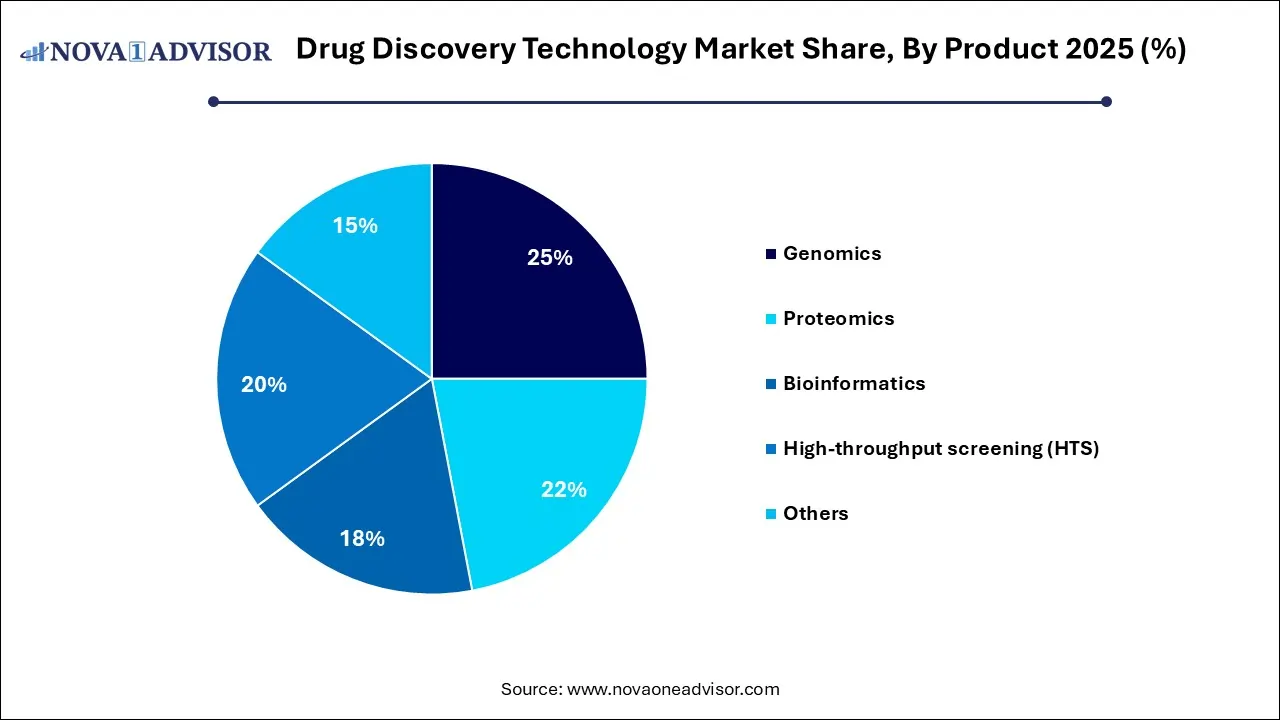
The bioinformatics segment held 18% share of the market in 2025, with the rapidly growing due to AI-driven drug design and big data integration. The need for personalized healthcare requires intensive computational tools to analyze genetic data, boosting the genomics growth. It helps in predicting harmful metabolites early in the pipeline, reducing risk and failures in later clinical trials.
The high-throughput screening (HTS) segment held 20% share of the market in 2025, with the shift toward digital approaches. The integration of automated liquid handling, robotics, and high-content imaging reduces manual errors, increases throughput, and enables complex cell-based assays.
The others segment held 15% share of the market in 2025, with the fragmented and less scalable compared to core technologies. The growing shift from traditional animal testing has increased the demand for new approach methodologies, advanced 3D cell cultures, organ-on-a-chip, and AI-driven toxicity models.
By End-User Insights
Why Did the pharmaceutical and biotechnology companies Segment Lead the Drug Discovery Technology Market?
The pharmaceutical and biotechnology companies segment registered its dominance over the market with a share of 55% in 2025, owing to the heavy R&D investments and direct involvement in drug pipelines. The shift toward complex biologics, monoclonal antibodies, cell therapies, and gene editing requires specialized, high-content screening and advanced analytical technologies.
The academic and research institutes segment held the 25% share of the market in 2025, with the funding constraints and lack of commercialization capabilities. The growing need for efficient data management, in silico modeling, and AI-driven drug design has driven the adoption of advanced software, with institutions increasingly using AI to predict and optimize drug candidates.
The CROs segment held the 20% share of the market in 2025, due to the growing demand for outsourcing, which exists but is still secondary to in-house pharma R&D. Increased government funding for research projects and partnerships with biotechnology firms for drug development programs fuel the market growth.
By Regional Insights
Why Did the North America Region Lead the Drug Discovery Technology Market?
The North America region registered its dominance over the market with a share of 38% in 2025, owing to the strong biotech ecosystem and funding availability. The region transforming from traditional laboratory methods to generative AI-native platforms, computer vision, and self-driving labs to accelerated approvals and novel clinical trial designs, encouraging the adoption of advanced technologies.
The Asia Pacific region held the 22% share of the market in 2025, with rapidly increasing due to outsourcing trends and government investments. The increasing prevalence of cancer, diabetes, and cardiovascular disease in the region requires novel therapeutics, growing funding for biotech, and regulatory harmonization with global standards, which are accelerating development.
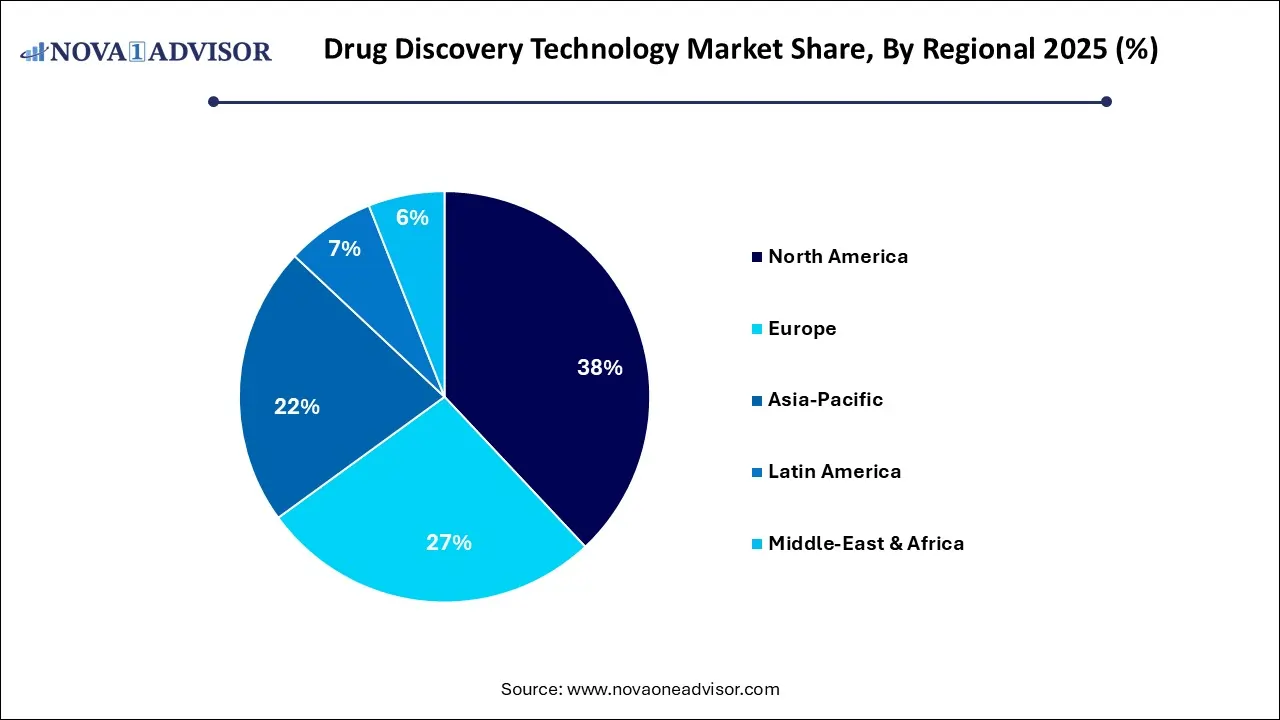
The Europe segment held 27% share of the market in 2025, due to the favorable regulations, increased funding for biotech, and regulatory harmonization with global standards, which are accelerating developments. Significant investment in specialized research and development for biologics, expanding the therapeutic pipeline.
The Latin America region held 7% share of the market in 2025, with lower R&D spending and infrastructure gaps. Increasing use of AI, 3D cultures, and lab automation in drug development. The region's firms are increasingly using contract manufacturing and research services to build supply chain resilience.
The MEA region held 6% share of the market in 2025, due to the growing healthcare investment and nascent biotech ecosystems. Growing partnership with CROs to conduct clinical trials, leveraging the region’s genetically diverse population to develop tailored therapies.
Recent Developments
- In April 2025, Revvity launched Signals One™, a unified software platform designed to accelerate the drug discovery lifecycle by integrating data management across research workflows. The platform enhances "Design-Make-Test-Decide" R&D through AI-ready data standardization and advanced analytics, supporting complex therapeutic development.
- In April 2024, Aurigene Pharmaceutical Services launched Aurigene.AI, a modular, cloud-based platform utilizing physics-based simulations and generative AI to accelerate drug discovery from hit identification to candidate nomination. Built on a database of 180 million compounds and 1.6 million bioassay data points, the platform demonstrated a 35% reduction in cycle time from design to testing.
- In May 2025, Danaher Corporation and AstraZeneca announced a strategic partnership to develop and commercialize AI-powered diagnostic tools designed to advance precision medicine, particularly for antibody-drug conjugates (ADCs). Utilizing the new Danaher Centers for Enabling Precision Medicine and Leica Biosystems' technology, the collaboration focuses on accelerating the development of computational pathology algorithms to improve patient selection.
Drug Discovery Technology Market Companies
- Agilent Technologies Inc.
- AstraZeneca Plc
- Amgen Inc.
- Bayer AG
- Charles River Laboratories International Inc.
- Bruker Corp.
- Danaher Corp.
- General Electric Co.
- Eli Lilly and Co.
- GlaxoSmithKline Plc
- Merck KGaA
- Illumina Inc.
- Novartis AG
- Promega Corp.
- Novo Nordisk AS
Segments Covered in the Report
This report forecasts revenue growth at country levels and provides an analysis of the latest industry trends in each of the sub-segments from 2021 to 2035. For this study, Nova one advisor, Inc. has segmented the drug discovery technology market.
By Product
- Genomics
- Proteomics
- Bioinformatics
- High-throughput screening (HTS)
- Others
By End-user
- Pharmaceutical and biotechnology companies
- Academic and research institutes
- CROs
By Region
- North America
- Europe
- Asia Pacific
- Latin America
- Middle East and Africa (MEA)
FAQ's

Proceed to Buy
Instant PDF delivery on confirmation

Drug Discovery Technology Market Size to Hit USD 80.27 Billion by 2035
 Request Customization
 Download Sample

Get a Sample of this Report
Drug Discovery Technology Market