

Testing and Analysis Services Market (By Sample Type; By Analysis Type; By Industry) - Global Industry Analysis, Share, Growth, Regional Outlook and Forecasts, 2026-2035
 Status Published
 Category Healthcare


Content
Testing and Analysis Services Market Size, Growth and Trends 2026 to 2035
The global testing and Analysis Services market size was estimated at USD 28.67 billion in 2025 and is expected to reach USD 53.31 billion by 2035, growing at a CAGR of 6.4% from 2025 to 2035.
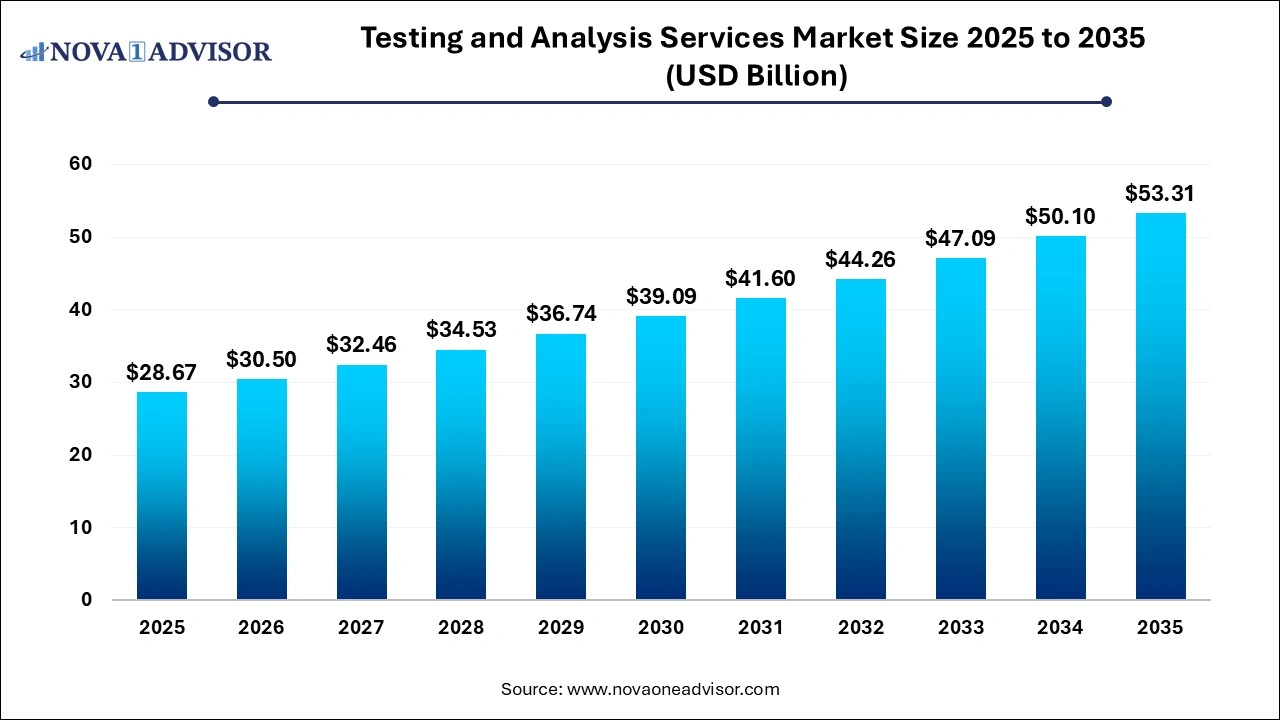
Testing and Analysis Services Market Outlook
- Market Growth Overview: The testing and analysis services market is expected to grow significantly between 2025 and 2034, driven by the increasing investment in drug discovery, clinical trials, and biosimilar compounds, creating high demand for bioanalytical testing services, stringent regulatory compliance, and an increasing outsourcing to specialized firms.
- Sustainability Trends: Sustainability trends involve the rise of ESG and carbon management, circular economy and material science, and green building and environmental testing.
- Major Investors: Major investors in the market include Eurofins Scientific, SGS SA, Bureau Veritas, DEKRA SE, TÜV SÜD AG, and Intertek Group.
Extensive Use across Several End Use Sectors to Bolster Growth of the Market
Products are no longer limited to a single location; instead, they are available globally, meeting international standards. As items must comply to local as well as international standards, global trade has raised test volume several times.
International testing services firms, particularly in Europe, have benefited from increased global commerce. Global commerce has benefited large testing services organizations the most, as multinational manufacturers use the same service providers across multiple locations.
Hundreds of tests for quantitative as well as qualitative product measurements are available in the global testing and analysis services market. The market has been divided into nine broad groups based on the sort of analysis used. In addition to that, each category was subdivided into subgroups based on closely comparable analyses and tests.
Elemental analysis, metallurgical analysis, particle size analysis, mineralogical analysis, petroleum and petrochemical tests, organic analysis, biochemical analysis, isotopic analysis, and other types of analysis/testing are among the most common.
Pharmaceutical and medical device testing, food and beverage, mining and minerals, environmental, and energy are just a few of the sectors that make use of testing and analysis services extensively. Testing materials for compatibility and strength, chemical and composition, food quality and quantification, environmental studies of broad categories of goods, and a variety of additional exclusive as well as non-exclusive testing services are all available in these sectors.
Testing and Analysis Services Market Report Scope
| Report Attribute | Details |
| Market Size Value in 2026 | USD 30.50 Billion |
| Revenue Forecast in 2035 | USD 53.31 Billion |
| Growth Rate | CAGR of 6.4% |
| Base Year for Estimation | 2025 |
| Forecast Period | 2026 - 2035 |
| Quantitative Units | Revenue in USD Million/Billion, and CAGR from 2026 to 2035 |
| Segments Covered | By Sample Type, By Type of Analysis, By Industry |
| Regional Scope | North America; Europe; Asia Pacific; Latin America; MEA |
| Key Companies Profiled | ALS Limited, Activation Laboratories Ltd. (Actlabs), EAG Inc. (EAG Laboratories), Element Materials Technology, Elemental Analysis, Inc. |
Growing trend of Outsourcing: Key Drivers
Most of the testing services are conducted in-house and is particularly evident in the life sciences, petrochemical, and chemical industries. Currently, only 45% to 48% of the services are being outsourced, served by independent service providers (companies whose primary business activities are providing testing services). However, the percentage has grown significantly in the past five years. Compared to 2015, the outsourced testing services market has grown more than 5%, and is expected to grow further during the forecast period.
Large companies are increasingly outsourcing testing in an attempt to reduce costs as the increasing levels of regulations make it progressively costlier to test in-house. These companies are focusing on core activities and passing on responsibilities to independent third parties for regulatory compliance. Outsourcing activities is highest in the environmental (including agriculture) industry; the number has reached approximately 60% in 2018. The food & beverage industry is the second largest market for outsourcing services. However, recent trends suggest that outsourcing services would grow at the highest rate in the biopharmaceutical and medical devices industry.
Manufacturing Migration and Short Product life Cycle
Higher value-added manufacturing (chemicals, biopharmaceuticals, medical devices, and precious commodities) continues to do reasonably well in most of the developed regions. However, manufacturing of general consumable goods, food, and other commodities has moved to emerging countries in the last decade due to high cost. Although manufacturing migration has little to moderate effect on large companies, it has opened new avenues of income for small companies in the region. Countries such as Vietnam, India, China, Brazil, and Mexico are picking up quite a bit of that work because labor costs are extremely low and these countries have easy access to the global market. Business operations in these countries would help increase revenue as well as brand recognition. Additionally, expanding business in these countries is cheap compared to western countries. Hence, risk on return on investment would be minimal.
High Capital Requirements to Hamper Market
High capital requirement is one of the major challenge for companies operating in the industry, especially for new market entrant and small size companies. A testing services company usually requires multiple instruments and well trained staff to run business efficiently.
The instruments may cost in excess of US$ 200,000 even for a small setup. Additionally, other costs such as consumables, premises, and staff would incur significant investment. Depending on the setup and up-front investment, the companies require large capital to sustain the business; a major restrain for small startup business.
Testing and Analysis Services Market Segmental Insights
By Sample Type Insights
How did the Water Segment Dominate the Testing and Analysis Services Market?
The water segment is driven by strict regulatory mandates regarding wastewater, pesticides, and heavy metal contaminants. Rapid industrialization has positioned the industrial sectors as necessitating advanced effluent standards and real-time monitoring. The adoption of AI and Alo T-enabled sensors, such as TOC analyzers, has significantly boosted data accuracy and operational efficiency. By the municipal and industrial sectors, which rely on these technological advancements to ensure environmental and safety compliance.
How did the Biological Samples Segment Expect to Hold the Fastest-Growing Testing and Analysis Services Market in the Coming Years?
The biological samples segment is driven by the increased development of complex biologics and biosimilars for chronic diseases. The rapid outsourcing of preclinical studies, specifically for plasma and serum analysis, has become a primary catalyst for growth in specialized labs. By integrating AI and next-generation sequencing, firms are drastically reducing time-to-market while meeting strict FDA and EMA regulatory mandates.
By Type of Analysis Insights
How did the Elemental Analysis Segment Account for the Largest Share in the Testing and Analysis Services Market?
The elemental analysis segment is driven by the high sensitivity of ICP-OES and ICP-MS technologies, which allow for the simultaneous detection of trace and major elements. By stringent pharmaceutical and food safety regulations that mandate rigorous testing for contaminants in worldwide supply chains. The widespread adoption of CHNS/O analyzers across diverse industries further drives high-volume demand by ensuring efficient material characterisation. The shift toward non-destructive testing methods like XRF has significantly improved cost-effectiveness and operational speed for large-scale laboratories.
How did the Biomedical and Biopharmaceutical Analysis Segment Expect to Hold the Fastest-Growing Testing and Analysis Services Market in the Coming Years?
The biomedical and biopharmaceutical analysis segment is driven by rise of complex biologics and ATMPs necessitates highly specialized, sensitive characterization. To manage high infrastructure costs, pharmaceutical companies are increasingly outsourcing to CROs that utilize advanced high-throughput technologies like HRMS. This strategic shift, coupled with stringent FDA/EMA data integrity mandates, ensures that expert analytical partners are now integral to the drug development lifecycle.
By Industry Insights
How did the pharmaceutical and medical devices segment account for the largest share in the Testing and Analysis Services market?
The pharmaceutical and medical devices segment is driven by adhering to rigorous FDA and European Commission standards for sterility, biocompatibility, and chemical characterization. The massive growth of In-vitro Diagnostics (IVD), which now accounts for roughly one-third of all medical device testing due to the rising chronic disease burden. By outsourcing specialized bioanalytical and clinical testing to expert facilities, companies are successfully accelerating the validation of complex biologics and expanding their product pipelines.
How did the Energy (oil & gas) and Environmental Segment Expect to Hold the Fastest-growing Testing and Analysis Services Market in the Coming Years?
The energy (oil & gas) and environmental segment is driven by the transition to digital always-on monitoring, which utilizes AI and IoT sensors for real-time defect detection and predictive maintenance. To manage aging global infrastructure, specialized non-destructive testing (NDT) has become essential for extending the lifecycle of mature pipelines and refineries. The testing services have evolved into critical enablers for meeting ESG reporting criteria and ensuring the integrity of high-hazard energy assets.
Key Players in the Testing and Analysis Services Market
- ALS Limited: ALS Limited is a global leader in testing, inspection, and certification (TIC) services, providing essential analytical testing and data-driven insights to industries like mining, environmental, and food.
- Activation Laboratories Ltd. (Actlabs): Actlabs is a premier analytical testing and contract research organization that provides high-quality geochemical, geo-metallurgical, and material testing services to the mining and exploration sectors.
- EAG Inc. (EAG Laboratories): EAG Laboratories offers advanced materials characterization, trace elemental analysis, and failure analysis to support research and development across sectors like semiconductors, medical devices, and aerospace.
- Element Materials Technology: Element is a leading global provider of testing, inspection, and certification services that ensure products, materials, and technologies are safe, compliant, and fit for purpose, particularly in sectors like aerospace and medical devices.
- Elemental Analysis, Inc.: Elemental Analysis, Inc. focuses on providing specialized, high-precision analytical chemistry services for the determination of elemental compositions in diverse materials. They contribute to the market by delivering precise, traceable measurements crucial for quality control in scientific research and commercial applications.
Segments Covered in the Report
This report forecasts revenue growth at global, regional, and country levels and provides an analysis of the latest industry trends in each of the sub-segments from 2026 to 2035. For this study, Nova one advisor, Inc. has segmented the global Testing and Analysis Services market
By Sample Type
- Water
- Soil (Manure and Air)
- Sediment
- Clay minerals
- Metal Alloys
- Biological Sample
- Food/Beverage
- Chemical Products
- Corrosion Products
- Oil , Gas and Fluids
- Minerals and Ores
By Type of Analysis
- Elemental Analysis
- Organic Analysis
- Isotopic Analysis
- Particle size analysis
- Mineralogical Analysis
- Metallurgical Analysis
- Petroleum Petrochemical
- Biomedical and Biopharmaceutical Analysis
- Others
By Industry
- Food & Beverage
- Pharmaceutical, Medical Devices
- Environmental
- Energy (Oil & Gas)
- Mining & Minerals
- Chemical & Commodities
- Heavy Industry
By Region
- North America
- U.S.
- Canada
- Europe
- Germany
- France
- United Kingdom
- Rest of Europe
- Asia Pacific
- China
- Japan
- India
- Southeast Asia
- Rest of Asia Pacific
- Latin America
- Brazil
- Rest of Latin America
- Middle East & Africa (MEA)
- GCC
- North Africa
- South Africa
- Rest of Middle East & Africa

Proceed to Buy
Instant PDF delivery on confirmation

Testing and Analysis Services Market Size to Worth Around USD 53.31 Bn by 2035
 Request Customization
 Download Sample

Get a Sample of this Report
Testing and Analysis Services Market