

Life Sciences BPO Market (By Services: Pharmaceutical Outsourcing, Medical devices outsourcing, Contract sales and marketing outsourcing, Others; By Application: Pharmaceuticals, Medical Device applications, Biopharmaceuticals, Research and development, others; By Protocol: Development, Site Management) - Global Industry Analysis, Size, Share, Growth, Trends, Regional Outlook, and Forecast 2026-2035
 Status Published
 Category Healthcare


Content
Life Sciences BPO Market Summary
The global Life Sciences BPO market size was exhibited at USD 525.06 billion in 2025 and is projected to hit around USD 1,325.18 billion by 2035, growing at a CAGR of 9.7% during the forecast period 2026 to 2035.
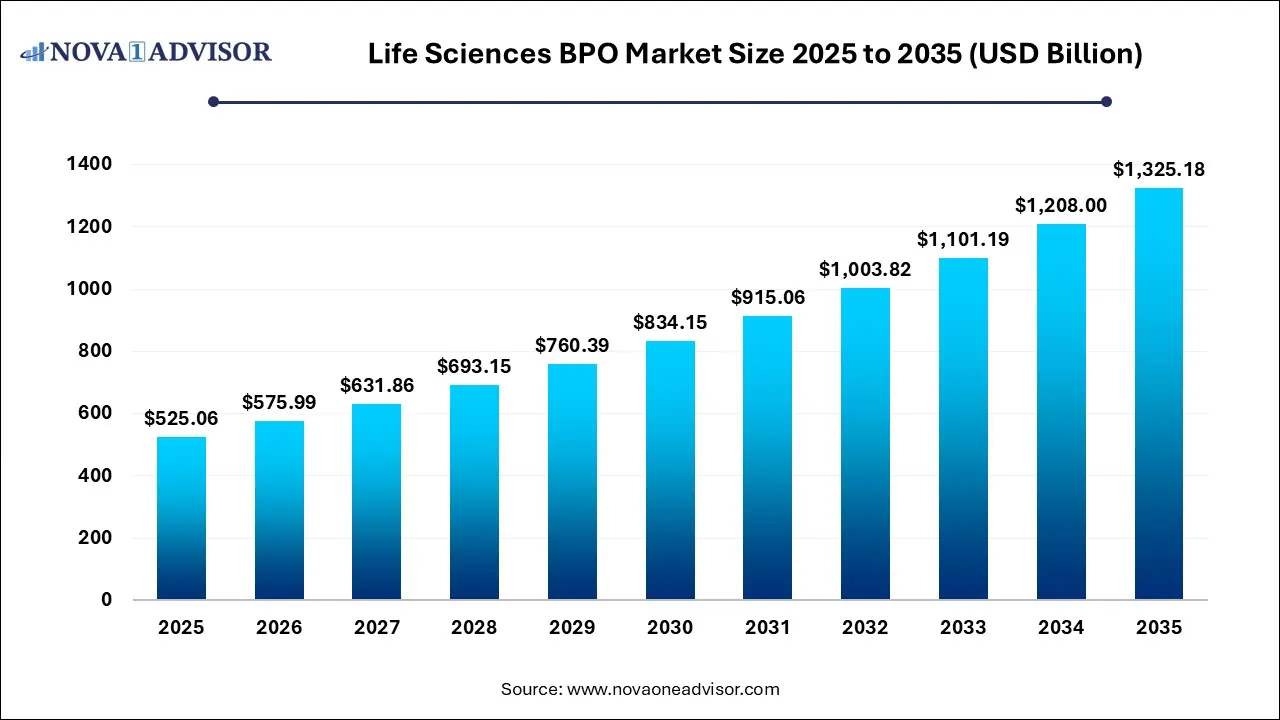
Market Overview
The Life Sciences BPO Market has become an integral part of the global healthcare and pharmaceutical industry, enabling organizations to optimize operations, reduce costs, improve efficiency, and focus on core competencies such as innovation and product development. Business process outsourcing in life sciences involves delegating specific operational activities to specialized third-party service providers, including clinical trial management, regulatory affairs, pharmacovigilance, manufacturing support, data management, medical billing, sales and marketing, and customer support services.
The growing complexity of healthcare systems and pharmaceutical regulations has significantly increased the need for outsourcing solutions. Pharmaceutical and biotechnology companies are under constant pressure to accelerate drug development timelines, ensure regulatory compliance, and minimize operational expenditures. As a result, outsourcing non-core activities has emerged as a strategic approach for improving productivity and operational flexibility.
The market has evolved from traditional back-office support services to highly specialized scientific and clinical functions. Earlier outsourcing models primarily focused on administrative activities such as customer support and data entry. However, modern life sciences BPO providers now offer end-to-end services including clinical research, pharmacovigilance, medical writing, regulatory consulting, supply chain management, and digital health support.
For example, pharmaceutical companies developing oncology drugs often outsource clinical data management and patient recruitment activities to specialized contract research organizations (CROs). Similarly, medical device manufacturers frequently partner with external firms for regulatory documentation and quality assurance processes to meet stringent approval requirements in global markets.
The increasing prevalence of chronic diseases such as cancer, diabetes, cardiovascular disorders, and neurological conditions has intensified global drug development activities. This surge in research pipelines is creating substantial demand for outsourcing services capable of supporting large-scale clinical studies and post-market surveillance programs.
Biopharmaceutical innovation is another important factor shaping the market. The development of biologics, biosimilars, cell therapies, and gene therapies involves highly complex manufacturing and regulatory processes. Many emerging biotechnology companies lack the internal infrastructure required to manage these activities efficiently, prompting greater reliance on specialized outsourcing partners.
Moreover, globalization has expanded outsourcing opportunities across emerging economies. Countries such as India, China, the Philippines, and several Eastern European nations have become prominent outsourcing hubs due to their skilled workforce, lower labor costs, and expanding healthcare infrastructure. Many multinational pharmaceutical companies now operate hybrid outsourcing models that combine onshore strategic management with offshore operational execution.
Technological advancements are also reshaping the competitive landscape. Digital transformation, cloud computing, robotic process automation (RPA), artificial intelligence, and big data analytics are improving service quality and operational efficiency within the BPO ecosystem. Companies are increasingly seeking outsourcing partners capable of delivering technologically advanced solutions rather than merely low-cost services.
Despite strong growth prospects, the market faces challenges related to data security, intellectual property protection, regulatory complexity, and dependency on third-party providers. Nevertheless, increasing healthcare expenditure, growing drug pipelines, and expanding demand for operational efficiency are expected to sustain long-term market growth.
Market Outlook
- Market Growth Overview: The life sciences BPO market is expected to grow significantly between 2025 and 2035, driven by the rise of specialized therapeutics, pharmaceutical firms outsourcing non-core functions, and the rise of specialized therapeutics.
- Sustainability Trends: Sustainability trends involve net-zero and energy efficiency, green manufacturing and logistics, and ESG-focused organizations.
- Major Investors: Major investors in the market include IQVIA, Accenture, Cognizant, Parexel, Catalent, Lonza Group, and Genpact
How AI is Impacting Life Science BPO Market
AI and ML are fundamentally transforming the life science BOP industry by shifting services from manual, labour-intensive tasks toward automated, high-speed digital solutions. BPO providers are leveraging these technologies to accelerate drug discovery, optimize clinical trial requirements, and automate complex regulatory submissions, significantly reducing both time-to-market and operational costs. An AI algorithm can analyse massive datasets to detect safety issues, while generative AI enhances medical writing and document management. By integrating these tools, BPO partners enable pharmaceutical companies to achieve faster decision-making, higher accuracy in data management, and better predictive insights into clinical trial outcomes.
Major Trends in the Market
- Increasing outsourcing of clinical trial management activities
- Growing demand for pharmacovigilance and regulatory affairs outsourcing
- Rising adoption of AI and robotic process automation in BPO operations
- Expansion of offshore outsourcing centers in Asia Pacific
- Increasing use of cloud-based healthcare data management platforms
- Growing importance of real-world evidence and healthcare analytics
- Rising demand for personalized medicine support services
- Increasing outsourcing among small and mid-sized biotechnology companies
- Expansion of biologics and biosimilar development outsourcing
- Growing investment in cybersecurity and healthcare data protection
- Increasing integration of digital health technologies into outsourced services
- Rising focus on patient-centric clinical trial models
- Growth in remote monitoring and decentralized clinical trials
- Increasing partnerships between pharmaceutical companies and CROs
- Expansion of medical device regulatory consulting services
Life Sciences BPO Market Report Scope
| Report Coverage | Details |
| Market Size in 2026 | USD 575.99 Billion |
| Market Size by 2035 | USD 1,325.18 Billion |
| Growth Rate From 2026 to 2035 | CAGR of 9.7% |
| Base Year | 2025 |
| Forecast Period | 2026 to 2035 |
| Segments Covered | Services, Application, Protocol, and Region |
| Market Analysis (Terms Used) | Value (USD Million/Billion) or (Volume/Units) |
| Regional Scope | North America; Europe; Asia Pacific; Central and South America; the Middle East and Africa |
| Key Companies Profiled | International Business Machines Corp, IOVIA, PAREXEL International Corp, Lonza Group, Infosys.Ltd, ICON plc, Genpact LTD, Covance, Inc. (Labcorp), Catalent, Inc, Boehringer Ingelheim Gmbh, Atos SE, Accenture plc, Syneos Health, Inc, Charkes River Laboratories International, Inc, Wuxi AppTec Co, Ltd, Medpace Holdings, Inc, PRA Health Sciences, Inc, Cognizant Technology Solutions, Quintiles Transactional Corporation, and Others |
Market Driver
Rising Pressure to Reduce Operational Costs and Improve Efficiency
One of the most significant drivers of the Life Sciences BPO Market is the increasing pressure on pharmaceutical, biotechnology, and medical device companies to reduce operational costs while improving productivity and accelerating product development timelines.
Drug development has become increasingly expensive and time-intensive. Developing a new pharmaceutical product often requires billions of dollars in investment and several years of clinical testing and regulatory review. Companies are therefore seeking ways to optimize resources and reduce overhead expenses without compromising quality or compliance.
Outsourcing enables life sciences organizations to access specialized expertise and scalable operational support without maintaining extensive in-house infrastructure. For example, pharmaceutical companies can outsource pharmacovigilance operations to external vendors capable of handling global safety reporting requirements more efficiently.
Additionally, outsourcing allows organizations to focus on core competencies such as innovation, strategic planning, and product commercialization. Instead of managing administrative or repetitive operational tasks internally, companies can leverage experienced BPO providers with advanced technological capabilities and regulatory expertise.
The increasing globalization of clinical research is further supporting outsourcing adoption. Conducting multinational clinical trials requires local regulatory knowledge, multilingual support, and regional operational coordination, all of which specialized BPO providers can efficiently deliver.
Market Restraint
Concerns Regarding Data Security and Regulatory Compliance
A major restraint in the Life Sciences BPO Market is the growing concern surrounding data security, patient privacy, and regulatory compliance. Life sciences outsourcing providers handle highly sensitive healthcare information, including clinical trial data, patient records, proprietary research information, and intellectual property.
Cybersecurity threats targeting healthcare organizations have increased substantially in recent years. Data breaches can lead to severe financial losses, regulatory penalties, reputational damage, and legal liabilities. As a result, pharmaceutical and biotechnology companies are often cautious when outsourcing critical business functions involving confidential information.
Regulatory frameworks such as HIPAA in the United States and GDPR in Europe impose strict requirements regarding healthcare data handling and privacy protection. BPO providers must maintain robust cybersecurity infrastructure and compliance protocols to meet these standards.
Cross-border outsourcing arrangements can further complicate compliance management. Different countries have varying data protection regulations, creating operational challenges for multinational outsourcing partnerships. Companies must ensure that offshore vendors maintain equivalent security standards and regulatory adherence.
Additionally, intellectual property protection remains a key concern, particularly in highly competitive therapeutic areas involving innovative drug candidates and proprietary technologies.
Market Opportunity
Expansion of Outsourcing Demand from Emerging Biotechnology Companies
The rapid growth of emerging biotechnology companies presents a significant opportunity for the Life Sciences BPO Market. Many startup and mid-sized biotech firms focus heavily on scientific innovation but lack the operational infrastructure required to manage clinical development, regulatory affairs, manufacturing support, and commercialization activities internally.
These companies increasingly rely on outsourcing partners to access specialized expertise and scalable resources without making substantial capital investments. Outsourcing enables biotech firms to accelerate product development while maintaining financial flexibility.
For example, gene therapy and cell therapy startups often outsource regulatory consulting, clinical trial management, and pharmacovigilance operations to experienced service providers familiar with complex approval pathways. This allows smaller innovators to compete more effectively in highly regulated markets.
The increasing number of venture capital-funded biotechnology companies globally is further expanding outsourcing demand. As biologics, precision medicine, and rare disease therapies gain momentum, BPO providers capable of supporting advanced therapeutic development are likely to experience strong growth opportunities.
Moreover, emerging biotech firms frequently require flexible service models tailored to evolving development stages, creating opportunities for specialized and adaptive outsourcing partnerships.
Segmental Analysis
By Services
Pharmaceutical Outsourcing Dominated the Market
Pharmaceutical outsourcing dominated the Life Sciences BPO Market because pharmaceutical companies account for the largest share of global healthcare R&D spending and operational outsourcing activities. Drug manufacturers increasingly rely on external service providers for clinical trial management, pharmacovigilance, regulatory affairs, manufacturing support, and commercialization activities.
The growing complexity of pharmaceutical product development has intensified outsourcing demand. Regulatory approval processes have become more rigorous, requiring extensive documentation, safety monitoring, and compliance management. Outsourcing providers help pharmaceutical companies navigate these challenges while improving operational efficiency and reducing costs. Large pharmaceutical firms often maintain long-term strategic partnerships with CROs and BPO vendors to manage global development programs more effectively.
Contract Sales and Marketing Outsourcing is the Fastest Growing Segment
Contract sales and marketing outsourcing is emerging as the fastest-growing service segment due to increasing commercialization pressures and changing pharmaceutical marketing strategies. Life sciences companies are seeking flexible sales models that allow rapid market expansion without maintaining large permanent salesforces.
Digital engagement platforms, remote physician communication, and data-driven marketing campaigns are reshaping pharmaceutical commercialization. Outsourcing providers now offer advanced omnichannel marketing services, customer relationship management, market access support, and patient engagement programs. Small and mid-sized pharmaceutical firms particularly benefit from outsourced sales models that provide scalable commercial capabilities at lower operational costs.
By Application
Pharmaceuticals Dominated the Market
Pharmaceutical applications dominated the market due to the extensive outsourcing requirements associated with drug discovery, clinical development, regulatory approval, and post-market surveillance. Pharmaceutical companies continue expanding their outsourcing strategies to accelerate development timelines and optimize resource utilization.
The increasing prevalence of chronic diseases and rising global demand for innovative therapies are driving pharmaceutical R&D investments. Outsourcing providers support pharmaceutical companies across multiple functions, including clinical data management, medical writing, safety monitoring, and regulatory submissions. The segment also benefits from strong outsourcing demand related to generic drug development and biosimilar commercialization.
Research and Development is the Fastest Growing Segment
Research and development applications are witnessing rapid growth as life sciences companies increasingly outsource scientific and clinical research activities to specialized service providers. R&D outsourcing allows organizations to access advanced expertise, global patient populations, and modern technological infrastructure.
Biotechnology firms developing precision medicine, biologics, and gene therapies frequently depend on external partners for laboratory services, bioinformatics, and clinical trial management. Decentralized clinical trials and AI-driven analytics are further expanding outsourcing opportunities within the R&D ecosystem. Companies are prioritizing faster innovation cycles, making outsourced research support increasingly valuable.
By Protocol
Development Dominated the Market
Development protocols dominated the market because drug and medical device development activities require extensive operational support across clinical research, regulatory affairs, and commercialization stages. Outsourcing providers play a critical role in helping life sciences companies manage development timelines efficiently.
The growing complexity of global clinical trials has increased reliance on specialized CROs and BPO vendors capable of handling multicenter studies, patient recruitment, and regulatory coordination. Pharmaceutical and biotechnology companies often outsource protocol design, clinical monitoring, statistical analysis, and submission preparation to improve operational flexibility and accelerate approvals.
Site Management is the Fastest Growing Segment
Site management is emerging as the fastest-growing protocol segment due to increasing clinical trial volumes and the growing adoption of decentralized research models. Effective site management is essential for ensuring patient enrollment, protocol compliance, data accuracy, and trial efficiency.
Outsourcing providers are increasingly offering remote monitoring, digital patient engagement, and centralized site coordination services. Advanced technologies such as AI-driven recruitment tools and cloud-based trial management platforms are improving operational performance. As global clinical trials become more geographically diverse, demand for efficient site management solutions is expected to rise significantly.
By Region
North America Dominated the Market
North America dominated the Life Sciences BPO Market due to the strong presence of major pharmaceutical companies, advanced healthcare infrastructure, and high research and development expenditure. The United States remains the largest contributor to regional market growth because of its extensive pharmaceutical innovation ecosystem and established outsourcing networks.
The region also benefits from a mature regulatory environment and widespread adoption of advanced technologies such as AI, cloud computing, and digital health platforms. Pharmaceutical companies in North America frequently outsource clinical trials, pharmacovigilance, and commercialization activities to improve operational efficiency and accelerate market entry.
U.S. Life Sciences BPO Market Trends
The U.S. integration of AI-driven automation and specialised CDMO services is enabling life sciences firms to streamline the high-cost transition from clinical research to commercial manufacturing. By leveraging BPO partners with robust real-world evidence (RWE) capabilities, companies are effectively mitigating the risks associated with increasingly complex global regulatory frameworks. This strategic shift allows organisations to maintain a lean operational structure, refocusing capital on core R&D while outsourcing administrative and data-heavy functions.
Asia Pacific is the Fastest Growing Region
Asia Pacific is the fastest-growing regional market due to expanding healthcare infrastructure, skilled workforce availability, and lower operational costs compared to Western markets. Countries such as India, China, and the Philippines have become major outsourcing destinations for pharmaceutical and biotechnology companies.
The region is witnessing rapid growth in clinical research activities, driven by large patient populations and increasing government support for healthcare innovation. Additionally, many multinational companies are establishing regional outsourcing centers in Asia Pacific to improve scalability and reduce operational expenses. Rising investment in biotechnology and digital healthcare is further strengthening regional market growth.
China Life Sciences BPO Market Trends
China’s strategic shift toward pharmaceutical and medical device outsourcing is enabling life sciences firms to mitigate rising research and development costs while navigating increasingly complex global regulatory landscapes. By integrating AI-driven predictive analytics and transitioning toward full, cycle-staggering partnerships, homegrown biotech entities are significantly accelerating their commercialization timelines.
Some of the prominent players in the Life Sciences BPO Market include:
- International Business Machines Corp
- IOVIA
- PAREXEL International Corp
- Lonza Group
- Infosys.Ltd
- ICON plc
- Genpact LTD
- Covance, Inc. (Labcorp)
- Catalent, Inc
- Boehringer Ingelheim Gmbh
- Atos SE
- Accenture plc
- Syneos Health, Inc
- Charkes River Laboratories International, Inc
- Wuxi AppTec Co, Ltd
- Medpace Holdings, Inc
- PRA Health Sciences, Inc
- Cognizant Technology Solutions
- Quintiles Transactional Corporation
- ProMab Biotechnologies, Inc
- Boehringer Ingelheim Gmbh
Recent Developments
- In March 2026, IQVIA expanded its AI-driven clinical trial analytics platform to improve decentralized trial management and patient recruitment efficiency.
- In January 2026, Accenture announced new partnerships with pharmaceutical firms to enhance digital pharmacovigilance operations using generative AI technologies.
- In November 2025, Cognizant launched advanced healthcare process automation solutions focused on regulatory compliance and clinical data management.
- In September 2025, Parexel expanded its global site management capabilities through investments in remote monitoring technologies for decentralized clinical trials.
- In July 2025, Syneos Health introduced AI-enabled patient engagement platforms designed to improve clinical trial retention rates.
- In May 2025, Labcorp Drug Development strengthened its bioanalytical outsourcing services with new laboratory expansions in Asia Pacific.
- In February 2025, ICON plc announced strategic investments in digital health technologies and real-world evidence analytics capabilities.
Segments Covered in the Report
This report forecasts revenue growth at global, regional, and country levels and provides an analysis of the latest industry trends in each of the sub-segments from 2021 to 2035. For this study, Nova one advisor, Inc. has segmented the global Life Sciences BPO market.
By Services
- Pharmaceutical Outsourcing
- Contract Manufacturing Market
- API
- Finished Dose Form
- Packaging
- Contract Research Organizations
- Drug Discovery
- Pre-clinical Studies
- Clinical Trial Studies
- Regulatory Services
- Pharmacovigilance
- Contract Manufacturing Market
- Medical devices outsourcing
- Contract Manufacturing Market
- Electronic Manufacturing Services
- Finished Goods
- Raw Materials/ Components
- Contract Research Organizations
- Regulatory Consulting Services
- Product Design and Development Services
- Product Testing Services
- Product Implementation Services
- Product Upgrade Services
- Product Maintenance Services
- Contract Manufacturing Market
- Contract sales and marketing outsourcing
- Others
By Application
- Pharmaceuticals
- Medical Device applications
- Biopharmaceuticals
- Research and development
- others
By Protocol
- Development
- Site Management
By Region
- North America
- Europe
- Asia-Pacific
- Latin America
- Middle East & Africa (MEA)
FAQ's

Proceed to Buy
Instant PDF delivery on confirmation

Life Sciences BPO Market Size to Hit USD 1,325.18 Billion by 2035
 Request Customization
 Download Sample

Get a Sample of this Report
Life Sciences BPO Market