

DNA Manufacturing Market Size, Share, and Trends 2026 to 2035
 Status Published
 Category Healthcare


Content
DNA Manufacturing Market Size and Growth 2026 to 2035
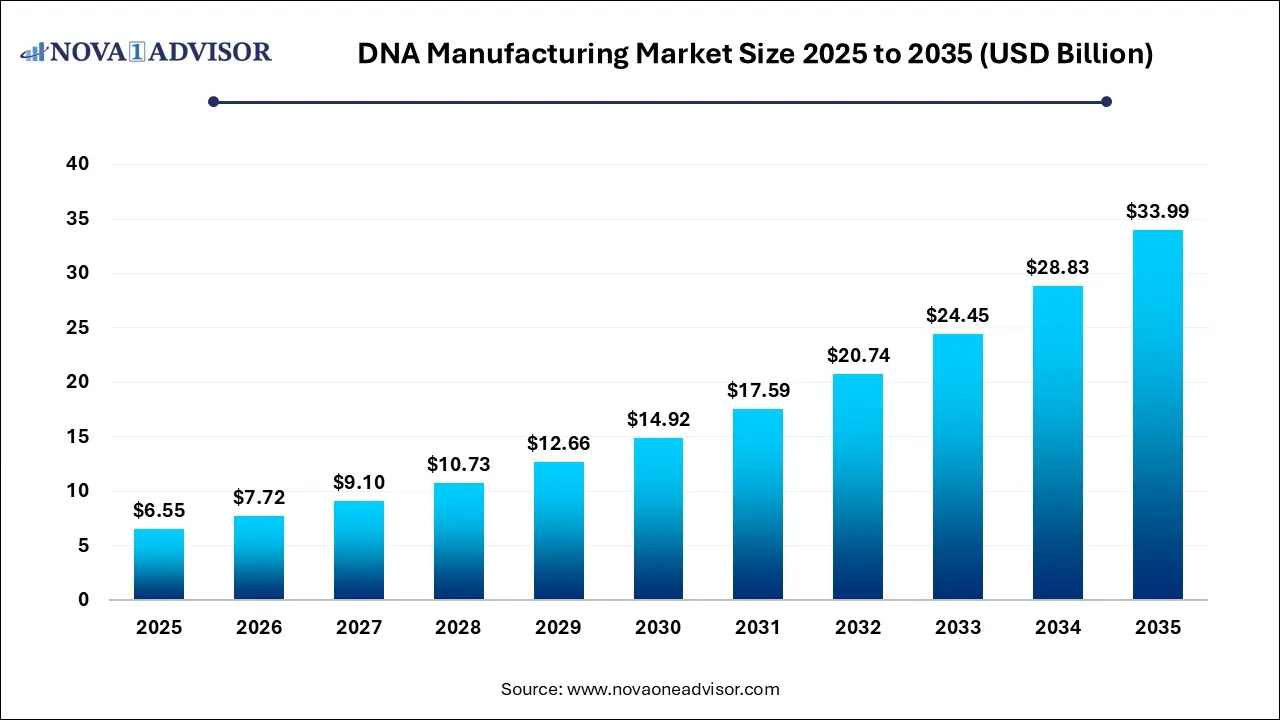
The DNA manufacturing market size was estimated at USD 6.55 billion in 2025 and is projected to increase from USD 7.72 billion in 2026 to approximately USD 33.99 billion by 2035, growing at a CAGR of 17.9% from 2026 to 2035. The DNA manufacturing market is driven by the rise in gene therapy and advanced therapeutics, the expansion of mRNA vaccine technology, and growing investment in biopharma and synthetic biology.
Key Takeaways
- By type, the plasmid DNA segment held a dominant position in the market with a share of 62% in 2025.
- By type, the synthetic DNA segment is the fastest growing between 2026 and 2035.
- By grade, the GMP grade segment held a dominant position in the market with a share of 68% in 2025.
- By grade, the R&D grade segment is the fastest growing between 2026 and 2035.
- By application, the cell & gene therapy segment held a dominant position in the market with a share of 42% in 2025.
- By end use, the pharmaceutical and biotechnology companies segment held a dominant position in the market with a share of 58% in 2025.
- By region, the North America region held a dominant position in the market with a share of 41% in 2025.
Innovation Driving Transformation in the DNA Manufacturing Market
DNA manufacturing comprises the customized production of synthetic and plasmid DNA molecules, which are essential tools for modern biotech research, gene therapies, mRNA vaccines, and molecular diagnostics. The key advantages include faster, automated, and more accurate synthetic production, which reduces dependency on traditional, time-consuming bacteria-based methods. The market growth is driven by surging demand for advanced cell and gene therapies, the rise of personalized medicine, and innovations in gene-editing tools such as CRISPR.
DNA Manufacturing Market Trends
- Strategic Migration to Cell-Free Enzymatic Synthesis
Moving away from traditional, slow cell-based fermentation, the industry is adopting enzymatic synthesis, such as polymerase-based methods, to produce high-purity synthetic DNA faster and more efficiently. This method is particularly suited for creating long, complex sequences with fewer impurities, making it ideal for mRNA therapeutics and gene therapies.
- Exponential Capital Inflow into GMP-Grade Plasmid Infrastructure
The surging development of gene therapies, viral vectors, and mRNA vaccines has created massive demand for high-quality, good manufacturing practice-compliant plasmid DNA. As more therapeutic products advance into late-stage clinical trials and commercialization, companies are investing in expanding their GMP capacity to prevent supply bottlenecks.
- Scalability Through Automation and High-Throughput Architectures
To overcome manual limitations and improve speed, manufacturers are increasingly using automated systems for synthesis, purification, and quality control. These high-throughput platforms, such as automated benchtop synthesizers, allow for the rapid creation of DNA libraries and customized sequences, reducing costs and accelerating research and development timelines.
Key AI Integration in the DNA Manufacturing Market
AI and ML are revolutionizing the DNA manufacturing industry by accelerating synthesis, improving accuracy, and reducing costs through intelligent sequence optimization and automated design. Machine learning algorithms can predict and resolve synthesis bottlenecks for complex sequences, increasing successful production rates while minimizing wasteful, iterative trial-and-error workflows. These technologies allow for the rapid, high-throughput creation of custom DNA for applications like mRNA vaccines, gene therapy, and synthetic biology, often reducing development timelines by up to 25% or more.
DNA Manufacturing Market Report Scope
| Report Coverage | Details |
| Market Size in 2026 | USD 7.72 Billion |
| Market Size by 2035 | USD 33.99 Billion |
| Growth Rate From 2026 to 2035 | CAGR of 17.9% |
| Base Year | 2025 |
| Forecast Period | 2026 to 2035 |
| Segments Covered | Type, Grade, Application, End use, Region |
| Market Analysis (Terms Used) | Value (USD Million/Billion) or (Volume/Units) |
| Regional Scope | North America; Europe; Asia Pacific; Central and South America; the Middle East and Africa |
| Key Companies Profiled | Charles River Laboratories; VGXI, Inc.; Danaher (Aldevron); Thermo Fisher Scientific; Lonza; GenScript; Catalent; Wuxi AppTec; Kaneka Corp.; Eurofins Genomics |
Market Dynamics
Driver
Surging Demand for Cell and Gene Therapies
With the rapid increases in FDA-approved therapies and clinical trials, particularly for CAR-T cell therapies and in vivo gene therapies, there is an exponential need for large-scale, GMP-grade DNA to produce viral vectors and genetic constructs. This rising demand for genetic medicine has intensified the need for specialized contract development and manufacturing organizations (CDMOs) to accelerate production, driving investment in DNA synthesis technologies. The expansion of RNA-based vaccines and emerging gene-editing tools, such as CRISPR-Cas systems, requires custom-designed, high-purity DNA sequences, propelling the market towards advanced, scalable manufacturing solutions.
Restraint
Tightening Regulatory and Biosecurity Frameworks
The market growth is hindered by introducing significant compliance bottlenecks, which increase the cost and time-to-market for custom sequences. Stringent biosecurity measures, such as mandatory sequence screening, require companies to invest heavily in specialized software and personnel, creating a high barrier to entry for new firms. The strict regulatory standards for (cGMP) can create production bottlenecks, slowing down the development and commercialization of new gene therapies and vaccines.
Opportunity
Enzymatic DNA Synthesis Technology
Overcoming the limitations of traditional phosphoramidite chemistry, specifically by producing longer, higher-purity DNA strands with improved efficiency. By leveraging biological enzymes like TdT, this approach allows for faster synthesis cycles and reduced reliance on hazardous solvents, which lowers operational costs and supports sustainable, greener manufacturing practices. This technology is transforming the industry from traditional methods to faster, automated, and more cost-effective solutions tailored for synthetic biology, vaccine development, and gene therapy applications.
Segment Insights
By Type Insights
Why Did the Plasmid DNA Segment Hold a 62% Share for the DNA Manufacturing Market?
The plasmid DNA segment held a dominant position in the market with a share of 62% in 2025. Owing to its critical role in cell and gene therapy manufacturing, and its established use in biopharmaceutical production pipelines. The increasing outsourcing of pDNA manufacturing to specialized contract development and manufacturing to specialized contract development and manufacturing organizations is scaling capacity to meet demand.
The synthetic DNA segment held a 38% share of the market in 2025, and the growing demand for precision medicine, synthetic biology, and customized therapeutics is accelerating adoption. The industry is shifting away from natural DNA isolation toward synthesizing novel proteins, enzymes, and custom genetic constructs for applications in biotechnology and healthcare.
By Grade Insights
Why Did the GMP Grade Segment Lead the DNA Manufacturing Market?
The GMP grade segment registered its dominance over the market with a share of 68% in 2025, owing to the regulatory-approved therapies requiring GMP-compliant DNA for safety and quality assurance. Increased adoption of mRNA technologies, which require specialized, high-purity DNA templates, bolstered the need for GMP-compliant manufacturing.
The R&D grade segment held the 32% share of the market in 2025, with the use in commercial-scale manufacturing and clinical applications. The rapidly expanding pipelines of preclinical therapeutics require a vast amount of DNA for proof-of-concept studies before moving to clinical trials.
By Application Insights
Why Did the Cell & Gene Therapy Segment Lead the DNA Manufacturing Market?
The cell & gene therapy segment registered its dominance over the market with a share of 42% in 2025, owing to the rapid expansion of gene therapy pipelines and increasing approvals of advanced therapies. The surge in clinical trials and commercialization of treatments for cancers and rare, inherited diseases necessitated large-scale manufacturing.
The vaccines screening segment held the 28% share of the market in 2025, with the continued investment in rapid-response vaccine technologies and infectious disease preparedness. Increases investment in cancer immunotherapies and infectious disease solutions, supported by government funding driven up the volume of DNA-based research.
The oligonucleotide-based drugs segment held the 20% share of the market in 2025, due to the rising adoption of precision genetic medicines and RNA-based therapeutics, which is fueling growth. The ability to produce high-quality oligonucleotides quickly and efficiently using solid-phase synthesis has encouraged pharmaceutical companies to invest in these technologies.
The others segment held the 10% share of the market in 2025, with the commercial investment remaining concentrated in therapeutic and vaccine-related applications. Academic institutions and reference labs heavily utilize these customized and specialized DNA products to support research and development and pilot studies.
By End Use Insights
Why Did the Pharmaceutical and Biotechnology Companies Segment Lead the DNA Manufacturing Market?
The pharmaceutical and biotechnology companies segment registered its dominance over the market with a share of 58% in 2025, owing to extensive investment in gene therapies, biologics, and large-scale DNA manufacturing capacity. The rapid expansion of mRNA platforms has been accelerated by the sustained need for high-throughput DNA manufacturing.
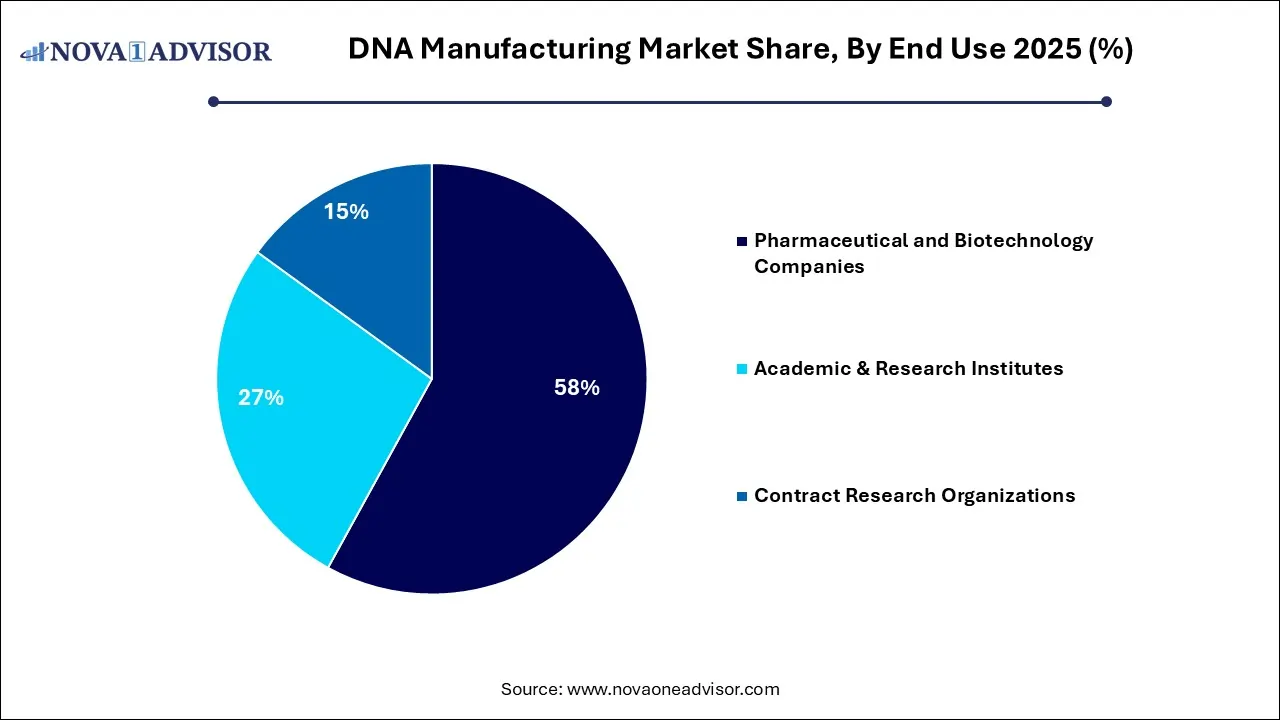
The academic & research institutes segment held the 27% share of the market in 2025, with the increased government and institutional funding for genomic and synthetic biology research supporting growth. The growing use of specialized CROs and CDMOs by academic researchers for custom DNA synthesis and sequencing needs.
The contract research organization segment held the 15% share of the market in 2025, due to the many leading companies maintaining in-house manufacturing for critical therapeutic programs. The surge in cell and gene therapy clinical trials necessitates, with many therapies requiring specialized, large-scale DNA synthesis, that specialized CDMOs can manage effectively.
By Regional Insights
Why Did the North America Region Lead the DNA Manufacturing Market?
The North America region registered its dominance over the market with a share of 41% in 2025, owing to the high R&D spending, strong presence of biotech companies, and favorable regulatory support for gene therapies. The growing focus on tailored treatments requires custom DNA synthesis, a sector that leads in innovation and capacity.
The Europe region held the 29% share of the market in 2025, due to the strong pharmaceutical manufacturing and government-backed biotech initiatives. The increasing partnership and capacity expansion by contract development and manufacturing organizations in the region.
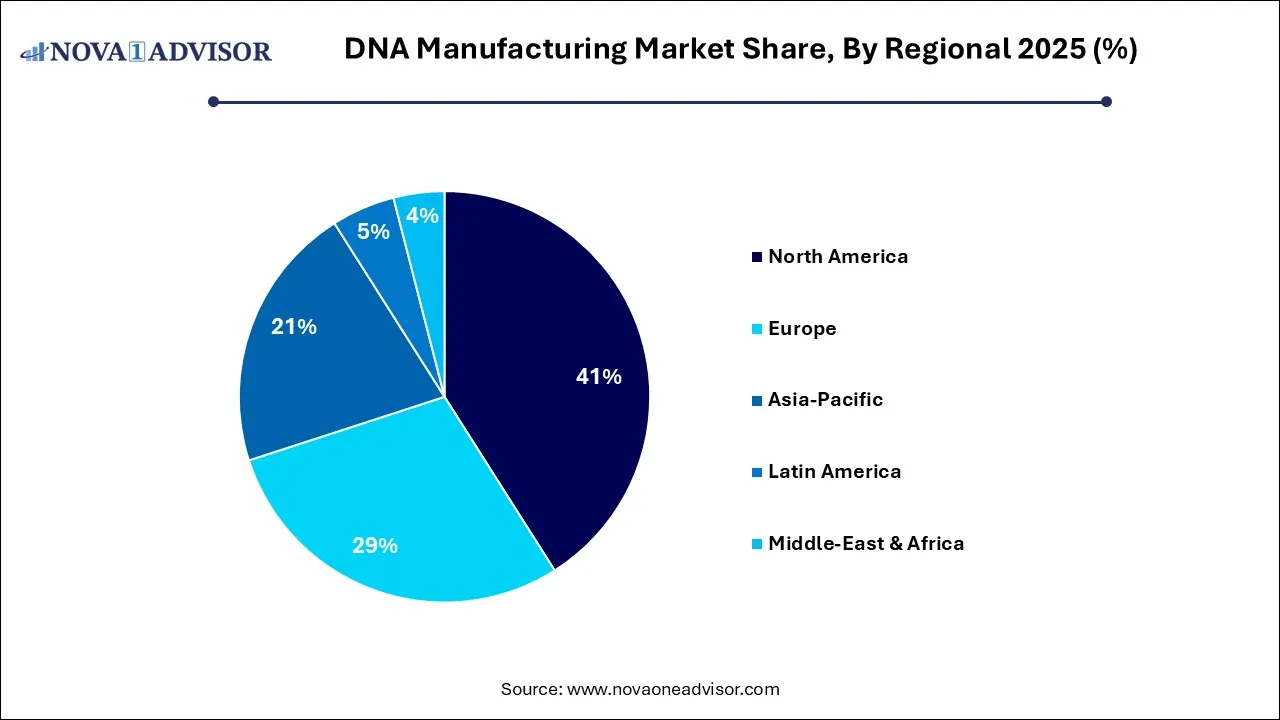
The Asia Pacific segment held 21% share of the market in 2025, due to the rising genomic research, lower manufacturing costs, and increasing biopharma production in China, Japan, and India. Increasing clinical trials for cancer and rare genetic diseases, growing demand for mRNA vaccines, drive the need for high-quality DNA.
The Latin America region held 5% share of the market in 2025, with the surging demand for cell therapies and a rapidly growing diagnostic sector. Increased investment in infrastructure, combined with regulatory harmonization initiatives, is accelerating market access for local biologics and high-quality DNA plasmid production.
The MEA region held 4% share of the market in 2025, due to the heavily investing in national genome programs to foster personalized medicine, which requires high-quality DNA for testing and therapies. Significant government spending aimed at building local biopharmaceutical manufacturing capabilities is reducing reliance on imports and fostering growth in regional contract manufacturing organizations.
DNA Manufacturing Market Companies
- Charles River Laboratories, Inc.
- Danaher Corporation (Aldevron)
- VGXI, Inc.
- Thermo Fisher Scientific
- GenScript
- Lonza
- Catalent
- Kaneka Corp.
- Eurofins Genomics
- Wuxi AppTec
Recent Developments
- In May 2025, Thermo Fisher Scientific launched the Applied Biosystems™ MagMAX™ Pro HT NoSpin Plasmid MiniPrep Kit, a rapid, automated solution designed to accelerate small-scale plasmid DNA isolation for therapeutic research. The kit utilizes magnetic bead technology to eliminate manual steps, enabling 96 minipreps in under 35 minutes while delivering high-purity, transfection-grade plasmid DNA. For larger volumes, the company also offers the automated KingFisher™ PlasmidPro Maxi Processor.
- In May 2026, Twist Bioscience Corporation (NASDAQ: TWST), a prominent biotech company specializing in synthetic biology, officially announced the early access expansion of its clonal genes portfolio to include structurally complex and highly engineered protein sequences. The new product pipeline, dubbed Complex Genes, addresses a long-standing constraint in the genomics space: the inability to reliably mass-produce challenging genetic architectures.
- In May 2025, Telesis Bio Inc. (OTCMKTS: TBIO), a prominent provider of automated DNA and mRNA synthesis solutions, has officially signed a new commercial licensing agreement with Regeneron Pharmaceuticals, Inc. Under the terms of the agreement, Regeneron will deploy Telesis Bio’s proprietary Gibson SOLA™ Enzymatic Synthesis platform across its core research and development facilities.
Segments Covered in the Report
This report forecasts revenue growth at country levels and provides an analysis of the latest industry trends in each of the sub-segments from 2021 to 2035. For this study, Nova one advisor, Inc. has segmented the DNA manufacturing market.
By Type
- Plasmid DNA
- Synthetic DNA
-
- Gene Synthesis
- Oligonucleotide Synthesis
By Grade
- GMP Grade
- R&D Grade
By Application
- Cell & Gene Therapy
- Vaccines
- Oligonucleotide-based Drugs
- Others
By End Use
- Pharmaceutical and Biotechnology Companies
- Academic & Research Institutes
- Contract Research Organizations
By Regional
- North America
- Europe
- Asia Pacific
- Latin America
- Middle East and Africa (MEA)

Proceed to Buy
Instant PDF delivery on confirmation

DNA Manufacturing Market Size to Hit USD 33.99 Billion by 2035
 Request Customization
 Download Sample

Get a Sample of this Report
DNA Manufacturing Market